Zimbabwe
Zimbabwe at a Glance
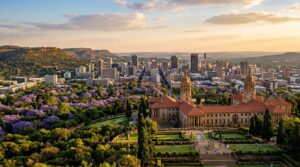
Zimbabwe sits in southern Africa, landlocked between the Zambezi River to the north and the Limpopo to the south — two waterways that have shaped the region’s ecology and human settlement for millennia. The official name is simply Zimbabwe; its capital is Harare, a city of broad jacaranda-lined avenues in the country’s northeast. The population stands at approximately 17 million, spread across a land area of 390,757 km² — roughly the size of Montana, or slightly larger than Germany.
The country is known for Victoria Falls (Mosi-oa-Tunya, “the smoke that thunders”), one of the largest waterfalls on earth by combined width and height; for the stone-walled medieval city of Great Zimbabwe, which gave the nation its name; and for a tradition of Shona stone sculpture that has placed Zimbabwean artists in permanent collections from the Smithsonian to the Tate. Tobacco remains a major agricultural export, and the national cricket team has competed at Test level since 1992. Travelers who arrive focused only on the Falls often underestimate how much the eastern Highlands — misty, green, and cool even in summer — reframe their understanding of what this country actually looks and feels like.
Geography & Climate
Zimbabwe sits in southern Africa, landlocked between Zambia to the north, Mozambique to the east, South Africa to the south, and Botswana and Namibia to the west. Its 390,757 square kilometers place it roughly between the Limpopo and Zambezi rivers — two defining boundaries that also mark its southern and northern borders respectively.
The country’s dominant feature is the highveld, a broad central plateau running northeast to southwest at elevations between 1,200 and 1,600 meters. The Eastern Highlands, near the Mozambique border, push higher still — Nyangani, Zimbabwe’s tallest peak, reaches 2,592 meters. In the thin, cool air up there, the scent of pine plantations mixes with red laterite soil after rain, a combination distinctly unlike the dry lowveld savanna that drops toward the Limpopo in the south.
Zimbabwe has a subtropical highland climate moderated by altitude. The rainy season runs roughly November through March, when warm, moisture-laden air sweeps in from the Indian Ocean and afternoon thunderstorms are near-daily events. The dry season, April through October, brings clear skies and cooler nights — Harare, sitting at around 1,490 meters, can drop to 7°C in June and July. Drought is a recurring risk, particularly in the lowveld, and El Niño cycles have periodically caused severe agricultural shortfalls across the region.
A Brief History of Zimbabwe
The territory now called Zimbabwe has been inhabited for millennia, but it was the Kingdom of Zimbabwe — centered on the stone-walled city of Great Zimbabwe, near present-day Masvingo — that defined the region’s pre-colonial peak. Built by the Shona-speaking Karanga people and flourishing between roughly the 11th and 15th centuries, Great Zimbabwe served as a royal court and trading hub, exchanging gold and ivory with merchants as far away as the Persian Gulf. The Rozvi and Mutapa states followed, maintaining Shona political authority across much of the plateau.
British colonization began in earnest in 1890, when the British South Africa Company, chartered by Cecil Rhodes, sent a column of settlers northward to claim the land they called Rhodesia. Company rule gave way to self-governing settler administration, and in 1965 Prime Minister Ian Smith issued a Unilateral Declaration of Independence from Britain, deepening white-minority rule. A protracted liberation war followed, fought by two main guerrilla movements — ZANU, led by Robert Mugabe, and ZAPU, led by Joshua Nkomo — against the Rhodesian government.
Zimbabwe achieved internationally recognized independence on April 18, 1980, following the Lancaster House Agreement. Mugabe became the country’s first prime minister, later president, and ruled for 37 years. His tenure included the violent Gukurahundi campaign in Matabeleland in the early 1980s and a fast-track land reform program beginning around 2000 that reshaped the economy dramatically. In November 2017, a military intervention ended Mugabe’s rule; Emmerson Mnangagwa has governed since.
Culture, Religion & Daily Life
## Culture, Religion & Daily Life
Christianity is the dominant faith in Zimbabwe, practiced by an estimated 85% of the population across denominations including Apostolic sects (particularly the Johane Masowe and Johane Marange movements, which blend Christian belief with indigenous spiritual practice), Catholicism, and mainline Protestantism. Traditional beliefs remain woven into daily life for many Zimbabweans regardless of formal religious affiliation, while Muslims make up a small minority, concentrated mainly in urban centers like Harare and Bulawayo.
Zimbabwe recognizes 16 official languages — among them Shona and Northern Ndebele, the two most widely spoken vernaculars, alongside English, which functions as the primary language of government and education. Shona alone encompasses several distinct dialects and is spoken by the majority of the country’s roughly 17 million people. The Shona and Ndebele peoples are the largest ethnic communities, with smaller groups including the Tonga of the Zambezi Valley maintaining distinct cultural traditions.
Daily life in communal areas often centers on the dare (dare), a shaded outdoor gathering space where elders meet to discuss community matters over cups of mahewu, a slightly sour fermented maize drink with a pale, milky appearance. Unity Day, observed in December, commemorates national reconciliation and is marked by public ceremonies and cultural performances across the country.
Economy & Industry
## Economy & Industry
Zimbabwe’s economy runs on agriculture, mining, and a growing informal sector that employs the majority of its 17 million people. The national currency is the Zimbabwe Gold (ZiG), which replaced earlier iterations of the Zimbabwean dollar ($) in 2024; the exchange rate has been volatile, sitting at approximately 25–28 ZiG to the USD in early 2025, though that figure shifts. GDP is estimated at around $20–25 billion, though informal activity makes precise measurement difficult.
Mining is the backbone of formal export earnings. Zimbabwe holds some of the world’s largest platinum reserves, with Zimplats — a subsidiary of Impala Platinum — operating the Great Dyke corridor northwest of Harare. Tobacco remains the dominant agricultural export, and Zimbabwe is consistently among Africa’s top producers. Tourism, anchored by Victoria Falls and Hwange National Park, contributes meaningfully but has yet to fully recover to pre-2000 levels.
Zimbabwe is a member of the Southern African Development Community (SADC) and a signatory to the African Continental Free Trade Area (AfCFTA), both of which shape its trade relationships with neighbors like [Zambia] and [South Africa]. The fastest-growing area to watch is lithium extraction — the country sits on significant deposits, and several Chinese-backed processing agreements signed in the early 2020s are moving toward full production.
People & Demographics
## People & Demographics
Zimbabwe’s population stands at approximately 17,073,087, spread across a land area that works out to roughly 44 people per square kilometer. The median age is around 19–20 years, making this a markedly young country — the majority of Zimbabweans are under 25, while those over 65 represent a small fraction of the total. Urbanization sits at around 32–35%, with Harare, the capital, home to an estimated 1.5 million people in the city proper and significantly more across its metropolitan area. Bulawayo, Zimbabwe’s second-largest city, holds an estimated 650,000 residents and serves as the economic and cultural hub of Matabeleland.
Life expectancy has recovered from historic lows and now sits at approximately 61–63 years, though estimates vary by source. Literacy rates are among the higher in sub-Saharan Africa, with around 88–90% of adults able to read and write — a legacy of strong post-independence investment in schooling. Zimbabwe’s diaspora is substantial: the largest communities live in South Africa, the United Kingdom, and Botswana, shaped by economic emigration that accelerated sharply in the 2000s.
Government & Political System
Zimbabwe is a presidential republic in which the head of state and head of government are the same person. The current president holds executive authority and governs from Harare, the capital, which houses the main offices of all three branches of government — the executive, legislature, and judiciary. Harare’s central business district is also where most national policy decisions are made and announced.
The legislature is bicameral, consisting of the Senate and the National Assembly, together forming Parliament. Power has shifted notably in recent decades: a military-assisted transition in November 2017 ended Robert Mugabe’s nearly four-decade rule, and subsequent elections have been held under a framework established by the 2013 constitution, which introduced term limits for the presidency. Those elections have been disputed by opposition parties and international observers on procedural grounds — a pattern that continues to shape Zimbabwe’s political landscape. For broader regional context, see [South Africa] and [Zambia], both of which share land borders and diplomatic ties with Zimbabwe.
Famous People from Zimbabwe
Zimbabwe has produced internationally recognized figures across literature, sport, politics, and music — a country of 16 million whose cultural and intellectual exports have shaped conversations well beyond its borders.
- Doris Lessing (1919–2013) — Nobel Prize-winning author whose novel The Grass is Singing (1950), set in Southern Rhodesia, launched one of the 20th century’s most celebrated literary careers.
- Dambudzo Marechera (1952–1987) — Avant-garde novelist awarded the Guardian Fiction Prize in 1979 for The House of Hunger, a raw, hallucinatory portrait of life under colonial Rhodesia.
- Kirsty Coventry (born 1983) — Olympic swimmer who won seven Olympic medals across the 2004, 2008, and 2012 Games, making her Africa’s most decorated Olympic athlete for over a decade.
- Oliver Mtukudzi (1952–2019) — Afrobeats and mbira-inflected guitarist and singer whose decades-long career produced over 60 albums and earned him a global following as one of Africa’s defining musical voices.
- Strive Masiyiwa (born 1961) — Telecommunications entrepreneur who founded Econet Wireless and became Zimbabwe’s first billionaire, now one of Africa’s most prominent philanthropists and business leaders.
- Tsitsi Dangarembga (born 1959) — Novelist, filmmaker, and activist whose debut Nervous Conditions (1988) was among the first novels published in English by a Black Zimbabwean woman, and who received the PEN Pinter Prize in 2021.
Food & Cuisine
Sadza, a stiff white maize porridge with the dense, doughy pull of fresh bread dough, is Zimbabwe’s foundational starch — served at nearly every meal alongside relishes, stewed greens, or grilled meat. The most common pairing is nyama, slow-cooked beef or goat, often braised with tomatoes and onions until the sauce deepens to a dark rust color. Muriwo une dovi is another staple: leafy vegetables cooked down with peanut butter into a thick, savory sauce that clings to a ball of sadza. For something more celebratory, madora — dried mopane worms, pan-fried until crisp — appear at family gatherings and roadside stalls across Matabeleland, where they’re eaten as a protein-rich snack or crumbled into relish. At those same stalls, roasted maize cobs (known locally as chibage) are the quintessential street snack, charred over open coals and rubbed with salt.
Drinks-wise, Chibuku Shake Shake — a commercially produced opaque sorghum beer sold in cardboard cartons — is the everyday working-class staple, cloudy and slightly sour. Regionally, communities in the Zambezi Valley tend toward freshwater fish dishes, particularly bream grilled whole over wood fires, reflecting the river’s influence on local cooking.
Sports & Recreation
## Sports & Recreation
Football is Zimbabwe’s dominant sport, followed closely by cricket — a legacy of the British colonial period that has outlasted most others. The senior men’s national football team, known as the Warriors, qualified for the Africa Cup of Nations in 2004 and 2006, reaching the group stage both times without advancing. Domestic matches at Harare’s National Sports Stadium, which holds around 60,000 spectators, draw passionate crowds, the roar audible well before kickoff.
Cricket is where Zimbabwe has punched hardest internationally. The national side held Test status and produced genuinely world-class players, most notably fast bowler Heath Streak, who took over 200 Test wickets before his death in 2023. At the Olympics, swimmer Kirsty Coventry is Zimbabwe’s standout figure, winning multiple medals across the 2004, 2008, and 2012 Games — her gold in the 200-meter backstroke at Athens remains the country’s most celebrated Olympic moment. She now serves as the country’s Minister of Sport.
Music & The Arts
## Music & The Arts
Zimbabwe’s signature instrument is the mbira dzavadzimu — a thumb piano whose buzzing, interlocking notes form the backbone of Shona ceremonial music and have influenced producers worldwide. That sound threads through contemporary Zimbabwean music, including the genre sometimes called zimdancehall, a local fusion of Jamaican dancehall and township rhythms. Winky D, whose 2022 album Gold Reign circulated well beyond Southern Africa, is the scene’s most globally recognized voice, blending social commentary with bass-heavy production.
In literature, Tsitsi Dangarembga — author of Nervous Conditions and founder of the International Images Film Festival for Women in Harare — is Zimbabwe’s most internationally decorated figure, winning the PEN International Award for Freedom of Expression in 2021. Visual arts center on the Tengenenge sculpture community near Guruve, where artists carve serpentine stone into figurative works that have entered collections in Europe and North America. That sculptural tradition represents Zimbabwe’s most durable cultural export, with pieces regularly appearing at international art fairs.
Wildlife & Natural Wonders
## Wildlife & Natural Wonders
Zimbabwe is one of Africa’s strongest Big Five destinations, with Hwange National Park — the country’s largest game reserve — supporting one of the continent’s biggest elephant populations, estimated at over 40,000 animals. Mana Pools National Park, a UNESCO World Heritage Site set along the Zambezi floodplain, is known for exceptional leopard sightings and the unusual spectacle of elephants standing on their hind legs to reach acacia pods. Both parks also carry healthy populations of lion, buffalo, and the critically endangered black rhino.
Victoria Falls, which the Kololo people call Mosi-oa-Tunya (“the smoke that thunders”), straddles the Zimbabwe-[Zambia] border and is itself a UNESCO World Heritage Site — the spray is visible from 30 kilometers away and soaks anyone standing at the main viewpoint within seconds. Conservation pressures are real: elephant overpopulation in Hwange strains water and vegetation resources, while poaching of rhino for horn remains an ongoing threat despite anti-poaching patrols. Zimbabwe’s wildlife estate is substantial, but its long-term health depends heavily on sustained funding and regional cooperation.
Top Things to See in Zimbabwe
Zimbabwe suits travelers who want serious wildlife, ancient stone ruins, and one of the world’s great waterfalls — often within a single two-week trip. It’s a landlocked country, so expect savanna, granite hills, and river frontiers rather than coastline. The pace is unhurried, the distances are real, and the rewards are proportional.
- Victoria Falls (Matabeleland North) — The Zambezi River drops over 100 meters into a basalt gorge here, producing a roar audible from kilometers away and a permanent mist that soaks visitors on the Zimbabwean side’s Rainforest Walk. Best visited November through January when flow is high enough to drench you; the walk takes 1–2 hours.
- Hwange National Park (Matabeleland North) — Zimbabwe’s largest game reserve, covering roughly 14,600 sq km, holds one of Africa’s densest elephant populations — estimates put the herd at over 40,000. Dry season (June–October) concentrates animals around waterholes; fly-in camps from Victoria Falls take under an hour.
- Great Zimbabwe National Monument (Masvingo) — The stone enclosures of Great Zimbabwe, built between the 11th and 15th centuries, are the largest ancient stone structures in sub-Saharan Africa and the origin of the country’s name. Allow 2–3 hours; the climb to the Hill Complex gives a clear view of the Valley Ruins below.
- Mana Pools National Park (Mashonaland West) — A UNESCO World Heritage Site along the Zambezi floodplain, Mana Pools is one of the few parks in Africa where walking safaris without a vehicle are permitted. Visit April through October; the park closes during the November–March rainy season.
- Matobo National Park (Matabeleland South) — Balancing granite boulders, San rock paintings, and the highest density of black and white rhino in Zimbabwe make Matobo worth the 35 km drive south of Bulawayo. Cecil Rhodes is buried at World’s View, a flat granite summit with a wide horizon; half a day covers the main sites.
- Lake Kariba (Mashonaland West / Matabeleland North) — Formed by the Kariba Dam in 1959, this is one of the world’s largest man-made reservoirs by volume, and houseboat trips on it remain a distinctly Zimbabwean experience. Sunset cruises depart from Kariba town; multi-day houseboats typically cost $150–$400 (ZWL equivalent varies
Visa & Travel Tips
## Visa & Travel Tips
Most visitors enter Zimbabwe on a visa-on-arrival or through the country’s e-visa portal at evisa.gov.zw — US and UK passport holders qualify for both options, while citizens of most EU member states can apply online before departure. ECOWAS nationals and several African Union member countries enter visa-free. Fees and eligible nationalities shift regularly, so confirm current requirements with your nearest Zimbabwean embassy or consulate before booking. The main international gateway is Robert Gabriel Mugabe International Airport in Harare, served by Ethiopian Airlines, Kenya Airways, and South African Airways, with a secondary hub at Joshua Mqabuko Nkomo International Airport in Bulawayo handling regional routes.
Zimbabwe operates on UTC+02:00 and the international dialling code is +263. The Zimbabwean dollar ($) circulates alongside the US dollar, which remains widely preferred for everyday transactions — carry USD cash, especially in smaller towns where card terminals are unreliable and ATMs can run dry. EcoCash, Zimbabwe’s dominant mobile money platform, is accepted at many vendors in Harare and Bulawayo. Power sockets use Type G plugs (the same three-pin rectangular type as the UK), so pack an adapter. Check your government’s official travel advisory for current safety guidance before departure — the situation on the ground can shift faster than travel guides update. Getting a local SIM or eSIM sorted early will make navigating all of this considerably smoother.
Staying Connected: Internet & eSIM in Zimbabwe
Mobile coverage in Zimbabwe runs on three main networks: Econet Wireless (the dominant carrier), Netone, and Telecel. All three offer 4G LTE in Harare, Bulawayo, and most provincial towns, though 5G has not yet launched commercially. Rural coverage drops off sharply once you leave the main highways — expect patchy 3G or no signal at all in remote areas like Hwange National Park’s interior.
The traditional route is a local SIM, available at Robert Gabriel Mugabe International Airport and most town-center phone shops. You’ll need your passport for mandatory registration; a starter SIM with a small data bundle costs around $Z 500–1,000 (approximately $1.40–$2.80 USD) and typically activates within the hour. For a faster setup, an eSIM lets you purchase and install a data plan before your flight lands — no queues, no surprise roaming charges, no physical card to lose — and works on most iPhone XS and later models and recent Android flagships such as the Samsung Galaxy S22 series. Hotel and café Wi-Fi is reasonably reliable in Harare and Victoria Falls, though speeds vary.