Liberia
Liberia at a Glance
Liberia sits on West Africa’s Atlantic coast, where the Guinea Highlands push down toward a shoreline of lagoons, mangrove estuaries, and surf-heavy beaches. The country’s official name is simply Liberia; its capital, Monrovia — named for U.S. President James Monroe — is home to roughly a third of the national population of approximately 5.2 million. At 111,369 km², the country is slightly smaller than Pennsylvania, compact enough that a driver can cross it in a day on the right roads.
What sets Liberia apart is a combination of history and raw material. It was founded in 1847 by formerly enslaved Americans and free Black settlers, making it one of Africa’s oldest republics and the source of a uniquely layered Americo-Liberian culture still visible in Monrovia’s architecture and surnames. Rubber has shaped the economy for over a century — the Firestone plantation near Harbel was once the world’s largest single rubber estate. The country also harbors some of West Africa’s most intact primary rainforest, including Sapo National Park, where forest elephants move through cathedral-canopy trees. Visitors who arrive expecting a country still defined by its civil-war years tend to find a place that has moved further, and faster, than the headlines suggest.
Geography & Climate
Liberia sits on West Africa’s Atlantic coast, bordered by Sierra Leone to the northwest, Guinea to the north, and Côte d’Ivoire to the east. The country covers approximately 111,369 square kilometers — roughly the size of Tennessee — and its position just north of the equator shapes nearly everything about its climate and landscape.
The terrain moves from a low, sandy coastline inland toward rolling hills and dense tropical rainforest, rising gradually to the Guinea Highlands in the north. Mount Wuteve, the country’s highest point at around 1,440 meters, anchors that northern plateau. The St. Paul River cuts through the interior, draining into the Atlantic near Monrovia, and the forest canopy along its banks is thick enough to block midday sun entirely.
Liberia is one of the wettest countries in West Africa. Monrovia receives well over 4,000 millimeters of rain annually, and the main rainy season runs from May through October, when afternoon downpours arrive with the smell of warm wet laterite soil — iron-rich, faintly metallic. A shorter dry season from November through April brings the harmattan, a dusty northeast wind that haze the sky and drops humidity noticeably. Temperatures stay warm year-round, typically between 22°C and 32°C. Coastal flooding is a recurring concern during peak rainy months, particularly in low-lying areas of Monrovia.
A Brief History of Liberia
Before the first American settlers arrived, the territory now called Liberia was home to a mosaic of peoples, including the Kpelle, Bassa, and Grebo. The Mande-speaking Mandinka had extended trade networks through the interior, and the coastal region was well integrated into trans-Atlantic commerce long before any formal colonization. Portuguese sailors made contact with the coast as early as the 1460s, naming stretches of it the “Grain Coast” for the melegueta pepper traded there.
Liberia’s founding is unlike any other African nation’s. Beginning in 1822, the American Colonization Society established settlements on Cape Mesurado for free Black Americans and formerly enslaved people. The project was deeply contested — both among African Americans and among the indigenous populations who were displaced or pressured into unequal treaties. Joseph Jenkins Roberts, a Virginia-born merchant, became the first president when Liberia declared independence on July 26, 1847, making it one of Africa’s oldest republics.
The twentieth century brought sharp turbulence. William V.S. Tubman, president from 1944 to 1971, opened Liberia to foreign investment and expanded political participation, though power remained concentrated. In 1980, Master Sergeant Samuel Doe led a coup that ended over a century of Americo-Liberian political dominance. Two devastating civil wars — the first beginning in 1989, the second ending in 2003 — killed an estimated 250,000 people and displaced millions. Ellen Johnson Sirleaf, elected in 2005 as Africa’s first female head of state, led a long reconstruction before a peaceful transfer of power in 2018.
Culture, Religion & Daily Life
## Culture, Religion & Daily Life
Christianity is the dominant faith in Liberia, practiced by roughly 85% of the population across Baptist, Methodist, Catholic, and Pentecostal congregations. Around 12% of Liberians are Muslim, concentrated largely in the north and among Mandingo communities, while a smaller share practice traditional indigenous religions, sometimes alongside Christianity or Islam.
English is the official language and the medium of government, education, and media. In everyday speech, most Liberians communicate in Liberian English, a creole-inflected variety with its own rhythms and vocabulary. Across the country’s 16 counties, approximately 30 indigenous languages are spoken, including Kpelle, Bassa, and Grebo — each tied to distinct ethnic communities. The Kpelle, Bassa, and Gio are among the largest ethnic groups, part of a broader mosaic of roughly 16 recognized peoples.
Daily life in Monrovia often centers on the market. At Waterside Market near the Mesurado River, traders sell dried fish, pepper, and cassava leaf from low wooden stalls; the air carries the sharp, smoky scent of grilled plantain from nearby coal pots. Conversations flow in a mix of Liberian English and Kpelle. Liberia Day, celebrated on July 26, marks the country’s 1847 declaration of independence with parades, speeches, and family gatherings across every county.
Economy & Industry
## Economy & Industry
Liberia’s economy is small but resource-rich, with a GDP of around $4 billion — modest for a country of 5.2 million people. The Liberian dollar trades at approximately 190–200 to the US dollar in 2025, though both currencies circulate freely in Monrovia’s markets, where vendors quote prices in either without hesitation.
Agriculture employs the majority of Liberians, with rubber remaining the country’s most recognizable export. The Firestone Natural Rubber plantation in Harbel — one of the largest single rubber estates in the world — has operated since 1926 and continues to anchor the sector. Iron ore is the other pillar: ArcelorMittal runs major mining operations in Nimba County, and gold and timber exports add further weight to the extractive economy. Fisheries along the Atlantic coast are significant but largely informal.
Liberia is a member of ECOWAS, which shapes its trade relationships with neighbors like [Sierra Leone] and [Guinea]. On the forward-looking side, the government has prioritized energy infrastructure — chronic electricity shortages have long constrained business — with the Millennium Challenge Corporation funding grid-expansion projects aimed at connecting more households and small manufacturers to reliable power. Mobile money adoption is also accelerating, with operators like Lonestar Cell MTN expanding financial access beyond Monrovia.
People & Demographics
## People & Demographics
Liberia’s population stands at approximately 5,248,621, spread across a land area that works out to roughly 47 people per square kilometer — one of West Africa’s lower densities. The median age is around 18 to 19 years, giving the country a sharply young profile: the majority of Liberians are under 30, and older adults over 60 represent a small fraction of the total. Life expectancy is approximately 65 years, a figure that reflects ongoing improvements in healthcare access since the civil-war era. Literacy runs around 48 percent nationally, though estimates vary and the gap between urban and rural rates is significant.
Urbanization is accelerating: roughly half the population now lives in cities, with Monrovia home to well over a million people and functioning as the country’s economic and cultural center. Gbarnga and Buchanan are the next largest urban centers, each with populations in the low hundreds of thousands. Substantial Liberian diaspora communities have settled in the United States — particularly in Minnesota and New Jersey — as well as in [Ghana] and [Ivory Coast].
Government & Political System
## Government & Political System
Liberia is a presidential republic, meaning the head of state and head of government are the same person. The current president governs from Monrovia, the capital, which also serves as the seat of the legislature and the country’s administrative center. Executive power is substantial: the president appoints cabinet ministers and commands the armed forces.
The legislature is bicameral, consisting of the Senate and the House of Representatives, together forming the National Legislature. Senators serve nine-year terms; representatives serve six. Liberia held a presidential runoff election in November 2023, and power transferred peacefully between the outgoing and incoming administrations — a notable moment in a country that spent much of the late twentieth century under authoritarian rule and civil conflict. Term limits are constitutionally enshrined, capping presidents at two six-year terms. [Sierra Leone] and [Guinea] share borders with Liberia and have their own distinct constitutional arrangements.
Famous People from Liberia
Liberia’s international profile has been shaped largely by political trailblazers and athletes, with a small but notable roster of figures who carried the country’s name into global arenas — from the Nobel stage to the Olympic track.
- Ellen Johnson Sirleaf (1938–) — Awarded the Nobel Peace Prize in 2011, she became Africa’s first elected female head of state and a global symbol of post-conflict democratic leadership.
- Leymah Gbowee (1972–) — Co-recipient of the 2011 Nobel Peace Prize for organizing the Women of Liberia Mass Action for Peace movement, which helped end the Second Liberian Civil War.
- George Weah (1966–) — Won the FIFA World Player of the Year award in 1995 and the Ballon d’Or, the only African player to do so in the 20th century, after a career at AC Milan and Paris Saint-Germain.
- William V.S. Tubman (1895–1971) — Served as Liberia’s longest-ruling president and became internationally recognized for his “Open Door Policy,” which drew significant foreign investment and shaped mid-20th-century West African diplomacy.
- Robtel Neajai Pailey (1981–) — Scholar, author, and development researcher whose writing on citizenship, race, and African governance has reached academic and policy audiences across Europe and North America.
- Sia Koroma (1983–) — Liberian-born singer who built a following across West Africa with Afropop releases blending Kru musical traditions with contemporary production.
Food & Cuisine
Rice is the undisputed staple of Liberian cooking, served at nearly every meal and often twice a day. It typically arrives alongside a thick, deeply savory soup or stew — palm butter soup, made from the red-orange oil extracted from palm fruit, is perhaps the most emblematic, slow-cooked with fish, chicken, or beef until the broth turns a rust-red and coats the back of a spoon. Dumboy, a dense, chewy dough pounded from cassava, is another fixture, served with pepper soup or greens. Jollof rice, cooked with tomatoes, onion, and spice, appears at celebrations across the country. Along the Atlantic coast, seafood dominates: grilled snapper sold from roadside stalls in Monrovia arrives wrapped in newspaper, fragrant with charcoal smoke and scotch bonnet pepper — the kind of snack a visitor genuinely encounters between the Capitol Building and Waterside Market.
Inland communities near the Guinea border rely more heavily on cassava leaves and bitter ball (a small, intensely bitter eggplant variety) cooked into stews with smoked fish. Palm wine, tapped fresh from raffia palms and sold in repurposed plastic jugs, is the defining local drink — sweet and slightly fizzy in the morning, noticeably alcoholic by afternoon.
Sports & Recreation
## Sports & Recreation
Football is Liberia’s dominant sport, played on packed-dirt pitches across Monrovia and upcountry towns alike — the thud of a worn ball against bare feet is a near-constant background sound in most neighborhoods. The senior men’s national team, known as the Lone Star, has had limited Africa Cup of Nations success, qualifying for the tournament in 1996 but exiting in the group stage. The country’s most celebrated athlete is George Weah, who won the FIFA World Player of the Year award in 1995 while playing for AC Milan — a feat no other African player had achieved at that point — and later became Liberia’s president in 2018.
Basketball holds genuine cultural weight as a second sport, partly reflecting Liberia’s historical ties to the United States. At the Olympics, Liberia has sent athletes across several Games but has not won a medal; sprinter Jangy Addy represented the country at the 2012 London Games, reaching the heats in the 100 meters.
Music & The Arts
## Music & The Arts
Liberia’s contemporary sound is rooted in Afrobeats and a home-grown style called “Liberian Afropop,” with artist Shadow the Entertainer drawing regional attention for fusing Kru coastal rhythms with electronic production. Beneath that pop surface, traditional music centers on the bele drum ensemble and the slit drum, both used ceremonially by Poro and Sande secret societies across the interior; the low, resonant knock of a slit drum carries across a village in a way no amplifier replicates.
On the literary side, Wayétu Moore — born in Monrovia and raised partly in the United States — published She Would Be King (2018), a novel weaving Liberian founding history into magical realism that reached international audiences. Liberian visual craft is perhaps best known for its country cloth, a hand-woven cotton textile with narrow geometric strips stitched together in earthy indigo and cream. Culturally, Liberia gained wider global visibility when Moore’s memoir The Dragons, the Giant, the Women (2020) was shortlisted for major American literary awards, positioning Liberian storytelling firmly in the international conversation.
Wildlife & Natural Wonders
## Wildlife & Natural Wonders
Liberia holds one of the largest remaining blocks of Upper Guinean rainforest in West Africa, a habitat that supports forest elephants, pygmy hippopotamuses, and West African chimpanzees rather than any of the classic Big Five. Sapo National Park, the country’s oldest and largest protected area, is the place to look for the pygmy hippo — a shy, solitary animal roughly the size of a large pig that slips through swamp forest at dusk. Nimba Nature Reserve, straddling the borders with [Guinea] and [Côte d’Ivoire], shelters a genetically distinct population of chimpanzees that have been observed using stone tools to crack nuts.
Liberia has no UNESCO-listed natural World Heritage sites, though Nimba Reserve’s cross-border sections in Guinea and Côte d’Ivoire carry that designation. For a non-park wonder, the Kpatawee Waterfall near Gbarnga drops through layered granite into a cool, clear pool ringed by forest — the spray carries the smell of wet rock and crushed leaves. Habitat loss from logging concessions and small-scale agriculture remains the primary conservation pressure on both forest cover and the species that depend on it.
Top Things to See in Liberia
Liberia suits travelers who want to combine Atlantic beach time with genuine rainforest hiking and a history unlike anywhere else on the continent — a nation founded by freed American slaves, with the architecture and graveyards to prove it. Infrastructure is improving but still thin, so expect adventure-style logistics rather than polished tourism.
- Providence Island (Monrovia) — The small island at the mouth of the Mesurado River where the first Americo-Liberian settlers landed in 1822; the ruins and monuments make it the country’s most loaded historical site. Accessible by short boat from central Monrovia; a few hours is enough.
- Sapo National Park (Sinoe County) — Liberia’s largest protected area and one of West Africa’s most significant tracts of primary rainforest, home to pygmy hippos, forest elephants, and chimpanzees. Dry season (November–April) is essential; reach the park via Greenville, then arrange a ranger-guided entry.
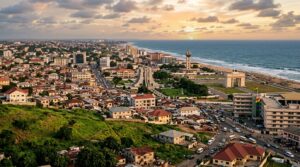
- Ducor Palace Hotel (Monrovia) — The skeletal shell of a once-grand hilltop hotel, abandoned since the civil war, now offering one of the best panoramic views over Monrovia and the Atlantic. A quick urban stop; visit in the morning before the haze builds.
- Robertsport (Grand Cape Mount County) — A quiet coastal town on Lake Piso with consistent beach breaks that have made it a small but real surf destination. The rainy season (May–October) actually produces the best swells; the drive from Monrovia takes roughly three hours on a paved road.
- Kpatawee Waterfall (Bong County) — A two-tiered waterfall set inside secondary forest, reachable on a short hike from the town of Gbarnga. Dry-season visits keep the trail manageable; budget half a day from Gbarnga.
- Firestone Plantation (Margibi County) — Once the world’s largest rubber plantation, still operating, and a site that anchors Liberia’s complex 20th-century economic history in a single landscape of orderly rubber trees stretching to the horizon. Located about 35 miles east of Monrovia; most visitors pass through en route to other destinations.
- Kendeja Cultural Village (Greater Monrovia) — A living cultural center on the edge of Monrovia where traditional music, masked dance performances, and craft demonstrations from Liberia’s 16 ethnic groups are staged for visitors. Weekend performances are most reliable; confirm scheduling locally before going.
- Lake Piso
Visa & Travel Tips
## Visa & Travel Tips
Most visitors to Liberia, including U.S. and EU citizens, require a visa obtained in advance through a Liberian embassy; visa-on-arrival is available to some nationalities but is not guaranteed, so confirm your status before booking. ECOWAS member nationals — Ghanaians, Senegalese, and others — generally enter without a visa under the community free-movement protocol. Policies shift without much notice, so check with the nearest Liberian mission or your own government’s travel portal before departure. Roberts International Airport (ROB), roughly 35 miles southeast of Monrovia, is the main entry point, served primarily by Brussels Airlines and regional carriers including Air Côte d’Ivoire.
On the ground, carry U.S. dollars — both USD and Liberian dollars (L$) circulate widely, and USD is accepted at most hotels and larger shops. Card infrastructure is thin outside Monrovia; ATMs exist at some banks in the capital but run out of cash frequently, so arrive with enough physical currency to cover your first few days. Mobile money via Lonestar MTN MoMo is the dominant cashless option for everyday transactions. Liberia runs on UTC (no daylight saving offset), and you’ll dial in with country code +231. Bring a Type C or G plug adapter. Check your government’s current safety advisory before travel — conditions vary by region. Getting a local SIM or eSIM sorted early will make navigating all of this considerably easier.
Staying Connected: Internet & eSIM in Liberia
Mobile coverage in Liberia is dominated by three main operators: Lonestar Cell MTN, Orange Liberia, and Cellcom. All three offer 4G LTE in Monrovia and a handful of larger towns such as Gbarnga and Buchanan. Outside those centers, coverage drops sharply — rural counties like Lofa and Grand Gedeh rely on patchy 3G or no signal at all. There is no commercial 5G service in the country as of 2024.
Travelers picking up a local SIM at Roberts International Airport will find MTN and Orange kiosks in the arrivals hall. Expect to hand over your passport for mandatory registration; a starter SIM with a small data bundle typically costs around 500–800 Liberian dollars (LR$) — roughly $2.50–$4.00 USD — and activation usually completes within the hour. For a faster start, an eSIM skips the kiosk entirely: purchase and download a profile before you board, and your data plan is live the moment you land — no queues, no surprise roaming charges. Most iPhone XS and newer models support eSIM, as do recent Android flagships from Samsung, Google, and Motorola. Hotel Wi-Fi is available at mid-range and upscale properties in Monrovia, and a growing number of cafés along Tubman Boulevard offer reliable connections.