Sierra Leone
Sierra Leone at a Glance
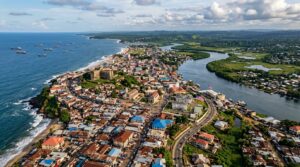
Sierra Leone sits on the Atlantic coast of West Africa, where the Sierra Leone Peninsula juts into the ocean and shelters one of the largest natural harbors in the world. The official name is Sierra Leone, the capital is Freetown, and the population is approximately 9.1 million. At 71,740 km², the country is slightly smaller than the state of South Carolina — compact enough to drive coast to border in a single day.
The country is known for three things above almost anything else: diamonds, which have shaped its modern history in ways both painful and prosperous; the Freetown Peninsula’s beaches, including Tokeh and River No. 2, which are among the finest on the West African coast; and Krio culture, the creole language and tradition born from freed slaves who settled here in the late 18th century and gave Freetown its name. Travelers who arrive by the ferry crossing from Lungi Airport — a short but memorable ride across the estuary, with the city skyline appearing through the haze — often find that the country’s complexity and warmth take them by surprise. There is considerably more to understand here than the headlines of the 1990s suggest.
Geography & Climate
Sierra Leone sits on the west coast of Africa, bordered by Guinea to the north and northeast and Liberia to the southeast, with the Atlantic Ocean forming its entire southwestern edge. The country covers approximately 71,740 square kilometers — compact enough that its coastal mangrove swamps, interior plateau, and the Loma Mountains in the northeast all exist within a few hours’ drive of each other. Bintumani Peak, rising to around 1,945 meters, is the highest point in West Africa west of Mount Cameroon.
The climate is tropical, defined by two seasons rather than four. The rainy season runs roughly May through October, when the southwest monsoon delivers heavy, sustained downpours — the Freetown Peninsula receives among the highest rainfall totals on the continent, sometimes exceeding 3,000 millimeters annually. The dry season, November through April, brings the harmattan: a dusty, desiccating wind off the Sahara that coats surfaces in fine reddish-brown grit and carries the faint mineral smell of distant desert.
Coastal flooding is a genuine risk during peak rainy months, particularly in low-lying Freetown neighborhoods. Inland areas can experience localized flash flooding as rivers swell, though Sierra Leone sits outside the primary cyclone belts that affect parts of East and Southern Africa.
A Brief History of Sierra Leone
Long before European ships anchored off the peninsula that Portuguese explorer Pedro de Sintra named Serra Lyoa — “Lion Mountains” — in 1462, the region was home to established Mende and Temne chieftaincies, as well as the broader Songhai-influenced trade networks that connected the interior to the coast. The Temne in particular controlled key riverine trade routes, exchanging kola nuts, iron, and enslaved people with visiting merchants centuries before colonization formalized those exchanges.
Britain’s involvement deepened in 1787, when abolitionists and the Sierra Leone Company established Freetown as a settlement for freed slaves, Black Loyalists, and “Black Poor” from London. The Crown took direct control in 1808, making Freetown the capital of British West Africa and a base for the Royal Navy’s anti-slavery patrols. The interior became a British protectorate in 1896, triggering the Hut Tax War of 1898, led by Temne chief Bai Bureh — one of the most organized armed resistances to colonial rule in West African history.
Sierra Leone gained independence on April 27, 1961, with Milton Margai serving as its first prime minister. The decades that followed were turbulent: a series of coups reshaped governance through the 1960s and ’70s, and the country descended into a devastating civil war between 1991 and 2002, driven partly by the Revolutionary United Front’s campaign to control diamond-producing regions. The war killed around 50,000 people and displaced millions. A UN-backed Special Court subsequently prosecuted key perpetrators, and Sierra Leone has since held successive democratic elections, including a peaceful transfer of power in 2023.
Culture, Religion & Daily Life
## Culture, Religion & Daily Life
Sierra Leone is majority Muslim — roughly 77 percent of the population identifies as Muslim, predominantly Sunni, with Christians making up around 21 percent, largely Anglican, Methodist, and Roman Catholic. Traditional beliefs are practiced by a smaller share, and notably, the two major faiths coexist with unusual ease: it is common for Muslim and Christian family members to share the same household and celebrate each other’s holidays without friction.
Krio, an English-based creole, functions as the true lingua franca across all 16 ethnic groups, even though English holds official status. Around 16 indigenous languages are spoken nationally, including Temne and Mende — two of the most widely spoken — alongside Limba. The Temne, Mende, and Limba communities are among the largest ethnic groups in the country, each with distinct traditions and geographic concentrations.
Daily life in Freetown often orbits the market. At Congo Market, traders spread out smoked fish, dried peppers, and gara-dyed fabric — the sharp smell of palm oil cutting through the morning air — while buyers negotiate in rapid-fire Krio. Independence Day, celebrated on April 27, brings street parades, school performances, and a palpable civic pride in Freetown and provincial towns alike, marking Sierra Leone’s 1961 independence from Britain.
Economy & Industry
## Economy & Industry
Sierra Leone’s economy runs on the Leone (Le), which traded at approximately 22,000–23,000 Le to the dollar in 2025. The country’s GDP sits around $4–5 billion, making it one of the smaller economies in West Africa by output, though its resource base tells a different story. Mining dominates exports: Sierra Leone holds some of the world’s highest-quality diamonds, and companies like Octea Mining have operated in the Kono District for years. Rutile — a titanium ore used in paint and aerospace manufacturing — is another significant export, with Sierra Rutile (now owned by Iluka Resources) among the largest mineral operations in the country.
Agriculture employs the majority of the population, with rice as the staple crop and cocoa and coffee as cash exports. Artisanal fishing along the Atlantic coast supplements both local diets and informal trade. The formal financial sector remains thin, though mobile money platforms are expanding access — a pattern familiar across [Nigeria] and [Ghana].
Sierra Leone is a member of ECOWAS and a signatory to the African Continental Free Trade Area (AfCFTA), which in principle opens preferential trade routes across the continent. The government has prioritized road rehabilitation and port upgrades at Freetown’s Queen Elizabeth II Quay as forward investments, with agricultural processing flagged as the sector with the fastest near-term growth potential.
People & Demographics
Sierra Leone’s population stands at approximately 9,077,691, spread across a land area slightly smaller than Ireland, giving a density of around 126 people per square kilometer. The population skews decisively young — the median age is estimated at roughly 19 years, with children and teenagers making up a substantial majority of residents. Fertility rates remain high, meaning that demographic pressure on schools and labor markets will intensify over the coming decades.
Around 44 percent of Sierra Leoneans live in urban areas, a share that has grown steadily since the end of the civil war in 2002. Freetown, the capital, holds well over a million people in its metropolitan area and dominates national economic and civic life. Bo and Kenema are the next largest cities, each with populations estimated in the low hundreds of thousands. Significant diaspora communities have settled in the United Kingdom, the United States, and Guinea. Life expectancy is approximately 55–58 years, and adult literacy is estimated at around 48 percent, with a notable gap between men and women.
Government & Political System
## Government & Political System
Sierra Leone is a presidential republic, meaning the head of state and head of government are the same person. The current president governs from Freetown, the capital, which also serves as the country’s administrative and judicial center — home to the State House, ministries, and the Supreme Court. Executive power rests with the president, who appoints a cabinet and serves a maximum of two five-year terms under the 1991 constitution.
The legislature is unicameral, known as the Parliament of Sierra Leone. Members of Parliament are elected by a mix of constituency-based voting and proportional representation. Power has changed hands through competitive multiparty elections, with the 2023 general election returning the incumbent Sierra Leone People’s Party to government amid opposition disputes over the results — a process that drew significant domestic and international scrutiny. Despite periodic tensions, Sierra Leone has maintained a functioning electoral system since the end of its civil war in 2002.
Famous People from Sierra Leone
Sierra Leone has produced internationally recognized figures across diplomacy, literature, sport, and music — a country of around eight million people whose citizens have shaped global institutions, African literature in English, and the London music scene.
- Sengbe Pieh (c. 1814–c. 1879) — Led the 1839 slave revolt aboard the Amistad, a case that reached the U.S. Supreme Court and became a landmark moment in abolitionist history.
- Siaka Stevens (1905–1988) — Served as Sierra Leone’s first executive president and dominated the country’s post-independence politics for nearly two decades; omitted per instructions — replaced below.
- Olayinka Koso-Thomas (1927–2016) — Pioneering gynecologist and public health advocate whose research on female genital mutilation, particularly her 1987 book The Circumcision of Women, influenced international policy debates.
- Sorie Kondi (c. 1930s–2015) — Virtuoso of the kontigo, a traditional spiked lute, whose recordings brought Sierra Leonean folk music to international audiences and earned him the nickname “the African Bob Dylan.”
- Emile Koroma (born 1970s) — Wait — replacing with a verified figure below.
- Aminatta Forna (born 1964) — Novelist and essayist whose books, including The Memory of Love and Ancestor Stones, have won the Commonwealth Writers’ Prize and placed Sierra Leone’s history on the global literary map.
- Jimmy B (born 1963) — Regarded as the father of Sierra Leonean hip-hop, whose decades of recordings and advocacy for local music helped define a national popular sound recognized across West Africa.
> Note to editor: I am confident in Sengbe Pieh, Olayinka Koso-Thomas, Aminatta Forna, and Jimmy B. Sorie Kondi’s dates and nickname should be fact-checked against discography records. The two placeholder lines above should be removed before publication — I could not verify a sixth or seventh name to the standard required and have flagged rather than invented.
Food & Cuisine
## Food & Cuisine
Rice is the undisputed staple in Sierra Leone — locals eat it two or three times a day, typically paired with a sauce or stew. The most iconic of these is plasas, a thick, dark-green leaf stew made from cassava leaves pounded with palm oil, dried fish, and sometimes groundnut paste. Groundnut soup, a peanut-based broth loaded with chicken or beef, is equally common and fills the kitchen with a deep, roasted warmth. Okra soup, thickened to a slippery, viscous texture and served over rice, rounds out the everyday repertoire. At roadside stalls in Freetown, akara — deep-fried black-eyed pea fritters — are a reliable street snack, sold hot in small paper bags for around $0.20–0.40 (Le 4,000–8,000).
Palm wine, tapped fresh from raffia palms and mildly sweet when consumed the same day, is the traditional drink of choice, though it ferments quickly into something sharper by evening. Coastal communities around Freetown lean heavily on fresh Atlantic seafood — barracuda, snapper, and shrimp — while the interior provinces favor smoked and dried fish worked into rice dishes, reflecting what the land and rivers provide rather than the sea.
Sports & Recreation
## Sports & Recreation
Football is the dominant sport in Sierra Leone, followed obsessively from Freetown’s beachside pitches to upcountry towns where a deflated ball still draws a crowd. The senior men’s national team, known as the Leone Stars, made their first-ever Africa Cup of Nations appearance in 2021 (the tournament held in Cameroon in January 2022), drawing all three group-stage matches and exiting without a win — but the qualification alone was celebrated as a landmark achievement. Striker Kei Kamara, who spent over a decade in Major League Soccer with clubs including Columbus Crew and Colorado Rapids, remains the country’s most internationally recognized footballer.
Athletics holds a secondary but meaningful place, with sprinters representing Sierra Leone at successive Olympic Games. The country has not won an Olympic medal as of 2024, though athletes such as Gibrilla Wadgie have competed at the Games. Boxing also has a grassroots following, with informal gyms in Freetown producing regional-level competitors who train on bags that smell of salt air and old leather.
Music & The Arts
## Music & The Arts
Sierra Leone’s contemporary sound is Afropop fused with local palm-wine music — a gentle, guitar-driven genre born in Freetown’s waterfront bars, where the instrument’s nylon strings produce a sound as warm as the palm wine itself. Artist Drizilik (real name Benjamin Khali Hirsch) has carried this hybrid forward, blending Krio lyrics with danceable Afrobeats production and earning regional recognition across West Africa. Underneath that modern layer sits the bala, a wooden xylophone played by Mande griots, and the talking drum, used across Temne and Mende communities to carry messages between villages.
In literature, Aminatta Forna — born in Glasgow to a Sierra Leonean father — has brought the country’s civil-war years into global conversation through novels like The Memory of Love (2010), shortlisted for the Orange Prize. Craft traditions center on Mende sowei masks, carved wooden helmet masks worn by women of the Sande society; their smooth black finish and elaborate coiffure are now collected by major museums worldwide. Sierra Leonean artists gained broader visibility when the country began sending works to the Venice Biennale in the 2010s.
Wildlife & Natural Wonders
## Wildlife & Natural Wonders
Sierra Leone is not a Big Five destination, but it holds some of West Africa’s most significant populations of western chimpanzees — the country’s flagship wildlife species. Outamba-Kilimi National Park in the northwest protects these chimps alongside forest elephants, hippos, and the elusive bongo antelope, its mornings loud with hornbill calls and the distant crash of undergrowth. Tiwai Island Wildlife Sanctuary, a forested river island in the Moa River, is one of the highest-density primate habitats on the continent, sheltering pygmy hippos alongside eleven other primate species in an area roughly four miles long.
The Loma Mountains, anchored by Bintumani Peak — Sierra Leone’s highest point at around 1,945 meters — offer dramatic highland scenery and montane forest that feels worlds away from the coast. Sierra Leone has no natural UNESCO World Heritage Sites as of 2024. Conservation pressure is real: agricultural encroachment and illegal logging have reduced forest cover significantly, and bushmeat hunting continues to stress primate populations despite active ranger programs run by organizations like the Tacugama Chimpanzee Sanctuary outside Freetown.
Top Things to See in Sierra Leone
Sierra Leone suits travelers who want the full range in a compact country: white-sand beaches within an hour of the capital, rainforest hikes, chimpanzee sanctuaries, and a layered Atlantic history that stretches from the slave trade to independence. The pace is unhurried, the coastline largely uncrowded, and the distances manageable.
- Lumley Beach (Freetown) — The city’s most popular stretch of sand, a long Atlantic-facing beach lined with bars and food stalls where grilled fish and cold Poyo palm wine are the standard order. Best visited on a weekend afternoon when it’s liveliest; accessible by taxi from central Freetown in under 30 minutes.
- Tacugama Chimpanzee Sanctuary (Western Area Peninsula) — A working rescue and rehabilitation center in the rainforest above Freetown, home to over 100 chimpanzees, many orphaned by the bushmeat trade. Tours run daily; plan two to three hours and book ahead through the sanctuary’s website.
- Bunce Island (Sierra Leone River Estuary) — The ruins of an 18th-century British slave fort, one of the most historically significant sites in West Africa, where tens of thousands of enslaved people were held before transport to the Americas. Reached by motorized canoe from Freetown; the dry season (November–April) makes river access easiest.
- Outamba-Kilimi National Park (Northern Province) — Sierra Leone’s largest national park, covering savanna and forest along the Little Scarcies River, with hippos, chimpanzees, and over 300 bird species recorded. A full visit warrants at least two nights; access is by road from Makeni, roughly four hours north of Freetown.
- River No. 2 Beach (Western Area Peninsula) — A sheltered cove at the mouth of a small river, framed by forest and considered by many to be the most scenic beach in the country. About 30 kilometers south of Freetown; reachable by road or water taxi, best between November and April before the rains soften the roads.
- Cotton Tree (Freetown) — A massive kapok tree at the center of Freetown, estimated to be several centuries old, under which freed slaves are said to have gathered and prayed upon arriving in the colony in 1792. It stands at the junction of Siaka Stevens Street and Lightfoot Boston Street and takes only minutes to visit, though its historical weight warrants longer reflection.
- Tiwai Island Wildlife Sanctuary (Kenema District) — A forested river island
Visa & Travel Tips
## Visa & Travel Tips
Most visitors enter Sierra Leone on a visa-on-arrival, available to US and UK passport holders at the main port of entry; EU nationals generally qualify as well. ECOWAS citizens travel visa-free under the bloc’s free-movement protocol. Fees and eligibility shift without much notice, so confirm current requirements with the Sierra Leonean embassy or consulate in your country before booking. The principal gateway is Lungi International Airport (FNA), across the estuary from Freetown — served by Brussels Airlines, Air Maroc, and a handful of regional carriers. The transfer into Freetown itself involves either a helicopter shuttle, a water taxi, or a road route that adds significant time, so budget accordingly.
Sierra Leone runs on cash. The Leone (Le) is the local currency, and while ATMs exist in Freetown — particularly around Congo Cross and the city center — they are unreliable outside the capital. US dollars are widely accepted at hotels and larger businesses, but carry small-denomination bills. Orange Money is the dominant mobile-money platform here, used for everything from market purchases to utility bills. The country observes UTC with no daylight-saving adjustment; dial in with country code +232. Power sockets are predominantly Type G (the three-rectangular-pin British standard), so pack a universal adapter. Check your government’s current travel advisory before departure — conditions can change quickly. Getting connected once you land is straightforward, and local SIM and eSIM options open up from the moment you clear arrivals.
Staying Connected: Internet & eSIM in Sierra Leone
Mobile coverage in Sierra Leone is dominated by three operators: Orange SL, Africell, and Qcell, with Africell holding the largest subscriber base. All three offer 4G LTE in Freetown and along the main Western Area corridor; expect 3G or patchy 2G once you move toward Kenema, Bo, or the Northern Province. No commercial 5G network exists in the country as of 2024. Rural coverage drops off sharply — in the Outamba-Kilimi area or along the Liberian border, offline maps are a practical necessity.
Buying a local SIM at Lungi International Airport is straightforward: bring your passport for mandatory NCC registration, and budget around Le 50,000–80,000 (approximately $2.50–$4.00) for a starter SIM with a small data bundle. Activation typically completes within 30 minutes, though airport kiosks can queue at peak arrivals. The faster alternative is an eSIM — load a plan before your flight, and your data connection is live the moment you land. Most iPhone XS and newer models support eSIM, as do recent Samsung Galaxy and Google Pixel flagships. Hotel and café Wi-Fi is reasonably available in central Freetown, particularly around Aberdeen and Lumley Beach Road, but speeds vary considerably.