Mali
Mali at a Glance
Mali sits in the western Sahel, straddling the southern edge of the Sahara Desert and the fertile Niger River inland delta — one of the largest wetland systems on the continent. Officially the Republic of Mali, the country is governed from Bamako, a fast-growing capital of several million on the Niger’s banks, and carries a national population of approximately 22.4 million. At 1,240,192 km², the country is roughly twice the size of Texas, with its northern two-thirds largely sand and stone.
What most people don’t immediately picture: the medieval mud-brick mosques of Djenné and Timbuktu, both UNESCO World Heritage Sites and once anchors of trans-Saharan trade routes that moved gold, salt, and manuscripts across the desert. The Dogon people’s cliff-side villages along the Bandiagara Escarpment represent one of West Africa’s most architecturally distinctive living cultures. Mali is also the world’s third-largest gold producer, a fact that shapes its economy far more than the tourist trade. Readers who assume the country is simply defined by its Saharan north will find the green, river-threaded south — and the layered history beneath it — considerably more complex than expected.
Geography & Climate
Mali sits in the western interior of Africa, a landlocked country sharing borders with Algeria to the north, Niger to the east, Burkina Faso and Côte d’Ivoire to the south, Guinea and Senegal to the southwest, and Mauritania to the west. At approximately 1,240,192 square kilometers, it is one of the largest countries on the continent — and one of the flattest, dominated by a vast, sun-bleached plain that tilts almost imperceptibly southward.
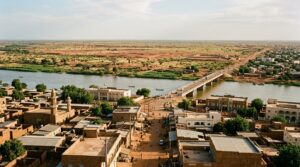
The north is pure Sahara: the Adrar des Ifoghas massif rises from the sand in the far northeast, its bare granite shoulders catching the cold that surprises most visitors after a scorching Saharan day. The central band transitions into the Sahel, a drier savanna where the Niger River — Mali’s defining geographic feature — traces a great inland arc called the Niger Inland Delta, flooding seasonally into a labyrinth of channels and wetlands that support millions of birds and fish.
Climate divides sharply by latitude. The south receives most of its rainfall between June and September, with temperatures ranging from around 20 °C in the cool season (November–February) to above 40 °C before the rains arrive. The north is essentially arid year-round. Between November and March, the harmattan blows down from the Sahara carrying fine reddish dust that coats everything and turns the sky a pale, milky orange. Drought is a recurring stress across the Sahel, and localized flooding can affect riverine communities during peak rainfall months.
A Brief History of Mali
The territory that is now Mali was the heartland of some of medieval Africa’s most powerful states. The Ghana Empire — centered further west but extending into present-day Mali — gave way to the Mali Empire around the 13th century, which at its peak controlled trans-Saharan gold and salt trade routes stretching from the Atlantic to the Niger Bend. Mansa Musa, who ruled in the early 14th century, became internationally famous after his 1324 pilgrimage to Mecca, during which he reportedly distributed so much gold that he temporarily depressed prices across North Africa and the Middle East. The Songhai Empire later absorbed much of the same territory before Moroccan forces broke its power at the Battle of Tondibi in 1591.
France began consolidating control over the region in the late 19th century, formally establishing French Sudan as part of French West Africa. Colonial administration restructured land use, labor, and trade to serve French economic interests, and Bamako — today the capital — grew as an administrative center along the Dakar-Niger railway.
Mali achieved independence on September 22, 1960, initially as part of a short-lived federation with Senegal before declaring full sovereignty. Modibo Keïta became the country’s first president, pursuing a socialist development path. Post-independence Mali has experienced repeated military coups, including those in 1968, 2012, and 2021, the latter two linked to a prolonged Tuareg and jihadist insurgency in the north that continues to shape the country’s politics today.
Culture, Religion & Daily Life
## Culture, Religion & Daily Life
Islam is the faith of roughly 95% of Mali’s 22 million people, practiced primarily in the Maliki Sunni tradition; Christianity accounts for around 2–3%, and traditional animist beliefs — often woven alongside Islamic practice rather than separate from it — make up the remainder. The country’s spiritual geography is anchored in cities like Djenné and Timbuktu, both historic centers of Islamic scholarship whose ancient manuscripts still draw researchers from across the world.
French is the official language of government and education, but most Malians navigate daily life in one of the country’s roughly 13 recognized indigenous languages. Bambara functions as the true lingua franca, spoken and understood by a majority of the population regardless of ethnicity. The Bambara, Fula (Fulani), and Dogon peoples are among the largest ethnic communities, each with distinct oral traditions and artistic practices.
Daily life in Bamako’s Marché Dibida — one of the capital’s main markets — runs on the rhythm of greetings: a proper Bambara salutation involves several call-and-response exchanges before any transaction begins, a small ceremony of mutual respect conducted in the shade of corrugated-iron stalls. Mali Independence Day falls in September, marking the country’s 1960 break from French colonial rule with parades and public celebrations.
Economy & Industry
## Economy & Industry
Mali’s economy runs on the West African CFA franc (Fr), shared across eight countries in the UEMOA monetary union and pegged to the euro — roughly 600 Fr to the dollar in 2025, though rates shift. With a population of around 22.4 million and a GDP of approximately $18–20 billion, Mali remains one of the lower-income economies in West Africa, heavily dependent on agriculture and extractive industries.
Gold is Mali’s most valuable export, with the Loulo-Gounkoto complex — operated by Barrick Gold — among the largest producing mines on the continent. Cotton is the other pillar: Mali is consistently one of Africa’s top cotton exporters, and smallholder farmers across the south depend on it for cash income. Subsistence agriculture, primarily millet, sorghum, and rice along the Niger River basin, employs the majority of the working population. Artisanal mining of gold also provides informal income for hundreds of thousands of people.
Mali is a member of ECOWAS, though its relations with the bloc have been strained following the military transitions since 2020. On the growth side, the government has prioritized expanding solar energy capacity — the Segou solar project and similar installations aim to address chronic electricity shortfalls that constrain manufacturing and small business activity across the country.
People & Demographics
Mali’s population stands at approximately 22.4 million, spread across a territory larger than Texas and California combined — giving it a density of around 18 people per square kilometer. The population skews extremely young: the median age is estimated at roughly 16 to 17 years, with children and teenagers making up the majority of the country. Urbanization is growing but still modest, with around 45 percent of Malians living in cities. Bamako, the capital, holds an estimated 2.5 to 3 million residents and is one of West Africa’s fastest-growing cities; Sikasso and Mopti are the next largest urban centers, each home to several hundred thousand people.
Life expectancy at birth is approximately 60 years, though estimates vary by source and region. Literacy runs around 35 percent nationally, with a significant gap between men and women. Mali’s diaspora is substantial — large communities have settled in France, Côte d’Ivoire, and [Senegal], where Malian migrants have historically moved for work and opportunity.
Government & Political System
## Government & Political System
Mali is formally a presidential republic, though its constitutional order has been suspended since the military coup of August 2020, followed by a second coup in May 2021. A transitional government currently holds power, led by a military-appointed president and prime minister — check current sources for the latest officeholders, as the transition timeline has shifted repeatedly. The capital, Bamako, functions as the seat of all executive, legislative, and judicial institutions, concentrating the country’s administrative machinery in a single city on the Niger River.
Under the suspended 1992 constitution, Mali’s legislature was the unicameral National Assembly, a single-chamber parliament based in Bamako. Transitional authorities have announced plans for a return to civilian rule, including a proposed new constitution approved by referendum in 2023, but the full restoration of elected government remains ongoing. Power has changed hands through military intervention rather than electoral process since 2020 — a fact the transitional government acknowledges while framing the period as a necessary reset.
Famous People from Mali
Mali’s international profile rests heavily on music — the country has produced some of the most celebrated guitarists and vocalists in world music — alongside figures in sport, literature, and film who have carried Malian stories to global audiences.
- Salif Keita (b. 1949) — Singer-songwriter known as “the Golden Voice of Africa,” whose Afropop and Afrobeat recordings, including the landmark album Soro (1987), brought Malian music to international concert halls and earned him a Grammy nomination.
- Ali Farka Touré (1939–2006) — Guitarist and singer whose spare, blues-inflected style drew direct comparisons to American Delta blues and won him two Grammy Awards, including a posthumous one for the album In the Heart of the Moon recorded with Toumani Diabaté.
- Toumani Diabaté (b. 1965) — Kora virtuoso from a 71-generation griot family who has collaborated with Björk, Herbie Hancock, and Damon Albarn, and holds multiple Grammy Awards for his recordings.
- Rokia Traoré (b. 1974) — Singer, composer, and activist whose spare acoustic arrangements and advocacy for women’s rights earned her the Victoires de la Musique award and a sustained European touring career spanning three decades.
- Amadou Hampâté Bâ (1900–1991) — Historian, ethnologist, and writer who preserved oral traditions of the Sahel in French and Fula, served as Mali’s UNESCO delegate, and is credited with the maxim “In Africa, when an old man dies, a library burns.”
- Cheick Tidiane Coulibaly (b. 1978) — Professional footballer who captained the Mali national team and played across top European leagues, becoming one of the most recognized Malian athletes in international football.
- Inna Modja (b. 1984) — Singer and climate activist born in Bamako whose French-language pop career brought her to mainstream European audiences and whose documentary work on desertification in the Sahel drew attention from the United Nations Environment Programme.
Food & Cuisine
## Food & Cuisine
Millet and sorghum are the backbone of Malian cooking, pounded into thick porridges or rolled into balls and served alongside leaf sauces heavy with okra, baobab powder, or dried fish. The most recognized dish is tô, a dense, slightly gluey millet paste scooped up with a peanut-and-leaf sauce called tigadèguèna — earthy, rich, and faintly smoky from long simmering. Maafe, a groundnut stew cooked with lamb or beef, is equally common, while capitaine fish braised with tomatoes and onions appears wherever the Niger River runs close. At roadside stalls in Bamako, brochettes — skewered, char-grilled mutton — arrive wrapped in newspaper with a wedge of raw onion, the smell of charcoal and fat cutting through the afternoon heat.
The national drink is Malian green tea, called wolo-wolo or ataya, served in three progressively sweeter rounds from a small glass — skipping a round is considered impolite. Regionally, the Saharan north relies more heavily on rice and camel milk, while the wetter south around Sikasso grows yams and produces richer, tomato-forward stews that reflect proximity to [Côte d’Ivoire] and [Guinea].
Sports & Recreation
## Sports & Recreation
Football is Mali’s dominant sport, followed closely by basketball — an unusual pairing that reflects both West African footballing culture and the country’s outsized influence on the NBA. The senior men’s national team, known as the Eagles (Les Aigles), reached the Africa Cup of Nations semi-finals in 2012, their best-ever run at the tournament, before losing to Côte d’Ivoire. That campaign announced Mali as a genuine continental force rather than a perennial underdog.
Basketball has produced Mali’s most globally recognized athletes. Hamidou Diallo, born to Malian parents, plays in the NBA, and the country’s women’s basketball program has competed at AfroBasket. Traditional wrestling (known locally as lutte traditionnelle) draws large crowds in rural areas, with bouts often staged at community festivals to a backdrop of djembe drumming. Mali has sent athletes to multiple Olympic Games but has not, as of 2024, won an Olympic medal — though sprinters and judokas have reached later rounds.
Music & The Arts
## Music & The Arts
Mali’s defining musical export is desert blues — a sparse, hypnotic genre rooted in Tuareg and Mande traditions that found global audiences through artists like Fatoumata Diawara, whose 2011 debut Fatou introduced her honeyed vocals to European and American stages. The kora, a 21-string bridge harp played by hereditary griots called jeliw, anchors much of Malian sound; Toumani Diabaté remains its most celebrated living master. Traditional wassoulou music, sung predominantly by women from the Wassoulou region, adds another distinct thread — Oumou Sangaré built an international career on it, her voice cutting through like a harmattan wind.
In visual arts, bogolanfini — hand-woven cotton cloth dyed with fermented mud in geometric patterns — is Mali’s most recognizable craft tradition, worn ceremonially and now sold in design markets worldwide. Filmmaker Souleymane Cissé, whose 1987 film Yeelen won the Jury Prize at Cannes, remains West Africa’s most decorated cinema auteur. Bamako has hosted the Rencontres de Bamako, a biennial African photography festival, since 1994 — one of the continent’s most important platforms for lens-based art.
Wildlife & Natural Wonders
## Wildlife & Natural Wonders
Mali is not a Big Five destination, but the Boucle du Baoulé Biosphere Reserve in the country’s west shelters one of West Africa’s last viable populations of western chimpanzees, along with lions, leopards, and African wild dogs that still range across its dry woodland. Douentza’s Gourma region, while not a formal park, is internationally recognized for hosting the northernmost elephant population on Earth — a small, drought-adapted herd that migrates hundreds of miles annually through Saharan-edge scrub, their footfalls raising pale dust visible from a distance.
Mali’s most arresting natural wonder is the Bandiagara Escarpment, a sandstone cliff face stretching roughly 150 kilometers above the Dogon Plateau, its ochre walls pocked with ancient cliff dwellings. UNESCO designated the Cliffs of Bandiagara a World Heritage Site in 1989, recognizing both its cultural landscape and dramatic geology. Conservation pressure here is severe: desertification is advancing southward, shrinking the Sahel’s already thin belt of viable habitat, while the chimpanzee populations in Boucle du Baoulé face poaching and agricultural encroachment that have pushed their numbers to critically low levels.
Top Things to See in Mali
Mali suits travelers drawn to ancient history, desert landscapes, and living traditions — the kind of trip where a 14th-century mosque and a Saharan salt caravan route share the itinerary. This is not a beach destination; it rewards patience, heat tolerance, and genuine curiosity about West African civilizations that predate most European capitals.
- Djenné Great Mosque (Djenné) — The largest mud-brick structure in the world and a UNESCO World Heritage Site, rebuilt in its current form in 1907 on foundations dating to the 13th century; its annual replastering festival draws the whole town. Best visited November–February during the dry season; the Monday market outside the mosque is worth timing your arrival around.
- Timbuktu (Timbuktu Region) — Once the intellectual capital of the medieval Islamic world, the city holds three historic mosques — Djinguereber, Sankore, and Sidi Yahia — and manuscript libraries that survived deliberate destruction by jihadist groups in 2012. Security conditions have fluctuated significantly since 2012; check current travel advisories before planning; flights from Bamako are the practical option.
- Bandiagara Escarpment (Dogon Country) — A 150-kilometer sandstone cliff face dotted with Dogon villages, granaries, and centuries-old cliff-side burial sites; the Dogon have maintained distinct cosmology and architecture largely intact. Hiking between villages like Tireli and Ende takes two to four days; a local Dogon guide is both culturally respectful and practically necessary.
- Niger River (National) — Mali’s geographic spine, the Niger runs roughly 1,700 kilometers through the country and supports fishing communities, rice paddies, and the famous pinasse boat journeys between Mopti and Timbuktu. The river is most navigable and scenic October–January after the rains; a two-day pinasse trip from Mopti is the classic way to experience it.
- Mopti (Mopti Region) — Mali’s busiest river port, where the Niger and Bani rivers meet, with a harbor stacked with wooden pirogues, a fish market that smells precisely as you’d expect, and a mud-brick mosque modeled on Djenné’s. A half-day walk through the port district and the old town covers the essentials; it also serves as the main gateway to Dogon Country.
- Bamako National Museum (Bamako) — The most coherent introduction to Malian art and material culture in the country, with permanent collections covering Dogon,
Visa & Travel Tips
## Visa & Travel Tips
Most visitors to Mali — including U.S., UK, and EU nationals — require a visa obtained in advance from a Malian embassy; visa-on-arrival is not reliably available, and no functional e-visa system currently exists for most nationalities. ECOWAS citizens (from [Senegal], [Côte d’Ivoire], and neighboring states) enter without a visa under the regional free-movement protocol. Policies shift with little notice, so confirm current requirements with your nearest Malian embassy or consulate before booking. The main international gateway is Bamako-Sénou International Airport (BKO), served primarily by Air France, Turkish Airlines, and regional carrier Air Côte d’Ivoire.
The West African CFA franc (Fr) is the only practical currency — card acceptance outside upscale Bamako hotels is rare, and ATMs are concentrated in the capital; carry sufficient cash before traveling upcountry. Mobile money via Orange Money is widely used for local transactions. The U.S. dollar is not routinely accepted at street level. Mali operates on UTC (no daylight saving), and the international dialing code is +223. Power sockets are Type C (round two-pin), standard across much of francophone West Africa. Given ongoing security concerns in northern and central regions, consult your government’s official travel advisory — the U.S. State Department and UK FCDO both maintain updated guidance. Getting a local SIM or eSIM sorted at the airport will make navigating Bamako’s connectivity landscape considerably easier.
Staying Connected: Internet & eSIM in Mali
Mobile coverage in Mali is dominated by three operators: Orange Mali, Telecel Mali (formerly Moov), and Malitel, the state-backed carrier. Orange holds the strongest network footprint, with reliable 4G LTE in Bamako and the larger regional towns of Ségou, Sikasso, and Mopti. Outside those corridors, coverage thins quickly — rural stretches along the Niger River and the northern Saharan regions often drop to 2G or nothing. No operator has launched 5G commercially in Mali as of 2024. Buying a local SIM at Bamako–Sénou International Airport or at any Orange or Malitel storefront in the capital is straightforward: bring your passport for mandatory registration, expect to pay around Fr 1,000–2,000 (roughly $1.60–$3.20) for the SIM itself, and budget Fr 3,000–10,000 for a starter data bundle. Activation typically completes within the hour, sometimes faster at airport kiosks.
An eSIM sidesteps the registration queue entirely — you download a profile before departure, and your data plan is live the moment the plane lands. Most iPhone XS and newer models support eSIM, as do recent Android flagships from Samsung, Google Pixel, and OnePlus. It is the cleaner option if you are transiting through multiple [West Africa] countries on one trip. For Wi-Fi, mid-range and upmarket hotels in Bamako generally offer it free, and a handful of cafés around the Hamdallaye district carry usable connections, though speeds vary.