Kenya
Kenya at a Glance
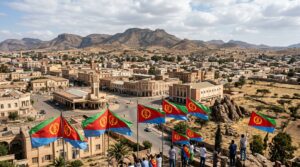
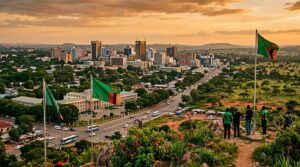
Kenya sits on East Africa’s equatorial coast, where the Great Rift Valley splits the landscape into highlands, lakes, and dramatic escarpments that run the length of the country. Officially simply Kenya, the capital is Nairobi — one of the continent’s major financial hubs — and the population stands at approximately 53.3 million. At 580,367 km², the country is slightly larger than France.
It is best known internationally for three things: the Maasai Mara’s annual wildebeest migration (shared with [Tanzania]’s Serengeti), a long-distance running tradition that has produced generations of world record holders from the Rift Valley highlands, and tea — Kenya ranks among the world’s top exporters, and the small-leaf black tea grown around Kericho has a distinct coppery brightness that sets it apart from other East African varieties. Nairobi also hosts one of the continent’s most active tech startup ecosystems, centered on an innovation corridor locals call Silicon Savannah. Readers who assume the country is defined by a single landscape or a single story will find that assumption challenged quickly.
Geography & Climate
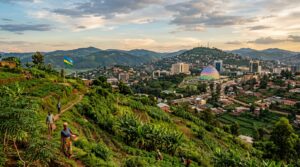
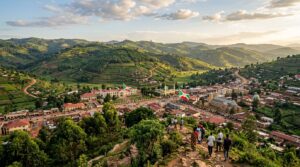
Kenya sits astride the equator in East Africa, sharing borders with Ethiopia and South Sudan to the north, Uganda to the west, Tanzania to the south, and Somalia to the east, with a roughly 500-kilometer coastline along the Indian Ocean. At 580,367 square kilometers, the country packs in an extraordinary range of terrain: white-sand beaches and mangrove creeks along the coast, the broad savanna of the Maasai Mara in the southwest, and the Central Highlands anchored by Mount Kenya — at 5,199 meters, the continent’s second-highest peak — whose glaciated summit smells of thin, cold air even at the equator.
Climate varies sharply by elevation and region. The coast and low-lying north are hot and humid year-round, while the highlands around Nairobi sit at around 1,600 meters and stay relatively mild, rarely exceeding 26 °C or dropping below 10 °C at night. Kenya has two rainy seasons: the “long rains” run roughly March–May, and the shorter “short rains” fall October–December. The arid north and northeast receive far less precipitation and experience near-permanent dry conditions.
Drought is the country’s most significant recurring natural hazard, particularly in the northern and eastern counties, where consecutive failed rainy seasons can affect millions of pastoralist households.
A Brief History of Kenya
Long before European contact, the territory now called Kenya was home to a mosaic of peoples and polities. The Swahili city-states along the coast — Mombasa chief among them — traded gold, ivory, and cloth with merchants from Arabia and India from at least the 10th century onward. Inland, the Maasai expanded across the Rift Valley during the 18th century, while Bantu-speaking agricultural communities had settled the fertile central highlands for centuries before that.
British influence arrived formally in 1895, when the Imperial British East Africa Company’s territory was absorbed into the British East Africa Protectorate, later the Kenya Colony. The construction of the Uganda Railway — built largely by indentured laborers from South Asia — opened the interior to white settler farming, displacing communities from the highlands and imposing cash taxation that forced many Kenyans into wage labor. Resistance was continuous, culminating in the Mau Mau uprising of the 1950s, a violent anti-colonial insurgency centered in Kikuyu communities that the British suppressed with considerable brutality.
Kenya became independent on December 12, 1963, with Jomo Kenyatta — former detainee, nationalist figurehead, and first prime minister — becoming its first president the following year. The decades that followed included single-party rule under both Kenyatta and Daniel arap Moi, whose presidency lasted from 1978 to 2002. A new constitution, passed by referendum in 2010, restructured government around devolved county administrations and introduced a bill of rights that significantly expanded civil liberties.
Culture, Religion & Daily Life
## Culture, Religion & Daily Life
Kenya is predominantly Christian — around 85% of the population identifies with some branch of the faith, with Catholics, Anglicans, and Pentecostal congregations all maintaining substantial followings. Muslims make up roughly 11%, concentrated mainly along the coast and in the northeast, while a smaller share practices traditional indigenous beliefs, sometimes alongside one of the major religions.
English and Swahili are both official languages, used in government, schools, and media, but Kenya’s roughly 68 indigenous languages are where daily conversation lives. In a Nairobi matatu — the privately operated minibuses that move the city — you might hear Kikuyu, Dholuo, and Kamba switching mid-sentence before the driver’s playlist cuts in with Afrobeats. The Kikuyu, Luo, and Kalenjin communities are among the largest ethnic groups, each with distinct cultural traditions and regional homelands.
Jamhuri Day, celebrated on December 12, marks Kenya’s 1963 independence from British rule and is one of the most widely observed national holidays, typically featuring parades, public speeches, and family gatherings. Everyday sociality is shaped by a strong culture of communal obligation — harambee, meaning “pulling together,” is a Swahili term that describes the tradition of community fundraising that still anchors weddings, funerals, and school fees across the country.
Economy & Industry
## Economy & Industry
Kenya runs on the Kenyan shilling (Sh), trading at approximately 130 to the dollar in 2025. With a GDP of around $110 billion, it is one of East Africa’s largest economies, anchored by agriculture, services, tourism, and a fintech sector that has drawn global attention. Tea and cut flowers are the country’s top export earners — Kenya is among the world’s leading suppliers of both — while Safaricom’s M-Pesa mobile money platform has become a reference point for financial inclusion far beyond the continent.
Tourism feeds a significant share of foreign exchange, with the Maasai Mara’s annual wildebeest migration pulling visitors who spend roughly $200–$400 (Sh 26,000–52,000) per night at mid-range camps. Manufacturing remains modest but is growing, concentrated around Nairobi and Mombasa’s port corridor. Kenya is a member of the East African Community (EAC) and the African Continental Free Trade Area (AfCFTA), both of which shape its cross-border trade rules and tariff structures.
The Standard Gauge Railway linking Mombasa to Naivasha — built to reduce freight costs from the coast — is being extended toward Uganda, a project that signals Kenya’s ambition to cement its role as the region’s logistics hub. Renewable energy, particularly geothermal power from the Olkaria fields in the Rift Valley, is also expanding rapidly, positioning Kenya as a potential clean-energy exporter.
People & Demographics
## People & Demographics
Kenya’s population stands at approximately 53.3 million, spread across a land area that works out to roughly 90 people per square kilometer — though density clusters sharply in the fertile highlands and along the coast. The median age is somewhere around 20, making Kenya a notably young country, with children and young adults forming the clear majority and older cohorts a comparatively small share of the total.
About 30 percent of Kenyans live in urban areas. Nairobi, the capital, holds an estimated 4–5 million residents in the city proper, with the wider metro considerably larger; Mombasa, the historic port city on the Indian Ocean, is the next largest, home to around 1.2 million. Kenyans abroad — particularly in the United Kingdom, the United States, and Canada — form substantial diaspora communities that send significant remittances home. Life expectancy is approximately 67 years, and literacy runs around 82 percent, though estimates vary by source and methodology.
Government & Political System
Kenya is a presidential republic in which the head of state and head of government are the same person. The current president leads the executive branch and appoints a cabinet, subject to approval by the legislature. Executive power is based in Nairobi, the capital, which also houses the Supreme Court and the bicameral Parliament — made up of the National Assembly (350 seats) and the Senate (67 seats), the latter representing Kenya’s 47 counties.
The 2010 constitution introduced a two-term limit and devolved significant authority to county governments, reshaping how Kenyans experience public services at the local level. Power has changed hands through competitive multiparty elections, though several recent cycles — including the 2022 general election — were followed by legal challenges resolved through the courts rather than the streets. Kenya’s political landscape is shaped heavily by ethnic coalition-building, and electoral outcomes have at times been disputed, though constitutional mechanisms have so far provided the framework for resolution.
Famous People from Kenya
Kenya has produced a disproportionate share of the world’s distance-running champions, alongside Nobel laureates, pioneering novelists, and conservation figures whose influence extends well beyond the continent.
- Wangari Maathai (1940–2011) — Environmental activist and founder of the Green Belt Movement who became the first African woman to receive the Nobel Peace Prize, in 2004.
- Eliud Kipchoge (b. 1984) — Marathon runner who broke the two-hour barrier in a 2019 time trial in Vienna and holds the official world marathon record.
- Ngũgĩ wa Thiong’o (b. 1938) — Novelist and literary theorist, author of Petals of Blood and Weep Not, Child, and a perennial Nobel Prize in Literature contender.
- Catherine Ndereba (b. 1972) — Four-time Boston Marathon champion and two-time Olympic marathon silver medalist, known in Kenya as “Catherine the Great.”
- Wilson Kipketer (b. 1970) — Middle-distance runner who broke Sebastian Coe’s 800-meter world record in 1997 and held it for over a decade, competing internationally for Denmark.
- Lupita Nyong’o (b. 1983) — Actor who won the Academy Award for Best Supporting Actress for 12 Years a Slave (2014) and went on to star in the Black Panther franchise.
- Richard Leakey (1944–2022) — Paleoanthropologist and conservationist whose fossil discoveries at Lake Turkana reshaped the understanding of early human evolution.
Food & Cuisine
## Food & Cuisine
Ugali — a dense, pale-white maize porridge that firms up like stiff polenta — is Kenya’s foundational starch, eaten at nearly every meal and scooped by hand to mop up stews. It typically accompanies sukuma wiki, braised collard greens cooked down with onion and tomato, or nyama choma, charcoal-grilled goat or beef served in rough-cut chunks with a side of kachumbari (a sharp tomato-onion salad). Githeri, a slow-cooked blend of maize and boiled beans, is the kind of filling, unfussy dish that sustained generations of Kenyan schoolchildren and still appears on lunch menus across the country. At roadside stalls in Nairobi, mandazi — lightly sweetened, triangular fried dough — sells for around $0.10–0.20 (10–20 Kenyan shillings) a piece and smells of frying oil and cardamom.
Kenya’s coastal strip around Mombasa follows a distinctly different culinary tradition shaped by centuries of Swahili and Arab trade. Rice replaces ugali as the staple here, cooked as pilau — fragrant with cumin, cardamom, and cloves — and seafood like grilled prawns or coconut fish curry appears on most menus. Inland, chai is the drink that holds everything together: a milky, heavily spiced tea brewed strong and served sweet at every hour of the day.
Sports & Recreation
## Sports & Recreation
Distance running is Kenya’s defining sport, producing a conveyor belt of world-record holders and Olympic champions that no other country has matched at middle and long distances. Eliud Kipchoge, from the Nandi Hills training hub of Iten, is the most decorated marathon runner alive — he broke the two-hour barrier (unofficially) in Vienna in 2019 and holds the official world record of 2:01:09 set in Berlin in 2022. At the Olympics, Kenya has won approximately 107 medals since Rome 1960, the overwhelming majority in track events from 800 meters to the steeplechase.
Football draws enormous crowds despite the national team — the Harambee Stars — having a modest continental record; they last qualified for the Africa Cup of Nations in 2019, exiting in the group stage. Athletics aside, rugby sevens has grown into a serious second sport: the Kenya Sevens team regularly contends on the World Rugby Sevens Series circuit, with a loyal, loud following at the annual Nairobi leg.
Music & The Arts
## Music & The Arts
Kenya’s contemporary sound is anchored in gengetone, a raw, percussive street genre that layers Sheng slang over electronic beats. Ethic Entertainment, the Nairobi collective behind the 2018 hit Lamba Lolo, helped push gengetone onto international playlists, while artists like Sauti Sol have carried Afro-pop with Swahili textures to stages across Europe and North America. Beneath the modern production, the nyatiti — a six- or eight-stringed lyre played by the Luo community of western Kenya — remains one of the continent’s most distinctive traditional instruments, its low resonant hum anchoring ceremonial songs that predate colonial contact.
Ngũgĩ wa Thiong’o, whose novel Petals of Blood (1977) remains a landmark of postcolonial African literature, is Kenya’s most internationally recognized writer and a perennial Nobel conversation name. In visual arts, Maasai beadwork — geometric patterns in red, blue, and white stitched onto leather — functions as both personal adornment and social language. Kenya’s cultural profile sharpened globally when the Nairobi-shot film Nairobi Half Life (2012) became the country’s first submission to the Academy Awards foreign-language category.
Wildlife & Natural Wonders
## Wildlife & Natural Wonders
Kenya is one of the few countries where all of the Big Five — lion, leopard, elephant, black rhino, and buffalo — can be seen in a single trip. The Maasai Mara National Reserve, in the southwest, is the most famous stage for this, and every July through October the thundering Wildebeest Migration spills across the Mara River from [Tanzania] in one of the most dramatic wildlife spectacles on the continent. Amboseli National Park, set against the backdrop of Mount Kilimanjaro, is particularly renowned for its large elephant herds moving through open plains dusted white with volcanic ash.
Kenya’s natural wonders extend beyond its parks. Mount Kenya, the country’s highest peak at approximately 5,199 meters, is a UNESCO World Heritage Site and supports Afro-alpine ecosystems found almost nowhere else — including giant lobelias that look like something from another planet. The Great Rift Valley cuts through the country north to south, and Lake Nakuru within it draws flamingos in their thousands, coloring the shallows pink. Poaching of elephants and rhinos remains a serious pressure, and habitat loss as agricultural land expands continues to fragment wildlife corridors across the country.
Top Things to See in Kenya
Kenya suits travelers who want more than one kind of trip. A single itinerary can move from Nairobi’s gallery scene to the Maasai Mara’s open plains, then down to the Swahili coast — all within a week. Wildlife, history, hiking, and beach are genuinely available in one country.
- Maasai Mara National Reserve (Narok County) — Kenya’s most celebrated game reserve, home to the annual wildebeest migration and year-round lion, elephant, and cheetah sightings. Best season: July–October for the migration; plan two to three nights minimum. Most visitors fly from Nairobi’s Wilson Airport in under an hour.
- Lamu Old Town (Lamu Island, Coast) — A UNESCO-listed Swahili settlement of coral-stone houses and narrow donkey lanes, continuously inhabited for over 700 years. The air carries woodsmoke and salt. Fly from Nairobi to Manda Airport; allow at least two nights to walk the alleys at your own pace.
- Amboseli National Park (Kajiado County) — Famous for large elephant herds moving against the backdrop of Mount Kilimanjaro, whose snow cap is visible on clear mornings. Accessible by road from Nairobi in roughly four hours or by charter flight; a two-night stay covers the main circuits.
- Nairobi National Museum (Nairobi) — The country’s primary natural history and cultural institution, housing the fossil collection of the Leakey excavations and rotating Kenyan contemporary art. Located on Museum Hill, a 15-minute drive from the city center; a thorough visit takes two to three hours.
- Diani Beach (Kwale County, South Coast) — A 17-kilometer stretch of white coral sand backed by casuarina trees, with water that runs turquoise in the shallows. Fly into Ukunda Airstrip or take the Likoni Ferry from Mombasa; best visited April–October when the southeast monsoon has cleared.
- Mount Kenya National Park (Central Kenya) — Africa’s second-highest mountain, with several trekking routes ranging from the accessible Sirimon route to technical summit climbs on Batian and Nelion peaks. Nairobi to Nanyuki gate takes about three hours by road; budget three to five days for a full traverse.
- Gedi Ruins (Kilifi County, Coast) — A 13th–17th century Swahili-Arab town abandoned under unclear circumstances, now a forest site where colobus
Visa & Travel Tips
## Visa & Travel Tips
Most visitors enter Kenya on an e-visa, applied for at evisa.go.ke before departure — US and UK citizens both qualify, as do most EU passport holders. ECOWAS nationals from countries such as Nigeria or Ghana generally benefit from more flexible arrangements under regional agreements, though the specifics shift regularly; always confirm current requirements with your nearest Kenyan embassy or high commission before booking. Jomo Kenyatta International Airport in Nairobi is the main hub, served by Kenya Airways, Ethiopian Airlines, and Emirates, among others. Mombasa’s Moi International Airport handles significant coastal traffic.
The Kenyan shilling (Sh) is the currency you’ll use day-to-day — USD cash is accepted at many hotels and safari operators, but smaller vendors and markets work in shillings. ATMs are reliable in Nairobi and Mombasa; carry some cash for rural areas. M-Pesa, the mobile money platform operated by Safaricom, is ubiquitous and worth setting up if you hold a local SIM. Card payments work at mid-range and upmarket establishments. Kenya operates on UTC+03:00, and the international dialling code is +254. Power sockets are predominantly Type G (the three-rectangular-pin British standard), so pack an adapter. Check your government’s official travel advisory for current safety guidance — conditions vary by region. Good connectivity starts with the right SIM or eSIM plan, covered next.
Staying Connected: Internet & eSIM in Kenya
Kenya has solid mobile infrastructure by regional standards. Safaricom dominates with the widest 4G LTE network, reaching most urban centers, major highways, and popular tourist areas like the Maasai Mara and Diani Beach. Airtel Kenya is the main competitor, offering decent 4G coverage in cities and larger towns. True 5G remains limited to parts of Nairobi. Rural and remote areas — particularly in northern counties like Turkana — can drop to 3G or lose signal entirely, so download offline maps before heading out. Wi-Fi is reliably available at hotels and cafés in Nairobi, Mombasa, and Kisumu, though speeds vary.
Buying a local SIM at Jomo Kenyatta International Airport is straightforward: bring your passport for mandatory registration, expect to pay around Sh 50–100 (roughly $0.40–$0.80) for the SIM itself, with data bundles starting from Sh 500 (~$3.80). Activation typically takes under 30 minutes. The faster alternative is a travel eSIM — it activates before you board, works on most iPhone XS and later models plus recent Android flagships like the Samsung Galaxy S23 series, and removes any roaming bill surprise entirely.