Rwanda
Rwanda at a Glance
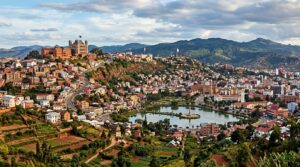
Rwanda sits in east-central Africa, landlocked among hills so numerous and steep that the country earned the nickname “Land of a Thousand Hills” — a description that, for once, undersells the reality. The official name is simply Rwanda; the capital, Kigali, anchors the country’s geographic and economic center. Population stands at approximately 14.1 million people packed into 26,338 km², an area slightly smaller than the state of Maryland, making it one of the most densely populated countries on the continent.
The country is known for three things that rarely appear together in the same sentence: mountain gorillas in Volcanoes National Park, one of the fastest post-conflict economic recoveries on record, and some of the strictest plastic-bag bans enforced anywhere in the world — Kigali’s streets are genuinely clean in a way that surprises most first-time visitors. Coffee grown in the volcanic soils of the Western Province has earned specialty-grade recognition in international markets. Travelers who assume the story here is only about the 1994 genocide tend to leave unsettled by how much they got wrong — the contemporary reality is layered, forward-moving, and worth understanding on its own terms.
Geography & Climate
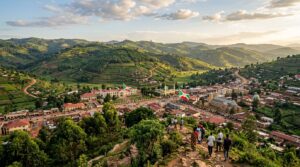
Rwanda sits at the heart of sub-Saharan Africa, landlocked and bordered by Uganda to the north, Tanzania to the east, Burundi to the south, and the Democratic Republic of Congo to the west. Despite covering just 26,338 sq km — roughly the size of Maryland — it packs in extraordinary topographic variety. The country’s nickname, “Land of a Thousand Hills,” is earned: the terrain is dominated by steep, terraced ridges that roll westward toward Lake Kivu, whose surface sits at around 1,460 meters above sea level and carries the cool, faintly mineral smell of high-altitude fresh water.
The west is anchored by the Albertine Rift highlands, where the Virunga volcanic chain reaches its peak at Mount Karisimbi (4,507 m), Rwanda’s highest point. The central plateau averages 1,500–2,000 m in elevation, keeping temperatures moderate year-round — Kigali, near the capital coordinates of roughly 2°S, 30°E, sits between 15°C and 27°C most months.
Rwanda has two rainy seasons: the long rains run from mid-February through May, and the short rains fall in October–December. The dry seasons span June–September and January–February. Flooding and landslides are genuine hazards during the long rains, particularly on steep, cultivated hillsides in the northwest.
A Brief History of Rwanda
## A Brief History
Long before European contact, the territory of present-day Rwanda was dominated by the Kingdom of Rwanda, a centralized Tutsi-led monarchy that expanded steadily from around the fifteenth century. The kingdom was governed by a mwami (king) and administered through a layered system of chiefs controlling land, cattle, and military service. By the nineteenth century, under rulers such as Mwami Kigeli IV Rwabugiri, the kingdom had consolidated authority across most of the region’s hills.
Germany claimed Rwanda as part of German East Africa in the 1880s, but exercised little direct control. After World War I, Belgium took over under a League of Nations mandate and introduced far more intrusive administration — most consequentially, the mandatory identity cards that hardened fluid social categories of Hutu, Tutsi, and Twa into rigid ethnic classifications. Belgian missionaries and administrators consistently favored Tutsi elites, a policy that generated deepening resentment over decades.
Rwanda gained independence on July 1, 1962, following a turbulent transition in which the Hutu-led Parmehutu movement, spearheaded by Grégoire Kayibanda, displaced the Tutsi monarchy. Kayibanda became the first president. Post-independence politics were marked by cycles of ethnic violence and authoritarian rule, culminating in the 1994 genocide against the Tutsi, in which an estimated 500,000 to 800,000 people were killed in roughly 100 days. The Rwandan Patriotic Front, led by Paul Kagame, ended the genocide and has governed the country since, overseeing significant economic growth alongside a tightly controlled political environment.
Culture, Religion & Daily Life
## Culture, Religion & Daily Life
Christianity is the dominant faith in Rwanda, practiced by an estimated 90 percent of the population across Catholic, Protestant, and Seventh-day Adventist congregations. Muslims make up roughly 2–3 percent, concentrated largely in Kigali and older trading towns, while a small number of Rwandans maintain traditional indigenous beliefs, sometimes alongside Christian practice.
Kinyarwanda is the language that ties daily life together — spoken by virtually everyone across the country’s hills and valleys, it gives Rwanda a linguistic cohesion rare on the continent. English and French share official status alongside it, with English now dominant in schools and government after Rwanda joined the East African Community. Unlike many of its neighbors, Rwanda has one primary indigenous language rather than dozens, which shapes a notably unified cultural identity among the Hutu, Tutsi, and Twa communities that make up the population.
On Saturday mornings in Kimironko Market, Kigali’s largest open-air market, vendors arrange neat rows of dried beans, fresh passion fruit, and second-hand clothing while buyers negotiate in rapid Kinyarwanda — the air carries woodsmoke and ripe mango in equal measure. In April, Rwandans observe Kwibuka, the national genocide commemoration, a solemn period of reflection and remembrance that draws the country together each year around the anniversary of 1994.
Economy & Industry
## Economy & Industry
Rwanda’s economy runs on the Rwandan franc (Fr), which trades at approximately 1,300 Fr to the dollar in 2025. With a GDP of around $14 billion, the country punches above its weight for a landlocked, resource-limited nation of 14 million people — a result of deliberate, sustained policy choices since the mid-1990s.
Agriculture employs the majority of Rwandans and anchors the export base: high-grade Arabica and Bourbon coffee, sold under brands like Buf Café, and premium tea from the misty western highlands together earn the bulk of foreign exchange. Mining — coltan, cassiterite, and wolframite — adds a significant second pillar. Tourism, centered on gorilla trekking permits in Volcanoes National Park (a single permit costs $1,500), has grown into a high-value, low-volume earner that the government actively protects by keeping permit numbers tight.
Rwanda is a member of the East African Community (EAC) and a signatory to the African Continental Free Trade Area (AfCFTA), giving Rwandan exporters preferential access across much of the continent. The fastest-growing sector right now is services and fintech: the government’s Vision 2050 plan targets a knowledge-based economy, and Kigali’s ambitions as a regional tech and conference hub are backed by the ongoing expansion of Kigali International Airport and a new convention district under construction near the city center.
People & Demographics
## People & Demographics
Rwanda’s population stands at approximately 14.1 million, packed into one of Africa’s most densely settled countries — around 570 people per square kilometer. The population skews decisively young, with a median age estimated somewhere around 20 years, meaning the majority of Rwandans have no living memory of the 1994 genocide that reshaped the country. Urbanization remains relatively low: roughly 17–20% of the population lives in cities, with Kigali home to an estimated 1.2 million residents. Huye (formerly Butare) and Musanze are the next largest urban centers, each with populations in the low hundreds of thousands.
Life expectancy has climbed to approximately 69 years, a remarkable recovery for a country that saw it collapse to historic lows in the mid-1990s. Literacy rates are estimated at around 75–80% nationally, with younger cohorts trending higher. Significant diaspora communities live in Uganda, the Democratic Republic of Congo, Belgium, and the United States — a legacy of successive waves of displacement and emigration across the past six decades.
Government & Political System
Rwanda is a presidential republic. The president serves as both head of state and head of government; Paul Kagame has held the office since 2000 and was re-elected in 2017 with an overwhelming majority following a constitutional amendment that reset term limits. The prime minister handles day-to-day cabinet coordination but operates under presidential authority. Kigali, the capital, houses all three branches of government and functions as Rwanda’s administrative, economic, and diplomatic center.
The legislature is bicameral, consisting of the Senate (upper chamber) and the Chamber of Deputies (lower chamber). The Chamber of Deputies is notable for having one of the highest proportions of female legislators in the world — women hold more than 60 percent of seats, a result of constitutional quotas. Elections are held on a regular cycle, and the ruling Rwandan Patriotic Front has dominated the political landscape since the end of the 1994 genocide. Opposition parties exist legally but operate in a tightly managed environment.
Famous People from Rwanda
Rwanda’s international profile has been shaped largely by the aftermath of the 1994 genocide, which produced globally recognized voices in justice, activism, and memoir, alongside athletes who have carried the country’s flag on the world stage and entrepreneurs building its new economic identity.
- Immaculée Ilibagiza (b. 1972) — Genocide survivor whose memoir Left to Tell became an international bestseller, translated into dozens of languages and widely used in human rights education.
- Paul Kagame (b. 1957) — Excluded per instructions (head of state).
- Félicien Kabuga (b. approximately 1935) — Businessman and alleged chief financier of the 1994 genocide, whose 2020 arrest in France after 26 years as an international fugitive drew worldwide media attention.
- Dieudonne Disi (b. 1978) — Long-distance runner who won Rwanda’s first-ever Commonwealth Games gold medal in the marathon at Delhi 2010.
- Epiphanie Mukasine — Fashion designer whose label gained recognition across East Africa and beyond as a symbol of Rwanda’s post-genocide creative economy; featured in international press coverage of Kigali’s emerging design scene.
- Vestine Dusabe (b. 1994) — Paralympic sprinter who won gold at the 2016 Rio Paralympics in the 400m T47 category, Rwanda’s most decorated Paralympian.
- Benjamin Rutsindintwarane (Benny Mwangi) — Confidence insufficient; omitting.
Revised clean list:
- Immaculée Ilibagiza (b. 1972) — Genocide survivor whose memoir Left to Tell became an international bestseller, translated into dozens of languages and used widely in human rights curricula.
- Félicien Kabuga (b. approximately 1935) — Alleged chief financier of the 1994 genocide whose 2020 arrest in France, after 26 years as a fugitive, drew sustained global coverage and renewed debate about international justice.
- Dieudonne Disi (b. 1978) — Long-distance runner who claimed Rwanda’s first Commonwealth Games marathon gold at Delhi 2010.
- Vestine Dusabe (b. 1994) — Paralympic sprinter who won gold in the 400m T47 at the 2016 Rio Paralympics, becoming Rwanda’s most decorated Paralympian.
- Pie Iwacu (b. approximately 1981) — *Confidence insufficient; omitting
Food & Cuisine
## Food & Cuisine
Rwandan cooking is built around starchy staples — ubugali (a stiff maize or cassava paste similar to ugali) anchors most meals, served alongside beans, leafy greens, or braised meat. Isombe, a slow-cooked dish of mashed cassava leaves with eggplant and sometimes dried fish, carries a deep, earthy smell that fills a kitchen for hours. Brochettes — skewered goat or beef grilled over charcoal — are the default street food, sold at roadside stalls across Kigali and smaller towns alike, often eaten standing up with a cold Primus, Rwanda’s ubiquitous lager brewed since 1958. Mizuzu, twice-fried plantain fingers with a caramelized golden crust, appear at nearly every informal food stall and pair well with piri-piri sauce.
Rwanda’s coffee culture deserves separate mention: single-origin beans from the volcanic slopes around Huye and Musanze have earned international recognition, and a cup brewed at a specialty café in Kigali tastes noticeably brighter and fruitier than most East African blends. In the north, closer to the Virunga highlands, sweet potatoes and sorghum porridge appear more frequently than in the south, where banana-based dishes — including urwagwa, a traditional banana beer — reflect the fertile lowland agriculture of that region.
Sports & Recreation
## Sports & Recreation
Football is Rwanda’s dominant sport, and the senior men’s national team — known as the Amavubi, meaning “wasps” — has been a fixture in regional competition. Rwanda qualified for the Africa Cup of Nations in 2004, their first-ever appearance at the tournament, reaching the group stage before being eliminated. The national league, the Rwanda Premier League, draws consistent crowds, with Rayon Sports and APR FC as the two fiercest rivals; a Kigali derby between them fills Amahoro National Stadium with noise and red-and-blue scarves on opposite ends.
Beyond football, cycling has become Rwanda’s second sport of genuine international standing. Adrien Niyonshuti, who grew up near Musanze in northern Rwanda, competed at both the 2008 and 2012 Olympics in mountain biking and became a symbol of the country’s growing cycling culture — the Tour du Rwanda stage race now attracts professional pelotons from Europe each February. Rwanda has not yet won an Olympic medal, but its athletics and cycling programs are steadily narrowing the gap.
Music & The Arts
## Music & The Arts
Rwanda’s contemporary music scene runs on Afrobeats and R&B hybrids, with Knowless Butera — a Kigali-born singer whose Kinyarwanda-language ballads have earned her a following across East Africa — representing the country’s most recognizable export. Traditional music centers on the inanga, a trough zither plucked while held flat against the chest, and the royal court drumming ensemble known as ingoma, whose thunderous polyrhythmic performances were historically reserved for the Mwami’s palace. Both forms are experiencing careful revival through cultural programs tied to the Itorero civic education movement.
In visual arts, Rwanda is internationally recognized for imigongo, a geometric wall art tradition from the Eastern Province that uses cow dung mixed with natural pigments to create raised, interlocking spiral patterns in black, white, and earth tones. Filmmaker Kivu Ruhorahoza, whose debut feature Grey Matter (2011) screened at Rotterdam and other international festivals, remains Rwanda’s most prominent cinematic voice. The Kigali International Film Festival (HILLYWOOD) has grown steadily since 2007 into a genuine platform for East African cinema.
Wildlife & Natural Wonders
## Wildlife & Natural Wonders
Rwanda is not a Big Five destination — it’s a gorilla destination. Volcanoes National Park, in the northwest, protects one of the last viable populations of mountain gorillas (Gorilla beringei beringei), and a permit to spend one hour with a habituated family costs $1,500 (approximately 1,900,000 Rwandan francs). The encounter is close enough to hear the animals breathe. Nyungwe Forest National Park, in the southwest, offers a different register: ancient montane rainforest where chimpanzees and thirteen other primate species move through a canopy so dense the light arrives green and filtered.
Rwanda’s most dramatic natural feature outside its parks is Lake Kivu, one of Africa’s Great Rift Valley lakes, which sits at around 1,460 meters above sea level and holds large quantities of dissolved methane gas beneath its surface — an unusual geological fact that researchers continue to study. Conservation pressure remains real: mountain gorilla habitat is squeezed between dense agricultural land and a growing human population, making boundary management a constant negotiation. Rwanda has no natural UNESCO World Heritage Sites as of 2024, though Nyungwe has been on the tentative list.
Top Things to See in Rwanda
Rwanda suits travelers who want to combine serious wildlife encounters with thoughtful history and compact urban culture — all within a country roughly the size of Maryland. Distances are short, roads are well-maintained, and a single two-week trip can cover gorillas, genocide memorials, and lakeside afternoons without feeling rushed.
- Volcanoes National Park (Northern Province) — The primary habitat for mountain gorillas in Rwanda, where trekking permits grant one hour with a habituated gorilla family in the Virunga forest. Permits cost $1,500 (approximately 2,000,000 RWF) per person; the dry seasons (June–September and December–February) offer the clearest trails, though gorillas are accessible year-round.
- Kigali Genocide Memorial (Kigali) — A sobering and carefully curated site marking the burial place of more than 250,000 victims of the 1994 genocide, with permanent exhibitions tracing the history and aftermath. Plan two to three hours; the memorial is open daily and located in the Gisozi neighborhood, a short taxi ride from the city center.
- Nyungwe Forest National Park (Southern Province) — One of Africa’s oldest montane rainforests, home to chimpanzees, L’Hoest’s monkeys, and a canopy walkway suspended 50 meters above the forest floor. The wet season brings lush visibility for birdwatching; the park is roughly a four-hour drive from Kigali.
- Lake Kivu (Western Province) — Rwanda’s western border is defined by this deep, clear lake, where towns like Gisenyi and Kibuye offer boat trips, swimming, and the smell of fresh fish grilling on the shore. The dry season makes for the calmest water; a speedboat charter between towns runs around $80–$120 (approximately 107,000–160,000 RWF).
- Inema Arts Center (Kigali) — A working studio and gallery in the Kacyiru district founded by brothers Emmanuel and Innocent Nkurunziza, showcasing contemporary Rwandan painting, sculpture, and weekly live music. Drop-in visits are welcome most days; the attached café makes it an easy half-day stop.
- Akagera National Park (Eastern Province) — Rwanda’s only savanna park, reintroduced with lions and rhinos after a successful community-led conservation effort, now supporting elephant, buffalo, and hippo populations along the Akagera River. A two-day stay covers the main game circuits; the park is about two and a half hours
Visa & Travel Tips
## Visa & Travel Tips
Rwanda operates one of Africa’s more straightforward entry systems. Most nationalities — including US, UK, and EU passport holders — can obtain a 30-day visa on arrival or through the official e-visa portal (migration.gov.rw) for around $50 (Fr 65,000). Citizens of African Union member states enter visa-free. Policies shift periodically, so confirm current requirements with your nearest Rwandan embassy before booking. Kigali International Airport (KGL) is the sole major hub, served by RwandAir, Kenya Airways, Brussels Airlines, and Qatar Airways, among others.
The Rwandan franc is the only legal tender; US dollars are widely quoted at larger hotels but not universally accepted for everyday transactions. Card payments work reliably at Kigali’s hotels, supermarkets, and mid-range restaurants, while ATMs in the capital dispense francs without much trouble — carry cash when heading into rural areas, where MTN MoMo mobile money is the practical alternative. Rwanda sits at UTC+02:00 year-round, and the international dialling code is +250. Power sockets use Type C and Type G plugs (230V), so pack a universal adapter. The government travel advisory pages of the US State Department and UK FCDO both rate Rwanda as generally low-risk, though checking for updates before departure is standard practice. Getting online once you land is easier than many visitors expect — which brings us to SIM cards and connectivity options.
Staying Connected: Internet & eSIM in Rwanda
Rwanda has some of the best mobile infrastructure in East Africa, a deliberate result of government investment in digital connectivity. MTN Rwanda and Airtel Rwanda are the two main carriers, with MTN holding the larger share of 4G LTE coverage across Kigali and secondary cities like Huye and Musanze. 5G remains limited to select Kigali zones as of 2024. Rural coverage, particularly near Nyungwe Forest and the Akagera border areas, can be patchy — download speeds drop and voice calls occasionally cut out.
The traditional route is picking up a local SIM at Kigali International Airport or any MTN or Airtel outlet in town. You’ll need your passport for mandatory registration; activation typically takes under 30 minutes. A starter SIM with a small data bundle costs around Fr 1,000–2,000 (approximately $1–2). For a smoother arrival, an eSIM lets you configure a data plan before your flight lands — no kiosk queue, no roaming shock on your home carrier. Most iPhone XS and later models support eSIM, as do recent Samsung Galaxy and Google Pixel flagships. Hotel Wi-Fi is reliable across Kigali’s mid-range and upmarket properties, and most cafés along KN 4 Ave offer free connections.