Djibouti
Djibouti at a Glance
Djibouti sits at the southern mouth of the Red Sea, where the Horn of Africa narrows to face the Arabian Peninsula across the Bab-el-Mandeb strait — one of the world’s busiest shipping chokepoints. The country’s official name is the Republic of Djibouti, its capital shares the country’s name, and its population stands at approximately 1,066,809, most of them concentrated in that same capital city. At 23,200 km², the territory is roughly the size of New Jersey, a compact footprint that contains startling geographic variety: salt lakes, volcanic rock fields, and stretches of the Afar Depression, one of the lowest and hottest places on Earth.
The country is genuinely known for three things beyond its strategic port: the eerie turquoise expanse of Lake Assal, a salt lake sitting 155 meters below sea level; its role as host to multiple foreign military bases, making it one of the most militarized small nations anywhere; and whale shark aggregations off the coast near Tadjoura Bay, which draw researchers and divers between October and February. Travelers who pass through primarily for the port or the bases often leave without registering that the interior landscape — cracked white salt flats giving way to jagged basalt — is unlike almost anywhere else on the continent.
Geography & Climate
Djibouti sits at the southern entrance to the Red Sea, wedged into the Horn of Africa and bordered by Eritrea to the north, Ethiopia to the west and south, and Somalia to the southeast. That position — controlling the Bab-el-Mandeb strait — makes it one of the most strategically watched pieces of land on the continent, covering just 23,200 square kilometers.
The terrain is stark and largely barren: a coastal plain gives way to a volcanic interior of cracked lava fields, salt flats, and low plateaus. Lake Assal, sitting roughly 155 meters below sea level, is the lowest point in Africa and one of the saltiest bodies of water on Earth — its white salt crust shimmers with a blinding, almost metallic glare under the midday sun. The Goda Mountains in the north offer the only real relief, topping out around 1,750 meters and supporting a thin strip of juniper forest.
The climate is one of the hottest and driest on the planet. Coastal temperatures routinely exceed 40°C (104°F) in summer (June–August), while the interior can feel even more punishing — the air carries a mineral dryness that parches the throat within minutes. A brief, unreliable rainy season runs roughly October–December, with a secondary window around March–April; annual rainfall rarely exceeds 150 mm. Drought is the primary natural hazard, periodically stressing both agriculture and freshwater supplies.
A Brief History of Djibouti
The territory that is now Djibouti has been inhabited for thousands of years, with Afar and Somali (Issa) clans establishing themselves along the Gulf of Tadjoura long before outside powers arrived. The region sat within the broader sphere of the Adal Sultanate, a powerful Somali-Afar Muslim state that dominated the Horn of Africa from the 13th through the 16th centuries, controlling trade routes connecting the interior of Ethiopia to the Red Sea coast.
France began establishing a foothold in the area in 1862, signing treaties with Afar sultans and formally claiming the port of Obock. The colony eventually became French Somaliland, later renamed the French Territory of the Afars and Issas in 1967 — a name reflecting the two dominant ethnic groups whose political tensions France navigated, often uneasily, throughout the colonial period. The capital, Djibouti City, grew into a strategic coaling and transit port, particularly after the completion of the Addis Ababa–Djibouti Railway in 1917.
Independence came on June 27, 1977, making Djibouti one of the last African nations to achieve it. Hassan Gouled Aptidon, an Issa political leader who had campaigned for self-determination, became the country’s first president. The post-independence decades were not without turbulence: a civil conflict between the government and the Afar-led FRUD movement ran from 1991 to around 1994, ending in a partial peace agreement. Ismail Omar Guelleh has held the presidency since 1999, overseeing Djibouti’s emergence as a host to multiple foreign military bases — a position that reflects the country’s continued strategic importance in the region.
Culture, Religion & Daily Life
## Culture, Religion & Daily Life
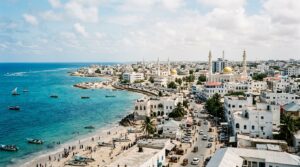
Islam is the foundation of public life in Djibouti, practiced by around 94% of the population, predominantly Sunni. The remaining share is largely Christian, including a small Catholic community with roots in the French colonial era. On Fridays, the Hamoudi Mosque in central Djibouti City fills with worshippers whose calls to prayer drift across the harbor, mixing with the salt-tinged air off the Gulf of Tadjoura.
Arabic and French are the official languages, used in government, schools, and formal media. In daily conversation, most people speak Somali (Issa dialect) or Afar — the two vernacular languages that reflect the country’s largest ethnic communities, the Issa Somali and the Afar, alongside smaller groups such as the Gadabuursi. Switching between languages mid-sentence is common in markets and cafés.
Everyday sociability often revolves around the midday khat session — bundles of the mildly stimulant leaf arrive from [Ethiopia] each morning, and by early afternoon men and women gather in shaded rooms to chew and talk. Djibouti’s Independence Day, celebrated in June, brings parades along Boulevard de la République and public gatherings that draw families from across the country’s five regions.
Economy & Industry
## Economy & Industry
Djibouti’s economy punches well above its size — for a country of around 1,066,809 people, it moves an outsized share of East Africa’s trade. The Djiboutian franc (Fr) is pegged to the US dollar at approximately 177 Fr to the dollar, a fixed rate that has held since 1973 and gives the economy unusual monetary stability for the region. GDP sits at around $3–4 billion, modest in absolute terms but heavily leveraged by geography.
The port sector is the engine. Djibouti Port, operated in part through agreements with Dubai’s DP World, handles the vast majority of landlocked Ethiopia’s imports and exports — a captive trade relationship that makes logistics and transit fees the country’s dominant revenue source. The Doraleh Multipurpose Port and the Djibouti Free Zone attract regional warehousing and light manufacturing. Military base leasing is a quieter but significant income stream: the US, France, China, and Japan all maintain facilities here, paying annual rents that contribute meaningfully to government revenue.
Djibouti is a member of COMESA and the Arab League, and has signed onto the AfCFTA framework. The most consequential forward-looking project is the Addis Ababa–Djibouti Railway, a Chinese-built electric line that, once running at full capacity, could substantially increase freight throughput and deepen the Ethiopia dependency that defines — and sustains — Djibouti’s economic identity.
People & Demographics
## People & Demographics
Djibouti’s population stands at approximately 1,066,809, spread across a territory roughly the size of New Jersey, yielding a density of around 46 people per square kilometer — though that figure is deeply uneven. The median age is estimated at around 24 years, reflecting a notably young population: children and young adults under 30 make up the clear majority, while the over-65 cohort remains small. Urbanization is striking: roughly 78 percent of Djiboutians live in cities, with Djibouti City alone holding well over half the national population — estimates place it above 600,000. Ali Sabieh and Tadjourah are the next largest urban centers, each home to tens of thousands.
Life expectancy at birth is approximately 65 years, though estimates vary by source. Literacy runs around 68 to 70 percent for adults, with a meaningful gap between men and women. Significant diaspora communities have settled in France, Ethiopia, and the Gulf states, particularly among Somali and Afar communities who straddle borders shared with [Ethiopia] and [Somalia].
Government & Political System
## Government & Political System
Djibouti is a presidential republic, with the same person serving as both head of state and head of government. Ismail Omar Guelleh has held the presidency since 1999, most recently securing re-election in 2021 under a constitutional framework that was amended in 2010 to remove term limits — a change that drew criticism from opposition groups. The ruling People’s Rally for Progress has dominated national politics since independence in 1977.
The legislature is unicameral: a 65-seat National Assembly whose members serve five-year terms. The capital, Djibouti city, functions as the country’s administrative, commercial, and judicial center — all major government ministries and the national court system operate from within its compact urban core. Opposition parties contest elections but have won limited representation; international observers have noted concerns about electoral competitiveness, though transfers of executive power have occurred without armed conflict.
Famous People from Djibouti
Djibouti’s small population — around one million people — has produced a modest but notable roster of internationally recognized figures, with the country’s greatest global footprint coming through long-distance running, early political leadership, and a growing literary voice.
- Hassan Abubakar Farah (1935–2009) — Djibouti’s first prime minister after independence in 1977, he played a central role in establishing the new state’s governmental institutions.
- Ahmed Salim Ahmed (born 1946) — longtime Secretary-General of the Organisation of African Unity (1989–2001), he was one of the most prominent African diplomats of the late twentieth century.
- Hodan Nalayeh (1976–2019) — Somali-Canadian journalist born in Djibouti who founded Integration TV to tell positive stories about the Somali diaspora, and was killed in a 2019 hotel attack in Kismayo.
- Omar Abdi (born 1975) — senior UNICEF official who has served as Deputy Executive Director, making him one of the most senior Djiboutians in the United Nations system.
- Ayanleh Souleiman (born 1992) — middle-distance runner and 2014 World Indoor 1500m champion, he is Djibouti’s most decorated active track athlete.
- Kadra Ahmed Hassan (born 1975) — women’s rights activist and former government minister recognized internationally for her work against female genital mutilation in the Horn of Africa.
Food & Cuisine
## Food & Cuisine
Djiboutian cooking sits at a crossroads of Somali, Afar, Yemeni, and French influences, with rice and flatbread serving as the everyday starches. The most common meal is skoudehkaris, a fragrant rice dish slow-cooked with goat or lamb, cumin, and cinnamon — the spice-heavy steam is the first thing you notice stepping into a family kitchen. Fah-fah is a close second: a thin, peppery goat soup eaten for breakfast, typically scooped up with flatbread. Along the Gulf of Tadjoura coast, grilled fish seasoned with tamarind and served over rice reflects the strong Yemeni maritime influence that shaped port towns like Obock. Inland among Afar communities, camel milk and dried meat feature more prominently than seafood.
For drinks, shaah, a spiced tea brewed with cardamom, cloves, and sugar, is served throughout the day in small glasses at virtually every café and household. At roadside stalls near the central market in Djibouti City, vendors sell sambuusa — crispy fried pastry pockets filled with spiced minced meat or lentils — for around $0.50 (90 Djiboutian francs) each. It is the snack most visitors encounter first, and the crunch holds even in the midday heat.
Sports & Recreation
## Sports & Recreation
Football is the dominant sport in Djibouti, where the senior men’s national team — nicknamed the Red Sea Stars — competes in AFCON qualification but has yet to reach the tournament proper. In the 2023 Africa Cup of Nations qualifying rounds, Djibouti finished bottom of Group G, held to narrow margins against stronger regional sides. The team plays home matches at the Stade du Ville in Djibouti City, a compact stadium where the heat alone is a factor for visiting squads.
Athletics carries real national pride, largely through distance runner Ayanleh Souleiman, who won the 1500m gold at the 2014 World Indoor Championships in Sopot — Djibouti’s most prominent moment in global track competition. Djibouti has sent athletes to multiple Olympic Games but has not yet won an Olympic medal. Boxing also draws a following, with gyms concentrated around the port district, where the sound of speed bags carries through the late-afternoon sea breeze.
Music & The Arts
## Music & The Arts
Djibouti’s contemporary music scene draws most heavily from taarab — the Indian Ocean coastal tradition blending Arabic maqam scales, East African rhythms, and Somali poetic forms — alongside a distinct strain of Somali popular music called heello. Singer Asad Dayib has carried Djiboutian-inflected heello to diaspora audiences across Europe and the Gulf, his recordings circulating widely on platforms serving Somali-speaking communities from Minneapolis to Marseille. Traditional sessions still feature the oud, played with a dry, percussive attack that cuts through the humid coastal air, alongside the kaban, a Somali lute whose buzzing lower strings anchor wedding and ceremonial performances.
Djibouti’s most internationally recognized literary voice is Abdourahman A. Waberi, whose novel Passage of Tears (2009) has been translated into multiple languages and taught in French universities. Visual craft traditions lean toward woven camel-leather goods and geometric embroidery on women’s ceremonial dress — intricate repeating diamond patterns in red, gold, and black. Djibouti has no major film festival of its own, but Waberi’s literary profile has made him the country’s clearest cultural ambassador abroad.
Wildlife & Natural Wonders
## Wildlife & Natural Wonders
Djibouti is not a Big Five destination — it has no elephants, lions, or rhinos — but the Gulf of Tadjoura delivers something rarer: whale sharks. Between October and February, these filter-feeding giants, some exceeding 12 meters, congregate near the Bay of Ghoubbet to feed on spawning fish eggs, making Djibouti one of the most reliable whale shark encounter sites on the continent. The Day Forest National Park, inland near the Goda Mountains, protects one of the last stands of juniper forest in the Horn of Africa and shelters the Djibouti francolin, a bird found nowhere else on Earth.
The country’s most dramatic natural wonder is Lake Assal, a crater lake sitting roughly 155 meters below sea level — the lowest point in Africa and the third lowest on the planet. Its surface is encrusted with salt so white it stings the eyes in midday sun. Desertification and overgrazing pressure the fragile Day Forest ecosystem, while rising sea temperatures threaten the coral reefs of the Gulf of Tadjoura. Djibouti does not currently hold a natural UNESCO World Heritage designation, though Lake Assal has been proposed.
Top Things to See in Djibouti
Djibouti rewards travelers who want geology, marine life, and stark desert landscapes in a compact package — the country is roughly the size of New Jersey. It’s not a conventional beach holiday or a Big Five safari; it’s something stranger and more specific: salt lakes, volcanic rock, and whale sharks.
- Lake Assal (Tadjourah Region) — A crater lake sitting 155 meters below sea level, making it the lowest point in Africa and one of the saltiest bodies of water on Earth; its bleached salt flats and turquoise center look almost extraterrestrial. Best visited October–April when temperatures are manageable; a day trip from Djibouti City by 4WD takes around two hours.
- Lac Abbé (Dikhil Region) — A soda lake straddling the Ethiopian border, famous for its limestone chimneys that vent steam at dawn, giving the landscape a primordial quality that has drawn film crews since the 1970s. Overnight camping near the lake is the standard approach; guides can be arranged through operators in Djibouti City.
- Gulf of Tadjourah Whale Shark Snorkeling (Tadjourah) — Between October and January, whale sharks congregate in the Gulf of Tadjourah to feed on spawn, making this one of the most reliable whale shark encounters on the continent. Day trips depart from Djibouti City’s port; bring your own snorkel gear or rent from local dive operators such as Dolphin Excursions.
- Day Forest National Park (Goda Mountains) — The country’s only significant forest, a juniper and olive woodland in the Goda Massif that shelters the endangered Djibouti francolin — a bird found nowhere else on Earth. The cool air at around 1,500 meters elevation is a genuine relief; access is via the town of Randa, roughly three hours from the capital.
- Moucha Island (Gulf of Aden) — A small coral island about 10 kilometers offshore from Djibouti City, with clear water suitable for snorkeling and a quieter pace than the mainland. Boats run from the Djibouti City marina on weekends; a day visit costs approximately $30–50 (17,000–28,000 DJF) depending on the operator.
- Place Mahmoud Harbi and the Old Quarter (Djibouti City) — The central square anchors the older part of the capital, where the covered market, the Hamoudi Mosque — built in the early twentieth century — and the port-side cafés
Visa & Travel Tips
## Visa & Travel Tips
Most visitors — including US, UK, and EU citizens — can obtain a visa on arrival at Djibouti-Ambouli International Airport, valid for 30 days and priced at around $70 (Fr 12,500). An e-visa option is also available through the government portal, which can save time at immigration. ECOWAS nationals should verify their specific status before travel, as bilateral agreements shift. Regardless of nationality, confirm current requirements with your nearest Djiboutian embassy before booking — policy changes without much notice.
Djibouti-Ambouli International Airport (JIB) is the country’s sole international gateway, served primarily by Ethiopian Airlines, Air France, and flydubai. The Djiboutian franc is pegged to the US dollar, and dollars are widely accepted in hotels and larger restaurants; carry cash for markets and smaller establishments, as card terminals are scarce outside the capital. ATMs exist in central Djibouti City but are unreliable — withdraw what you need early. Mobile money is not widely used here the way M-Pesa is in [Kenya] or Wave in [Senegal]. The country runs on UTC+03:00, the international dialling code is +253, and sockets are Type C and E — a universal adapter covers both. Check your government’s official travel advisory for current security guidance before departure. Getting online once you land is its own puzzle, covered in the next section.
Staying Connected: Internet & eSIM in Djibouti
Mobile coverage in Djibouti is handled almost entirely by Djibouti Telecom, the state-owned monopoly — there is no MTN, Airtel, or Orange operating here. 4G LTE is available in Djibouti City and along the main corridor to Ethiopia; rural areas and the interior, including much of the Tadjourah and Obock regions, drop to 3G or lose signal entirely. 5G has not launched commercially. Expect solid data speeds near the port district and Plateau du Serpent, patchy service elsewhere.
Buying a local SIM at Djibouti-Ambouli International Airport is straightforward: present your passport, complete a registration form, and a prepaid Djibouti Telecom SIM typically costs around Fr 1,000–2,000 (approximately $5–$11 USD) with a starter data bundle. Activation usually takes 30–60 minutes. The faster alternative is an eSIM — load it before your flight, and data starts the moment you land, no kiosk queue, no roaming bill shock. Most iPhone XS and newer models support eSIM, as do recent Samsung Galaxy and Google Pixel flagships. Hotel lobbies and cafés in Djibouti City, particularly around Place Mahmoud Harbi, generally offer free Wi-Fi, though speeds vary.