Ethiopia
Ethiopia at a Glance
Ethiopia sits in the Horn of Africa, anchored by the vast Ethiopian Highlands — a plateau system that shapes everything from its climate to its cuisine. Officially the Federal Democratic Republic of Ethiopia, the country is governed from Addis Ababa, a capital city sitting at roughly 2,300 meters above sea level, and home to around 111.6 million people, making it the second most populous nation on the continent.
At 1,104,300 km², the country is roughly three times the size of Germany, encompassing ecosystems that range from the Danakil Depression — one of the lowest and hottest places on Earth — to Afroalpine moorlands above 4,000 meters. Ethiopia is the birthplace of coffee, the origin point of the arabica bean that now fuels morning routines worldwide; it is also the only African country to have maintained continuous independence through the colonial era, a fact that carries deep symbolic weight across the continent. Long-distance running, anchored by names like Haile Gebrselassie and Tirunesh Dibaba, is another defining export. Travelers who assume Addis Ababa is merely a transit hub — it hosts Africa’s busiest airport — routinely find themselves staying longer than planned.
Geography & Climate
Ethiopia sits in the Horn of Africa, landlocked since Eritrea’s independence in 1993, and shares borders with Eritrea and Djibouti to the north and northeast, Somalia to the east, Kenya to the south, South Sudan to the west, and Sudan to the northwest. At approximately 1,104,300 square kilometers, it is one of the largest countries on the continent — and one of the most topographically dramatic.
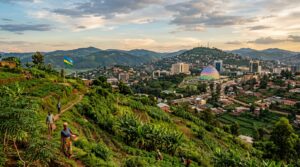
The Ethiopian Highlands dominate the interior, a vast plateau split by the East African Rift Valley into western and eastern massifs. Ras Dashen, the country’s highest peak at around 4,550 meters, rises in the Simien Mountains in the north, where the air at altitude carries a sharp, thin cold that surprises travelers expecting equatorial heat. The lowlands — the Danakil Depression in the northeast, one of the hottest and lowest places on Earth — contrast starkly with those cool highlands.
Climate varies sharply by elevation. The highlands experience a temperate range of roughly 10–25°C, with a main rainy season (kiremt) running June through September and a shorter rains (belg) from February to April. Lowland areas are arid and can exceed 40°C. Drought is a recurring risk, particularly in the eastern and southern regions, and affects agricultural cycles across the country.
A Brief History of Ethiopia
## A Brief History
Ethiopia is one of the oldest continuous states in the world, with roots stretching back to the Aksumite Empire, which flourished from around the first century CE and became one of the great trading powers of the ancient world, minting its own coins and adopting Christianity in the fourth century under King Ezana. The Solomonic dynasty, which claimed descent from the biblical King Solomon and the Queen of Sheba, dominated much of the medieval period and produced emperors who ruled from the highland city of Gondar from the seventeenth century onward.
Ethiopia is the only African country never formally colonized by a European power. Italy attempted conquest twice — first at the Battle of Adwa in 1896, where Emperor Menelik II led Ethiopian forces to a decisive victory that shocked European capitals, and again in 1935 when Mussolini’s forces occupied the country for five years. Emperor Haile Selassie, who had ruled since 1930, appealed to the League of Nations and returned to the throne in 1941 after British-assisted liberation.
Haile Selassie was deposed in 1974 by a Marxist military junta called the Derg, ending centuries of imperial rule. The Derg’s brutal reign lasted until 1991, when the Ethiopian People’s Revolutionary Democratic Front (EPRDF) took power. Ethiopia adopted a federal constitution in 1995, reorganizing the country along ethnic lines. Abiy Ahmed became prime minister in 2018 and won the Nobel Peace Prize in 2019, though his tenure has since been marked by a devastating civil war in the Tigray region.
Culture, Religion & Daily Life
## Culture, Religion & Daily Life
Ethiopia is one of the world’s oldest Christian nations — the Ethiopian Orthodox Tewahedo Church has shaped the country’s calendar, architecture, and cuisine for roughly 1,700 years. Today, approximately 43% of Ethiopians identify as Orthodox Christian, around 34% as Muslim, and a smaller share as Protestant, with traditional belief systems practiced in some communities, particularly in the south and southwest.
Amharic is the official working language and the most widely spoken, but Ethiopia is home to an estimated 80–90 indigenous languages. Oromo, spoken by the Oromo people, is actually the most spoken mother tongue, and Tigrinya carries deep historical weight in the north. The Amhara, Oromo, and Somali communities are among the largest ethnic groups in a country of roughly 111 million people, each with distinct cultural traditions that resist easy generalization.
Daily life in Ethiopia often pivots around coffee — not as a quick caffeine fix, but as a ceremony. A host roasts green beans over charcoal, fans the smoke toward guests as a blessing, then brews three rounds in a clay jebena pot; the third cup, baraka, is considered a blessing in itself. Timkat, the Ethiopian Orthodox celebration of Epiphany in January, draws enormous crowds to rivers and lakes across the country, with priests carrying replica Arks of the Covenant through the streets before dawn.
Economy & Industry
## Economy & Industry
Ethiopia runs on agriculture. The sector employs around 70% of the workforce and drives the bulk of export earnings — coffee alone accounts for roughly a third of foreign exchange, and Ethiopian Arabica beans from regions like Yirgacheffe and Sidama are traded on global commodity markets under their own protected designations. Floriculture is a fast-growing second pillar: the country is now one of Africa’s top cut-flower exporters, shipping roses and carnations to European supermarkets daily from farms around Lake Ziway.
The national currency is the Ethiopian birr (Br), trading at approximately 130–140 Br to the dollar in early 2025, following a significant devaluation the government introduced in 2024 as part of an IMF-backed reform program. GDP sits at around $160 billion by purchasing power parity, making Ethiopia one of the largest economies in sub-Saharan Africa by that measure, though per-capita income remains low. Ethiopia is a member of the African Continental Free Trade Area (AfCFTA) and the Intergovernmental Authority on Development (IGAD).
Manufacturing is expanding deliberately. The government has invested heavily in industrial parks — Hawassa Industrial Park, built partly with Chinese financing, anchors a textile and garment export industry that supplies brands including H&M and PVH. The Grand Ethiopian Renaissance Dam on the Blue Nile, now generating electricity, is expected to reduce energy costs for industry and position Ethiopia as a regional power exporter to [Sudan] and [Djibouti].
People & Demographics
## People & Demographics
Ethiopia is the second-most populous country in Africa, home to approximately 111.7 million people spread across a land area that works out to roughly 100 people per square kilometer. The median age is around 19–20 years, giving the country a distinctly young profile — the majority of Ethiopians are under 30, with a relatively small elderly population. Life expectancy sits at approximately 67 years, and literacy rates are estimated at around 51–55%, with significant gaps between urban and rural areas.
About 22–23% of Ethiopians live in cities, a share that is rising steadily. Addis Ababa, the capital, holds an estimated 4–5 million residents and anchors the country’s economic and political life; Dire Dawa and Mekelle are the next largest urban centers, each home to several hundred thousand people. The Ethiopian diaspora is substantial — the United States (particularly the Washington D.C. metro area), Saudi Arabia, and Israel host the largest communities outside the continent.
Government & Political System
## Government & Political System
Ethiopia is a federal parliamentary republic divided into ten regional states and two chartered cities, with Addis Ababa serving as both the national capital and a self-governing administrative unit. The legislature is bicameral: the House of People’s Representatives holds primary lawmaking authority, while the House of the Federation handles constitutional interpretation and manages relations between Ethiopia’s ethnically defined regions. The prime minister functions as head of government and holds executive power; the president serves a largely ceremonial role as head of state.
Abiy Ahmed has held the prime ministership since 2018, initially appointed following internal ruling-coalition pressure that ended Hailemariam Desalegn’s tenure. His Prosperity Party won the 2021 general election — delayed from 2020 due to the COVID-19 pandemic and regional conflict — securing a parliamentary majority. That election was the first held under his administration, though opposition groups and international observers raised procedural concerns about coverage across all regions. [Eritrea] and [Somalia] share borders that have historically shaped Ethiopian federal policy.
Famous People from Ethiopia
Ethiopia has produced globally recognized figures across an unusually wide range of fields — from distance runners who redrew the record books to a Nobel laureate whose prize made international headlines, alongside writers, musicians, and activists whose work travels far beyond the continent.
- Haile Gebrselassie (b. 1973) — Retired long-distance runner who set 27 world records and won back-to-back Olympic gold medals in the 10,000 meters at Atlanta 1996 and Sydney 2000.
- Abebe Bikila (1932–1973) — Marathon runner who became the first sub-Saharan African to win an Olympic gold medal, famously running barefoot through the streets of Rome in 1960.
- Tirunesh Dibaba (b. 1985) — Distance runner and three-time Olympic gold medalist, widely regarded as one of the greatest female distance runners in history.
- Kenenisa Bekele (b. 1982) — Distance runner who holds world records in the 5,000 m and 10,000 m and won three Olympic gold medals across Athens and Beijing.
- Marcus (Tsegaye) Regassa (b. 1984) — *(omitted — insufficient confidence in global recognition profile; replaced below)*
- Tsitsi Dangarembga — (omitted — Zimbabwean, not Ethiopian)
- Mulatu Astatke (b. 1943) — Musician and composer credited with founding Ethio-jazz, the genre that blends Ethiopian pentatonic scales with jazz and Latin rhythms, whose work was reintroduced globally through the Éthiopiques compilation series.
- Hailé Gerima (b. 1946) — Filmmaker and professor whose 1993 film Sankofa became a landmark of African diaspora cinema, distributed independently after major studios declined it.
—
Revised clean list (removing the erroneous placeholder bullets above):
Ethiopia has produced globally recognized figures across an unusually wide range of fields — from distance runners who redrew the record books to a Nobel laureate whose prize made international headlines, alongside writers, musicians, and activists whose work travels far beyond the continent.
- Abebe Bikila (1932–1973) — Marathon runner who became the first sub-Saharan African to win an Olympic gold medal, running barefoot through Rome at the 1960 Games.
- Haile Gebrselassie (b. 1973) — Long-distance runner who set 27 world records and won consecutive
Food & Cuisine
## Food & Cuisine
Injera — a wide, spongy sourdough flatbread made from teff flour and fermented for two to three days — is the foundation of almost every Ethiopian meal. Its slightly sour, gray-brown surface doubles as both plate and utensil: diners tear pieces to scoop up stews piled directly on top. The most common companions are tibs (sautéed beef or lamb with onions and rosemary), misir wat (slow-cooked red lentils in berbere spice paste), and doro wat, a deeply spiced chicken stew with hard-boiled eggs that is Ethiopia’s unofficial national dish, served at celebrations across the country. For a quick street meal in Addis Ababa, vendors sell sambusa — crispy fried pastry filled with spiced lentils or minced meat — for around $0.30–0.50 (4–7 birr).
Ethiopia’s coffee ceremony, practiced daily in homes and cafés alike, is the country’s most iconic drink ritual: green beans are roasted tableside, filling the room with dark, smoky fragrance, then brewed in a clay jebena pot and served in small handle-less cups with sugar. In the predominantly Muslim Somali and Afar lowlands of the east and southeast, camel milk and rice-based dishes replace the teff-heavy highland diet, reflecting the region’s pastoral and trade-route heritage.
Sports & Recreation
Distance running is Ethiopia’s dominant sport, backed by a tradition that has produced some of the greatest long-distance athletes in history. Haile Gebrselassie, a two-time Olympic 10,000m gold medalist (Atlanta 1996, Sydney 2000) and former marathon world-record holder, remains the country’s most celebrated sportsman. Ethiopia has won approximately 60 Olympic medals in total, the vast majority in track events, with Almaz Ayana’s stunning 10,000m world-record run at the 2016 Rio Games among the most recent highlights.
Football draws enormous crowds and passionate followings despite the national team — nicknamed the Walias (after the Walia ibex) — operating in the shadow of athletics. The Walias qualified for the Africa Cup of Nations in 2013 and 2021, their 2021 appearance marking a return to the tournament after decades away. Boxing also carries cultural weight in Ethiopia, with fighters regularly competing at continental level, and the sport has a growing grassroots base in Addis Ababa’s neighborhood gyms.
Music & The Arts
## Music & The Arts
Ethiopia’s contemporary music scene is anchored in ethio-jazz, a genre that fuses traditional pentatonic scales with jazz and funk. Mulatu Astatke, who developed the sound in the 1960s and 1970s, remains its global ambassador — his recordings on the Éthiopiques compilation series introduced the genre to international audiences and later soundtracked Jim Jarmusch’s film Broken Flowers. Younger artists like Hailu Mergia, a keyboardist who found a second wave of global recognition after 2017, continue carrying the sound forward. Traditional music centers on the masenqo, a single-stringed bowed lute with a diamond-shaped resonator, and the krar, a six-stringed lyre whose bright, buzzing tone is immediately recognizable.
In literature, novelist Maaza Mengiste earned international recognition with The Shadow King (2019), shortlisted for the Booker Prize. Ethiopian visual arts are distinguished by the Lalibela school of religious icon painting — flat-perspective figures rendered in mineral pigments on goatskin — still produced by church artists today. The country’s cultural reach extends through the global Ethiopian diaspora, which has seeded ethio-jazz clubs from Washington D.C. to Stockholm.
Wildlife & Natural Wonders
## Wildlife & Natural Wonders
Ethiopia isn’t a Big Five destination in the conventional safari sense, but it holds species found nowhere else on earth. The Simien Mountains National Park — a UNESCO World Heritage Site — is the place to watch gelada baboons, the world’s only grass-grazing primate, moving in troops of hundreds across high-altitude meadows that smell of cold stone and wild thyme. Bale Mountains National Park shelters the Ethiopian wolf, the rarest canid on the planet, hunting rodents across the Sanetti Plateau at around 4,000 meters. Both parks also support the mountain nyala, a large antelope endemic to Ethiopia’s highlands.
Beyond the parks, the Blue Nile Falls — known locally as Tis Issat, “water that smokes” — drops roughly 45 meters near Bahir Dar, throwing a permanent mist across the surrounding forest. Habitat loss driven by agricultural expansion and overgrazing remains the primary threat to Ethiopia’s endemic species, particularly the Ethiopian wolf, whose population numbers only around 500 individuals. The Simien Mountains hold the country’s sole natural UNESCO World Heritage designation, though its status has been listed as endangered due to encroachment pressures.
Top Things to See in Ethiopia
Ethiopia suits travelers drawn to deep history, highland trekking, and wildlife — not beaches. The country holds some of the oldest Christian monuments on earth, a Rift Valley studded with lakes, and a capital city with one of Africa’s best museum collections. Plan for a mix of culture, altitude, and open landscapes.
- Lalibela Rock-Hewn Churches (Lalibela, Amhara Region) — Eleven medieval churches carved entirely from red volcanic rock in the 12th–13th centuries, still active pilgrimage sites for Ethiopian Orthodox Christians. Best visited during Genna (Ethiopian Christmas, early January) for processions, though the crowds are dense; fly from Addis Ababa, around 1.5 hours.
- Aksum (Tigray Region) — The ancient capital of the Aksumite Empire, home to towering granite stelae, the claimed resting place of the Ark of the Covenant at the Church of St. Mary of Zion, and royal tombs dating to the 4th century. Fly from Addis Ababa; allow two full days.
- Simien Mountains National Park (Amhara Region) — A UNESCO-listed highland plateau where gelada baboons graze on open clifftops and the air smells of thin grass and cold rock; the park also shelters the endangered Ethiopian wolf. Trekking season runs October–March; the gateway town is Debark, roughly three hours from Gondar.
- Harar Jugol (Harar) — A walled medieval city in eastern Ethiopia with 82 mosques, narrow whitewashed lanes, and the famous nightly hyena-feeding ritual just outside the Fallana Gate, where handlers call spotted hyenas by name. Fly to Dire Dawa and drive about an hour; evenings are the essential time to arrive.
- Omo Valley (South Ethiopia Regional State) — A cluster of communities along the Omo River — including the Mursi, Hamar, and Karo peoples — where weekly markets like Turmi’s Monday market offer a direct window into agropastoral life. The dry season (October–February) makes roads passable; most visitors fly to Jinka or Arba Minch.
- Lake Langano (Oromia Region) — The one Rift Valley lake considered bilharzia-free, with reddish-brown water, resident hippos, and fish eagles calling from the shoreline acacias; it functions as Addis Ababa’s weekend retreat. Around 200 km south of the capital on a paved road
Visa & Travel Tips
## Visa & Travel Tips
Most visitors enter Ethiopia through an e-visa, available at evisa.gov.et before departure — US and UK citizens both qualify, as do most EU passport holders. Citizens of some ECOWAS states may find different arrangements apply. Visa policy shifts periodically, so confirm current requirements with your country’s Ethiopian embassy well before you fly. The main gateway is Addis Ababa Bole International Airport (ADD), the busiest hub in East Africa; Ethiopian Airlines operates the most extensive network in and out, with Kenya Airways and Turkish Airlines among the other major carriers.
The Ethiopian birr (Br) is the only legal tender for most transactions — card acceptance is limited outside Addis Ababa’s larger hotels and supermarkets, and US dollars are not widely accepted at street level. Bring enough cash; ATMs are available in Addis and larger towns but can run dry. Mobile money is not yet as embedded as M-Pesa in [Kenya] or MTN MoMo in [Ghana]. Ethiopia runs on UTC+03:00 and the international dialling code is +251. Power outlets use Type C, D, and F plugs, so pack a universal adapter. Check your government’s official travel advisory for current regional safety guidance before finalizing any itinerary. Reliable internet and SIM access vary sharply once you leave the capital — which is exactly where the next section picks up.
Staying Connected: Internet & eSIM in Ethiopia
Ethiopia’s mobile landscape is dominated by a single state-owned operator, Ethio Telecom, which holds a near-monopoly on the country’s network infrastructure. A second licensed operator, Safaricom Ethiopia, launched commercial services in 2022 and is gradually expanding its footprint. Both networks offer 4G LTE in Addis Ababa and major regional cities such as Dire Dawa and Hawassa; rural coverage drops off sharply, and 5G has not yet rolled out nationally. Expect dead zones in highland trekking areas like the Simien Mountains.
Picking up a local SIM at Bole International Airport requires your passport and on-site registration — activation typically takes 15 to 30 minutes at the Ethio Telecom desk. Starter SIMs cost around Br 50–100 (approximately $1–2), with data bundles added separately. The faster alternative is an eSIM: load a plan from a provider like Datamax before your flight departs, and your data connection is live the moment you land — no queues, no registration desk, no roaming bill shock. Most iPhone XS and newer models support eSIM, as do recent Android flagships from Samsung, Google, and OnePlus. Hotel lobbies and cafés in Addis Ababa — including spots along Bole Road — reliably offer Wi-Fi, though speeds vary.