Guinea
Guinea at a Glance
Guinea sits on West Africa’s Atlantic coast, where the Fouta Djallon highlands push up from the interior like a crumpled spine, feeding the Niger, Senegal, and Gambia rivers at their sources. The official name is simply Guinea — not to be confused with [Guinea-Bissau] or [Equatorial Guinea] — with Conakry as its capital and a population of approximately 14.4 million people spread across 245,857 km², an area roughly the size of the United Kingdom.
The country holds around a third of the world’s known bauxite reserves, making it one of the most mineral-significant nations on the continent, yet it is equally known for its kora and balafon music traditions, which have shaped the broader West African sound heard from Dakar to Bamako. The Fouta Djallon plateau, with its cool air and terraced waterfalls, looks nothing like the coastal mangroves an hour’s drive away — that geographic contrast alone rewards closer attention. Travelers who arrive expecting a single landscape or story tend to leave recalibrating their mental map of the region entirely.
Geography & Climate
Guinea sits on West Africa’s Atlantic coast, roughly centered at 11°N, 10°W, sharing land borders with Guinea-Bissau, Senegal, and Mali to the north, Côte d’Ivoire to the east, and Sierra Leone and Liberia to the south. At 245,857 square kilometers, it is a country of sharply contrasting landscapes packed into a relatively compact space.
Four distinct terrain zones run roughly west to east. A narrow coastal plain — mangrove-fringed and humid — gives way to the Fouta Djallon plateau, a highland massif of sandstone and laterite that climbs above 1,500 meters and acts as the headwater source for the Niger, Gambia, and Senegal rivers. Further east, the savanna lowlands of Upper Guinea roll toward the Malian border, while the forested Guinea Highlands in the southeast reach their peak at Mount Nimba (1,752 m), a UNESCO Biosphere Reserve straddling the border with Côte d’Ivoire and Liberia.
Guinea has a tropical climate with a pronounced wet season running May through October, when Conakry — one of West Africa’s wettest capitals — can receive over 4,300 mm of rain annually. The dry season, November through April, brings the harmattan: a dusty, desiccating wind off the Sahara that coats surfaces in fine red-brown grit and turns the sky a milky ochre. Temperatures range from around 18°C in the Fouta Djallon highlands to 35°C on the coast at peak dry season. Seasonal flooding is a recurring hazard in low-lying urban areas.
A Brief History of Guinea
Long before European ships appeared off the West African coast, the territory now called Guinea fell within the orbit of powerful Sahelian empires. The Mali Empire extended its reach across the region from around the 13th century, and later the Fula-led Imamate of Futa Jallon, established in the highlands during the 18th century, became one of the most organized Islamic states in West Africa, reshaping the ethnic and religious landscape of the interior.
France began asserting control over the coastal region in the mid-19th century, formalizing Guinea as a distinct colony by 1891. French administration reorganized land tenure, imposed forced labor, and redirected trade toward Conakry, the purpose-built colonial capital on the Kaloum Peninsula. Resistance was persistent — the warrior leader Samori Touré fought French expansion across the wider region for nearly two decades before his capture in 1898.
Guinea became the first French sub-Saharan colony to vote “No” in Charles de Gaulle’s 1958 referendum on joining the French Community, a decision driven by the labor organizer and nationalist Sékou Touré. Independence followed immediately on October 2, 1958. Sékou Touré ruled as an authoritarian president until his death in 1984, a period marked by political repression and economic isolation. A military coup that same year brought Lansana Conté to power; he governed until his death in 2008. Since then, Guinea has cycled through contested elections, a massacre of protesters at a Conakry stadium in 2009, and a military coup in 2021 that removed President Alpha Condé.
Culture, Religion & Daily Life
## Culture, Religion & Daily Life
Islam is the faith of roughly 85 percent of Guinea’s 14,363,931 people, practiced predominantly in the Sunni Maliki tradition; Christianity accounts for around 8 percent, and traditional beliefs — often woven alongside both — make up most of the remainder. The Fula (Peul), Mandinka, and Susu are among the largest ethnic communities, each carrying distinct musical and oral traditions that have shaped the country’s cultural identity for centuries.
French is the official language and the medium of government and formal education, but most Guineans navigate daily life in one of roughly 40 indigenous languages. Pular, spoken by the Fula, and Mandinka and Susu each serve as regional trade languages, meaning a market vendor in Conakry might shift between three languages before noon.
That market scene is worth pausing on: at Madina Market in Conakry, the smell of dried fish and bissap — the deep-crimson hibiscus used for juice — hangs in the humid air as traders call prices in rapid Susu. On Fridays, the rhythm shifts; neighborhoods quiet as men in white boubous walk to the mosque for Jumuah prayer, a weekly ritual that structures the social week across the country. Independence Day, celebrated every October 2nd, marks Guinea’s 1958 break from France with parades and public gatherings nationwide.
Economy & Industry
## Economy & Industry
Guinea’s economy runs on the Guinean franc (Fr), which traded at approximately 8,600 to the dollar in 2025. With a GDP of around $20 billion, the country punches well above that number in raw resource terms — Guinea holds an estimated one-third of the world’s bauxite reserves, making it the planet’s largest exporter of the ore used to produce aluminum. The Compagnie des Bauxites de Guinée (CBG), a joint venture with international partners including Alcoa and Rio Tinto, has operated the Sangarédi mine for decades and remains the backbone of export revenue.
Mining dominates, but agriculture employs the majority of Guinea’s 14 million people. Smallholder farmers grow rice, cassava, and coffee across the Fouta Djallon highlands, where the cool air carries the faint sourness of drying coffee cherries during harvest season. Fisheries along the Atlantic coast add a secondary export stream, though industrial overfishing by foreign fleets remains a pressure point.
Guinea is a member of ECOWAS and a signatory to the AfCFTA, giving it preferential trade access across the continent. The most consequential forward-looking project is the Simandou iron ore complex in the southeast — one of the largest untapped iron deposits on Earth — where construction of a dedicated rail corridor and deep-water port is advancing, with production targeted for the late 2020s.
People & Demographics
Guinea’s population stands at approximately 14.4 million, spread across a land area roughly the size of Oregon, yielding a density of around 58 people per square kilometer. The population skews decisively young — the median age is estimated at around 18 to 19 years, with children and teenagers making up the majority of residents. Urbanization is growing but uneven: roughly 37 to 40 percent of Guineans live in cities, with Conakry, the capital, home to an estimated 2 to 3 million people in its greater metropolitan area. Kankan and Nzérékoré are the next significant urban centers, each with populations in the low hundreds of thousands.
Life expectancy at birth is approximately 59 to 62 years, reflecting ongoing challenges in healthcare access. Adult literacy runs around 45 percent, with a pronounced gap between men and women. Guinea’s diaspora is substantial: large communities have settled in Senegal, Côte d’Ivoire, and France, with a notable presence in the United States, particularly in New York City.
Government & Political System
## Government & Political System
Guinea is a presidential republic in which the head of state also serves as head of government. As of 2023, the country is governed by a military-led transitional administration following the September 2021 coup that removed longtime president Alpha Condé. The transitional government, led by Colonel Mamadi Doumbouya, suspended the constitution and dissolved existing state institutions, placing executive authority in the hands of the Rassemblement du Peuple de Guinée — the junta’s governing body — with a civilian prime minister appointed to manage day-to-day administration.
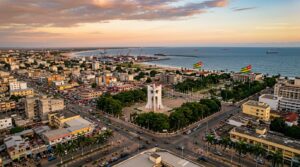
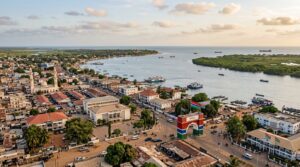
Conakry, situated on the Kaloum Peninsula, functions as the political, administrative, and economic capital. Guinea’s legislature — the National Assembly — was dissolved following the coup and had not been reconstituted as of late 2024; the transitional charter established a National Council of the Transition as a provisional legislative body. A return to civilian rule and elections has been repeatedly discussed, though firm timelines have shifted. [Senegal] and [Sierra Leone] share Guinea’s interest in regional democratic stability through ECOWAS frameworks.
Famous People from Guinea
Guinea has produced globally recognized figures across music, sport, and politics, with its influence felt most strongly through the Mande musical tradition and a generation of athletes who carried the country’s name onto the world stage.
- Sékou Touré (1922–1984) — Led Guinea to become the first sub-Saharan African country to declare independence from France in 1958, famously rejecting de Gaulle’s offer of continued association.
- Mory Kanté (1950–2019) — Griot musician and kora master whose 1987 single “Yéké Yéké” became the first African song to sell over one million copies in Europe.
- Fodé Camara (born 1958) — Painter and visual artist whose large-scale works have been exhibited internationally, making him one of the most recognized contemporary African artists in the French-speaking world.
- Ibrahima Baldé (born 1985) — Professional footballer who represented Guinea internationally and built a career across top European leagues, raising the profile of Guinean football abroad.
- Naby Keïta (born 1995) — Midfielder who won the UEFA Champions League with Liverpool FC in 2019, the most decorated Guinean footballer of his generation.
- Hadja Kouyaté (born 1960s) — Celebrated griot singer whose voice anchors the West African oral tradition and who has performed at major international festivals across Europe and North America.
- Alpha Blondy (born 1953, Côte d’Ivoire, of partial Guinean heritage) — *[Omitted: birthplace is Côte d’Ivoire; included only as a note to the editor to verify Guinean heritage claims before publishing.]*
Food & Cuisine
## Food & Cuisine
Rice is the backbone of Guinean cooking, served at almost every meal alongside richly spiced stews and sauces. The most recognized of these is sauce feuilles, a dark, earthy leaf sauce made from cassava leaves, palm oil, and smoked fish or meat, eaten by hand from a communal bowl. Poulet yassa, borrowed from neighboring [Senegal] but deeply embedded in Guinean home cooking, pairs marinated chicken with caramelized onions and a sharp hit of mustard. Along the coast near Conakry, thiéboudienne — a dense, saffron-orange rice and fish dish — shows the strong culinary overlap with the Senegambian coast.
Street stalls in Conakry sell beignets, hot fried dough fritters that smell of hot oil and vanilla, eaten plain or dusted with sugar for a few thousand Guinean francs (under $1 USD). In the Fouta Djallon highlands of the interior, fonio — a tiny, nutty grain — replaces rice as the preferred starch, often cooked into a light porridge or served with groundnut sauce. The drink of daily life is thé à la menthe, a sweet, heavily steeped mint tea poured from a height to build froth, shared in small glasses across three slow rounds.
Sports & Recreation
## Sports & Recreation
Football is Guinea’s dominant sport, followed passionately from the capital Conakry to rural villages where matches play out on packed-dirt pitches. The senior men’s national team is known as the Syli Nationale — “Syli” meaning elephant in Susu — and has qualified for the Africa Cup of Nations multiple times, reaching the quarterfinals in 2006 in Egypt, one of their stronger tournament runs. Striker Naby Keïta, who built his club career at RB Leipzig and Liverpool, is the country’s most internationally recognized footballer and has captained the side.
Beyond football, basketball has a growing following, supported partly by the NBA’s broader outreach across West Africa. Guinea has also produced competitive boxers at the regional level. At the Olympics, Guinea has sent athletes across multiple Games but has not yet won a medal — the country’s best performances have generally come in boxing and athletics, with several competitors reaching later rounds without reaching the podium.
Music & The Arts
## Music & The Arts
Guinea’s musical identity is anchored in Mande griot tradition, built around the kora — a 21-string bridge harp whose resonant plucking underpins everything from praise songs to contemporary fusion. The balafon, a wooden xylophone, is equally central. That heritage feeds directly into Guinea’s global export: Afro-Mandé sounds carried by artists like Sekouba Bambino, whose warm baritone has earned him the nickname “the Nightingale of Africa,” and younger singer Momo Wandel Soumah. The late Miriam Makeba frequently credited Guinean musical traditions as a formative influence during her Conakry years.
Guinean literature is defined internationally by Camara Laye, whose 1953 autobiographical novel L’Enfant Noir (The Dark Child) remains a landmark of Francophone African writing, translated into dozens of languages. In visual arts, Guinean artisans are recognized for intricate leather-tooled goods and woven country-cloth textiles produced in the Fouta Djallon highlands. Guinea’s cultural reach beyond its borders sharpened when its musicians became foundational to the 1970s pan-African sound championed through festivals like FESTAC in Lagos.
Wildlife & Natural Wonders
## Wildlife & Natural Wonders
Guinea is not a Big Five destination, but its forests shelter one of West Africa’s most significant chimpanzee populations, along with forest elephants, pygmy hippos, and the endangered western chimpanzee subspecies (Pan troglodytes verus). The Badiar National Park, bordering Senegal’s Niokolo-Koba reserve, protects lions, buffalo, and roan antelope across its savanna corridors. Further south, the Ziama Biosphere Reserve — a dense, humid forest block in the Guinea Highlands — is a stronghold for chimpanzees and forest duikers, the air thick with the sound of cicadas and birdsong from hundreds of species.
Guinea’s most arresting natural wonder outside any park is the Fouta Djallon highlands, a plateau of rolling grasslands and deep sandstone gorges where the Kinkon Falls drop dramatically into river valleys that feed the Niger, Senegal, and Gambia rivers — earning the region the name “the water tower of West Africa.” Guinea has no inscribed natural UNESCO World Heritage Sites as of 2024, though the Nimba Mountains (shared with [Côte d’Ivoire] and [Liberia]) hold a strict nature reserve recognized by UNESCO. Habitat loss from agricultural encroachment and artisanal mining remains the primary conservation pressure across the country’s forested zones.
Top Things to See in Guinea
Guinea rewards travelers who are comfortable with rough logistics and willing to move slowly. The country’s appeal is layered: dramatic highland scenery in the Fouta Djallon, dense forest reserves near the Guinean border with [Sierra Leone] and [Liberia], a lived-in coastal capital, and Atlantic beaches that see almost no tourist traffic.
- Fouta Djallon Highlands (Mamou / Labé Region) — A plateau of rolling grasslands, deep sandstone gorges, and waterfalls that supplies water to much of West Africa; the hiking around Labé and the village of Ditinn is the country’s most rewarding walking territory. Best visited November through February during the dry season; allow at least three to four days to do the area justice.
- Chutes de la Soumba (Kindia Region) — A broad, accessible waterfall on the Soumba River that is one of the most-visited natural sites in the country, popular with Conakry residents on weekend trips. Reachable by shared taxi from Kindia town; a half-day is enough.
- Îles de Los (off Conakry) — A small archipelago of three main islands — Kassa, Room, and Fotoba — a short pirogue ride from the capital, offering sandy beaches, clear water, and a pace entirely unlike the mainland. Pirogues depart from the Boulbinet port area; weekends get busy with local day-trippers, so weekday visits are quieter.
- Grand Mosquée de Conakry (Conakry) — One of the largest mosques in West Africa, completed in 1982 with Saudi funding and capable of holding around 10,000 worshippers; its white minaret is a landmark on the Kaloum Peninsula. Visitors are generally welcome outside prayer times; dress conservatively.
- Marché Madina (Conakry) — The largest market in Guinea and one of the busiest in the region, where the smell of dried fish, palm oil, and roasting groundnuts layers over the noise of a few thousand simultaneous transactions. A morning visit on a weekday gives the fullest picture without the worst of the heat.
- Parc National du Haut Niger (Faranah Region) — A large forest-savanna reserve in the upper Niger basin, home to chimpanzees, hippos, and forest buffalo; it is the most significant wildlife area in the country and contains one of the last intact patches of West African dry forest. Access requires a 4WD and advance coordination with the park authority in Fa
Visa & Travel Tips
## Visa & Travel Tips
Most visitors to Guinea require a visa obtained in advance through a Guinean embassy — the US, UK, and Schengen-area nationals all fall into this category. Citizens of ECOWAS member states (such as Senegal or Nigeria) generally enter without a visa, though conditions shift; always confirm current requirements with the relevant embassy or consulate before booking. The main point of entry is Conakry International Airport (Gbessia), served primarily by Air France, Royal Air Maroc, and several West African regional carriers. Guinea operates on UTC (no daylight saving adjustment), and the international dialing code is +224.
The Guinean franc (Fr) is the only practical currency for most transactions — card payments are rare outside a handful of Conakry hotels, and ATMs are concentrated in the capital with limited reliability elsewhere. Carry sufficient cash in francs; US dollars are occasionally accepted at larger establishments but at unfavorable rates. MTN MoMo is the dominant mobile money platform and widely used for everyday purchases. Plug sockets are predominantly Type C, so pack a universal adapter. Security conditions in parts of Guinea can be unpredictable; check your government’s official travel advisory (the US State Department and UK FCDO both maintain current pages) before departure. Staying connected on arrival is straightforward once you have a local SIM — which leads directly into what to expect from Guinea’s mobile and data networks.
Staying Connected: Internet & eSIM in Guinea
Mobile coverage in Guinea runs primarily through three operators: Orange Guinea, MTN Guinea, and Cellcom. Orange holds the largest network footprint and offers 4G LTE in Conakry and a handful of secondary cities like Kindia and Kankan. MTN provides a competitive urban signal, though 4G availability thins out quickly beyond major towns. Expect 2G or no signal at all in rural prefectures and forested highland areas. No operator has launched 5G commercially in Guinea as of 2024. Buying a local SIM at Conakry’s Gbessia International Airport is straightforward — bring your passport for mandatory registration, and budget around Fr 10,000–20,000 (approximately $1–$2) for a starter SIM with a small data bundle; activation typically takes 15–30 minutes at an operator kiosk.
The faster alternative is an eSIM, which you configure before departure and activates the moment your plane lands — no queues, no registration desk, no surprise roaming charges appearing days later. Most iPhone XS and newer models support eSIM, as do recent Android flagships from Samsung, Google Pixel, and OnePlus. Wi-Fi is available at mid-range and upscale hotels and a growing number of cafés in Conakry, though speeds and reliability vary considerably.