Ivory Coast
Ivory Coast at a Glance
Ivory Coast sits on the southern edge of West Africa, where the Gulf of Guinea’s warm Atlantic surf meets a coastal strip of lagoons before the land rises into dense rainforest and savanna. The country’s official name is République de Côte d’Ivoire; its designated capital is Yamoussoukro, though the commercial hub Abidjan handles most government functions in practice. Population stands at approximately 31.7 million, spread across a land area of 322,463 km² — roughly the size of New Mexico.
The country is the world’s largest producer of cacao, supplying around 40% of the global crop, which means the faint fermented sweetness of drying beans is a genuine sensory backdrop in farming regions like the southwest. Beyond agriculture, Ivory Coast has a serious football culture — the generation that included Didier Drogba turned the national team, Les Éléphants, into a continental force — and Abidjan’s Plateau district is one of West Africa’s more architecturally ambitious skylines. Visitors who assume the country is simply a transit point between [Senegal] and [Ghana] tend to miss the weekly zouglou music scene in Treichville and the extraordinary Basilica of Our Lady of Peace in Yamoussoukro, which rewards anyone willing to look past the obvious.
Geography & Climate
Ivory Coast sits in the southern curve of West Africa, bordered by Liberia and Guinea to the west, Mali and Burkina Faso to the north, and Ghana to the east. Its southern edge opens onto roughly 515 kilometers of Atlantic coastline along the Gulf of Guinea. The country covers 322,463 square kilometers — about the size of New Mexico — and sits at approximately 8°N, 5°W.
The terrain rises from a narrow coastal strip of lagoons and sandbars into a broad interior plateau averaging around 250–500 meters. Forests thicken in the southwest, where the Man region reaches toward the Nimba Range near the Guinean border, with peaks climbing above 1,700 meters. The Sassandra, Bandama, and Comoé rivers cut south through the plateau to the sea, shaping both agriculture and transport.
Climate divides roughly along a north-south axis. The south runs on a humid equatorial pattern with two rainy seasons: the main one from April to July, a shorter one from October to November, and dry spells in between. The north follows a single rainy season from June to September, then a long dry stretch when the harmattan blows in from the Sahara — a wind that carries fine reddish dust and leaves a faint mineral taste on the lips. Flooding is a recurring hazard in low-lying coastal areas and along river valleys during peak rains.
A Brief History of Ivory Coast
Before European contact, the territory now called Ivory Coast was home to several distinct polities, most notably the Kong Empire, a Dyula-founded Muslim trading state established in the early 18th century in the north. The Baoulé people, led by Queen Abla Pokou — who, according to oral tradition, sacrificed her son to cross the Comoé River — migrated into the central region around the same period, establishing communities that persist today. Trade in gold, kola nuts, and enslaved people connected these societies to broader trans-Saharan and Atlantic networks.
France began asserting control over the coastal region through treaties in the 1840s and declared Ivory Coast a formal colony in 1893. French administration reorganized land tenure, imposed forced labor, and expanded cocoa and coffee cultivation — crops that still anchor the economy. The colonial capital was established at Grand-Bassam before moving eventually to Abidjan. Félix Houphouët-Boigny, a physician and planter who had served in the French National Assembly, became the dominant independence figure, steering the country to independence on August 7, 1960 through negotiation rather than armed struggle.
Houphouët-Boigny governed until his death in 1993, presiding over relative prosperity but suppressing political opposition. The decades that followed were turbulent: a military coup in 1999, then a civil war beginning in 2002 that split the country between government-held south and rebel-held north. The election crisis of 2010-2011, when incumbent Laurent Gbagbo refused to accept results recognizing Alassane Ouattara’s victory, ended with Gbagbo’s arrest and Ouattara taking office.
Culture, Religion & Daily Life
## Culture, Religion & Daily Life
Ivory Coast’s 31.7 million people practice a mix of Islam (roughly 42%), Christianity (around 34%), and indigenous belief systems that often coexist within the same family. Muslims are concentrated largely in the north, where Sunni practice predominates; Catholics and Protestants are more common in the south and among urban communities in Abidjan.
French is the official language and the medium of government, education, and national media, but it shares daily space with Dioula — a Mande trade language that functions as a practical lingua franca across market stalls and bus stations nationwide. Linguists count approximately 78 indigenous languages spoken across the country, reflecting the presence of major ethnic communities including the Baoulé, the Bété, and the Dioula peoples. At a busy market like the Marché de Cocody in Abidjan, you’ll hear three or four languages layered in a single transaction: a price negotiated in Dioula, a receipt written in French, pleasantries exchanged in Baoulé.
The Fête Nationale on August 7 marks independence from France and draws parades, concerts, and family gatherings across the country. It is one of the few occasions when Ivorians from different regions and faiths tend to celebrate in the same public squares, sharing grilled alloco — fried plantain served with chili sauce — from roadside vendors well into the evening.
Economy & Industry
## Economy & Industry
Ivory Coast holds the largest economy in the West African Economic and Monetary Union (WAEMU), with a GDP of around $70 billion. The country uses the West African CFA franc (Fr), pegged to the euro and trading at approximately 600 Fr to the dollar in 2025. That stability has made Abidjan one of the continent’s more predictable environments for foreign investment.
Agriculture remains the backbone. Ivory Coast produces roughly 40% of the world’s cocoa, and the Conseil Café-Cacao regulates the sector from farm gate to export terminal. Cashews, rubber, and palm oil round out a commodity portfolio that keeps the port of Abidjan — the busiest in the region — in near-constant motion. The smell of drying cocoa beans is a fixture of the interior towns around Yamoussoukro and Daloa. Beyond agriculture, a growing construction and services sector anchors the formal urban economy, with Abidjan’s skyline expanding visibly each year.
Ivory Coast is a member of both ECOWAS and the African Continental Free Trade Area (AfCFTA), giving exporters preferential access across much of the continent. The most significant forward-looking development is the ongoing expansion of the Abidjan Metro (Line 1), a $1.4 billion urban rail project expected to reshape commuting in a city of roughly five million people and signal the country’s infrastructure ambitions to regional investors.
People & Demographics
## People & Demographics
Ivory Coast has a population of approximately 31.7 million, spread across a land area that gives it a density of around 100 people per square kilometer. The population skews young — the median age is estimated at roughly 19 to 20 years, with children and teenagers making up a substantial share of the total. Around half the population lives in urban areas, with Abidjan, the commercial capital, home to an estimated 5 to 6 million people in its greater metro area. The political capital, Yamoussoukro, is far smaller, with a city population of perhaps 300,000 to 400,000.
French is the official language, though dozens of local languages are spoken daily, including Dioula, which functions as a widely understood trade language in markets across the country. Large Ivorian diaspora communities are concentrated in France and other Francophone West African countries, particularly [Burkina Faso] and [Mali]. Life expectancy sits at approximately 59 to 60 years, and adult literacy is estimated at around 47 to 50 percent, with a notable gap between men and women.
Government & Political System
## Government & Political System
Ivory Coast is a presidential republic, where the president serves as both head of state and head of government. The current president holds executive authority and appoints the prime minister, who manages day-to-day government operations. The legislature is bicameral, consisting of the National Assembly (the lower house) and the Senate, which was reestablished under the 2016 constitution after a decades-long absence.
Yamoussoukro is the official political capital — home to the National Assembly building and formal government institutions — though Abidjan functions as the administrative and economic center where most ministries operate in practice. Political power in Ivory Coast has shifted through a combination of contested elections and negotiated transitions since the post-2010 civil conflict; recent electoral cycles have proceeded under significant opposition tension, with debates over term limits shaping the political landscape. [Nigeria] and [Ghana] offer useful regional comparisons for West African presidential systems.
Famous People from Ivory Coast
Ivory Coast punches well above its weight in global cultural output, producing world-class footballers, acclaimed authors, and musicians whose influence stretches across francophone Africa and beyond.
- Didier Drogba (1978–) — retired Chelsea and Ivory Coast striker widely regarded as one of the greatest African footballers of all time, credited with helping broker a ceasefire during the 2002–2007 civil war.
- Ahmadou Kourouma (1927–2003) — novelist whose debut Les Soleils des indépendances (1968) reshaped francophone African literature by bending French syntax to reflect Malinké oral tradition.
- Alpha Blondy (1953–) — reggae singer whose Dioula- and French-language albums, including Cocody Rock (1984), made him one of the most recognized African reggae artists internationally.
- Yaya Touré (1983–) — midfielder who won four consecutive Premier League titles with Manchester City and was named African Footballer of the Year four times between 2011 and 2014.
- Françoise Remarck (1967–) — former Minister of Culture and Francophonie who became one of the continent’s most prominent advocates for African creative industries and intellectual property rights.
- Gnoan Roger M’Bala (1942–) — film director whose Adanggaman (2000) brought the story of intra-African involvement in the slave trade to international festival screens, winning prizes at FESPACO.
Food & Cuisine
## Food & Cuisine
Rice is the staple in southern Ivory Coast, typically served alongside a sauce — most often sauce graine, a thick, rust-colored palm nut stew cooked with fish or chicken that coats the back of a spoon like gravy. Attiéké, fermented cassava couscous with a faintly sour smell and granular texture, is equally ubiquitous and pairs well with grilled fish (poisson braisé) straight off a charcoal grill. Kedjenou is a slow-braised chicken or guinea fowl dish sealed in a clay pot with vegetables and mild spices, a specialty of the Baoulé people of the interior. At roadside stalls in Abidjan, aloco — fried ripe plantain dusted with chili — is the snack you’ll encounter most, sold in small paper cones for around $0.50 (250 CFA francs).
In the predominantly Muslim north, millet and sorghum replace rice as the base starch, and pork disappears from menus entirely. Across the country, bangui (palm wine, tapped fresh each morning) is the traditional drink of choice in villages, while Abidjan’s café culture runs on locally grown Ivorian robusta coffee, one of the world’s largest exports.
Sports & Recreation
## Sports & Recreation
Football is the dominant sport in Ivory Coast, and the national men’s team — the Elephants — is one of the continent’s most decorated sides. They won the Africa Cup of Nations in 1992 and 2015, and reached the knockout rounds of the 2006 and 2010 FIFA World Cups. The generation that produced Didier Drogba, the Chelsea and Marseille striker who retired in 2018, remains the most celebrated in Ivorian sporting memory; Drogba’s name still draws genuine reverence in Abidjan’s street-side maquis bars when old matches replay on screen.
Basketball has grown steadily as a second sport, partly driven by the NBA’s African outreach programs and a handful of Ivorian players competing in European leagues. At the Olympics, Ivory Coast has won a small number of medals — around three, mostly in boxing and sprinting — with sprinter Murielle Ahouré, a two-time World Championship silver medalist in the 60 meters, being the country’s most prominent track athlete.
Music & The Arts
## Music & The Arts
Ivory Coast is the birthplace of coupé-décalé, a percussive, brass-laced dance genre that erupted in Paris in the early 2000s and spread across Francophone Africa. DJ Arafat, who died in 2019, remains its defining figure — his track “Dosabado” still fills dancefloors from Abidjan to Dakar. More recently, Ivorian artists have folded into the broader afrobeats current; Suspect 95 and Kerozen carry the national sound into streaming playlists globally. Beneath the contemporary scene, the djembe and the balafon — a wooden xylophone whose resonant thud you feel in the chest before you hear it — anchor traditional Mande and Senufo musical ceremonies in the north.
In literature, novelist Ahmadou Kourouma reshaped Francophone African writing with Les Soleils des Indépendances (1968), bending French syntax to Malinké rhythms. Ivorian visual culture is anchored in the painted wooden masks and hand-woven kente-adjacent cloth of the Baoulé and Senufo peoples, whose work appears in major ethnographic collections worldwide. The country’s cultural reach got a formal stage when Abidjan hosted the Masa festival — the Marché des Arts du Spectacle Africain — drawing theater and music professionals from across the continent.
Wildlife & Natural Wonders
## Wildlife & Natural Wonders
Ivory Coast’s flagship protected area is Taï National Park, a 3,300 sq km block of primary rainforest in the southwest that UNESCO designated a World Heritage Site in 1982 — one of the last significant tracts of Upper Guinean forest remaining in West Africa. Taï is best known for its wild chimpanzees, studied continuously since the 1970s, which use stone and wooden tools to crack open nuts, a behavior documented here before almost anywhere else. Comoé National Park, in the northeast, covers around 11,500 sq km and shelters lions and a small, isolated population of hippos along the Comoé River.
Ivory Coast is not a Big Five destination, but its forests hold forest elephants, leopards, and over 1,300 bird species, making it a serious draw for birders. The country’s most striking natural wonder outside the parks is the Man region’s Mount Nimba, whose forested slopes straddle the borders with [Guinea] and [Liberia] and harbor the rare viviparous toad. Habitat loss from cocoa farming and illegal logging remains the primary conservation pressure across the southern forest zone, steadily shrinking the range of species that depend on intact canopy cover.
Top Things to See in Ivory Coast
Ivory Coast suits travelers who want variety without long overland hauls: a working port city with genuine street food and nightlife, a purpose-built capital with surreal religious architecture, forest reserves with chimpanzees, and a coastline of lagoons and surf breaks — all within a country roughly the size of New Mexico.
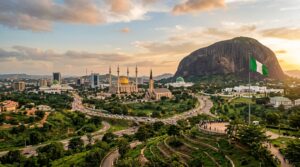
- Basilique Notre-Dame de la Paix (Yamoussoukro) — The largest church by volume in the world, consecrated in 1990, its dome modeled on St. Peter’s in Rome but taller; the marble floors and stained glass alone justify the visit. Best visited on a weekday morning when tour groups are thin; allow two to three hours including the grounds.
- Parc National de Taï (Southwest Region) — A UNESCO World Heritage rainforest and one of West Africa’s last major primary forests, home to habituated western chimpanzees and pygmy hippos. The dry season (November–March) makes trails passable; the research station near Taï town arranges guided forest walks.
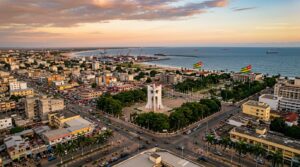
- Plateau District (Abidjan) — The commercial center of Abidjan, where the skyline reflects off the Ébrié Lagoon and the Marché de Cocody sells everything from kola nuts to Dutch wax fabric. A half-day wander covers the waterfront, the Cathédrale Saint-Paul, and a lunch stop for attiéké and grilled fish at a maquis.
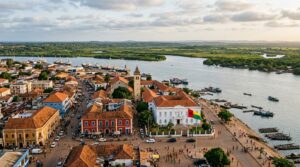
- Grand-Bassam (Southeast Coast) — A UNESCO-listed colonial town of faded French administrative buildings set between the ocean and a lagoon, about 40 km east of Abidjan. Weekends draw Abidjanais to the beach; the historic quarter is quieter and walkable in under two hours.
- Parc National de la Comoé (Northeast Region) — The largest protected area in West Africa by area, covering savanna, gallery forest, and the Comoé River, with lions, elephants, and over 500 bird species. Access is easiest from Bouna; the park reopened to tourism after a long closure, so confirm current access conditions before traveling.
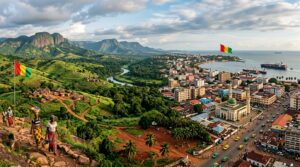
- Man and the Dix-Huit Montagnes Region (West) — A highland area of forested peaks, rope bridges, and the weekly market at Man where Dan community traders sell carved masks and hand-woven cloth. The cooler dry season (November–February) is ideal for hiking toward Mont Tonkoui, the country’s highest point at around 1,752 m.
- Assinie-Mafia (Southeast Coast
Visa & Travel Tips
## Visa & Travel Tips
Ivory Coast operates a mixed entry system: ECOWAS nationals (including Ghanaians and Senegalese) enter without a visa, while US and UK citizens can obtain a visa on arrival at Félix Houphouët-Boigny International Airport in Abidjan — the country’s main hub, served by Air Côte d’Ivoire, Air France, Ethiopian Airlines, and Turkish Airlines. EU citizens’ requirements vary by nationality. Because visa rules shift with little notice, confirm current requirements with the Ivorian embassy or consulate in your country before booking. The airport sits roughly 16 km from the Plateau business district; shared taxis and app-based rides are both available at the exit.
The West African CFA franc (Fr) is pegged to the euro, making exchange rates predictable. Cards work at ATMs in Abidjan and larger towns like Bouaké and San-Pédro, but cash remains king outside urban centers; USD is rarely accepted directly. MTN MoMo is the dominant mobile-money platform and is useful for everyday purchases where a SIM card is in hand. Ivory Coast runs on UTC (no daylight saving), and the international dialing code is +225. Bring a Type C or E plug adapter. Check your government’s official travel advisory before departure — the north and west borders warrant particular attention. Getting a local SIM sorted early makes everything from navigation to mobile payments considerably smoother, which leads directly into connectivity options.
Staying Connected: Internet & eSIM in Ivory Coast
Mobile coverage in Ivory Coast is anchored by three main operators: Orange CI, MTN Ivory Coast, and Moov Africa. Orange and MTN both offer solid 4G LTE across Abidjan and other major cities such as Bouaké and San-Pédro. Rural coverage thins out considerably once you leave the main corridors — expect 2G or no signal in remote agricultural zones. 5G is not yet commercially available.
Picking up a local SIM at Félix-Houphouët-Boigny International Airport is straightforward: bring your passport for mandatory registration, and a starter SIM with a small data bundle typically costs around Fr 1,000–2,000 (roughly $1.60–$3.30 USD). Activation usually completes within the hour, though airport kiosks can have queues on busy arrival days. An eSIM skips all of that — you configure it before your flight lands, pay a fixed rate (Datamax starts at $4.50 per GB), and your phone connects automatically on arrival with no roaming surprises; most iPhone XS and newer models and recent Android flagships from Samsung and Google support eSIM natively. Hotels and cafés in Abidjan reliably offer Wi-Fi, with coverage patchier in smaller cities.