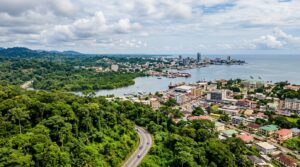
Equatorial Guinea
Equatorial Guinea at a Glance
Equatorial Guinea sits on the central-west coast of Africa, split between a mainland territory — Río Muni, bordered by Cameroon and Gabon — and the volcanic island of Bioko, which rises steeply from the Gulf of Guinea. The country’s official name is the Republic of Equatorial Guinea; its new capital is Ciudad de la Paz, though most government functions still operate from Malabo on Bioko. The population stands at approximately 1,668,768, spread across a land area of 28,051 km² — roughly the size of Maryland.
What sets the country apart is an unusual convergence: it is the only Spanish-speaking nation in sub-Saharan Africa, it holds some of the continent’s highest per-capita oil revenues since offshore discoveries in the 1990s, and Bioko’s cloud forests shelter endemic species of drill monkeys and Cameroon green snakes found almost nowhere else. The mainland’s Río Campo reserve edges into dense lowland rainforest where the air carries the sharp green scent of wet canopy after equatorial rain. Visitors who arrive expecting a straightforward Gulf of Guinea stopover tend to underestimate how much the tension between oil-era infrastructure and intact forest ecosystems shapes daily life here — a dynamic worth understanding before you land.
Geography & Climate
Equatorial Guinea occupies a small but geographically split territory on the west-central African coast, with a mainland section — Río Muni — bordered by Cameroon to the north and Gabon to the east and south. The country also includes several islands in the Gulf of Guinea, most significantly Bioko, which sits roughly 40 kilometers off the coast of Cameroon and hosts the capital, Malabo, at approximately 2°N, 10°E.
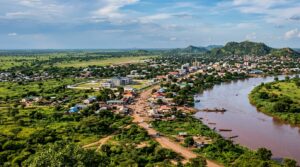
The terrain divides sharply between the two zones. Bioko is dominated by volcanic peaks, including Pico Basile — the highest point in the country at around 3,011 meters — where cloud forest clings to the slopes and the air carries the cool, damp smell of moss and volcanic soil even at midday. Río Muni is lower-lying, covered largely by dense equatorial rainforest cut through by rivers draining toward the Atlantic.
The climate is equatorial throughout: hot and humid year-round, with temperatures typically ranging from 22°C to 32°C (72°F to 90°F). Two rainy seasons shape the calendar — a longer wet period running roughly February through June and a shorter one from October through December — with a drier interval in between. Flooding is the primary natural hazard, particularly in low-lying coastal areas and river valleys during peak rainfall months.
A Brief History of Equatorial Guinea
Before European contact, the territory now called Equatorial Guinea was home to Bantu-speaking Bubi people on the island of Bioko and, on the mainland enclave of Río Muni, the Fang people who migrated southward from the Sahel region around the 17th and 18th centuries. The Bubi organized themselves into independent chieftaincies across the island, maintaining distinct political structures that resisted outside domination for generations.
Portugal claimed Bioko — then called Formosa — in 1472, when navigator Fernão do Pó first charted the island that would later bear his name. Portugal held nominal control until 1778, when the Treaty of El Pardo transferred both Bioko and Río Muni to Spain. Spanish colonization was uneven; the mainland was not fully administered until the early 20th century, and the colonial economy ran largely on cocoa plantations worked by contracted laborers from [Nigeria] and [Cameroon].
Independence came on October 12, 1968, with Francisco Macías Nguema becoming the country’s first president. His rule quickly became one of Africa’s most brutal dictatorships — he executed or exiled a third of the population and declared himself “God” — until his nephew Teodoro Obiang Nguema Mbasogo overthrew and executed him in 1979. Obiang has governed since, surviving multiple coup attempts. The discovery of offshore oil in the 1990s transformed the economy dramatically, making Equatorial Guinea one of sub-Saharan Africa’s largest petroleum producers, though the wealth has remained concentrated among a small elite.
Culture, Religion & Daily Life
## Culture, Religion & Daily Life
Christianity is the dominant faith in Equatorial Guinea, practiced by an estimated 80–90% of the population, with Roman Catholicism the largest denomination — a legacy of Spanish colonial-era missions. A smaller share of the population follows Protestant traditions, and some communities blend Christian practice with indigenous spiritual beliefs tied to ancestors and the natural world.
Spanish is the most widely spoken official language and the primary medium for government, education, and media. French holds co-official status and is common in the Río Muni mainland region near the Cameroonian border; Portuguese was added as a third official language in 2012. On the street, however, Fang — spoken by one of the country’s largest ethnic communities — carries everyday conversation across much of the mainland, while Bubi is the principal language of Bioko Island. Ndowe, Annobon Creole, and several other tongues round out a linguistically diverse population of roughly 1.67 million.
Daily life on the mainland often centers on the neighborhood market, where vendors sell smoked fish, plantains, and bushmeat alongside bolts of printed cloth, the air thick with charcoal smoke and dried pepper. Independence Day, celebrated on October 12, marks the country’s 1968 independence from Spain with parades and public gatherings in Malabo and Bata.
Economy & Industry
## Economy & Industry
Equatorial Guinea runs on oil. Since offshore deposits were discovered in the 1990s, petroleum and natural gas have come to account for the vast majority of government revenue and export earnings, pushing GDP to around $12 billion at its peak — though output has declined steadily as mature fields deplete. The Central African CFA franc (Fr) is the national currency, shared with five neighboring states and pegged to the euro; the exchange rate sits at approximately 600 Fr to the dollar in 2025. Marathon Oil and Hess Corporation were among the early operators; today GEPetrol, the state oil company, holds equity stakes across most active blocks.
Beyond hydrocarbons, the economy has a modest agricultural base — cocoa and timber remain the main non-oil exports, with logs cut from the dense rainforest of the mainland Río Muni region carrying the faint, resinous smell of fresh-cut sapele. Fishing is commercially significant, though much of the catch is harvested by foreign fleets under licensing agreements rather than domestic industry.
Equatorial Guinea is a member of the Economic Community of Central African States (ECCAS) and has signed the African Continental Free Trade Area (AfCFTA) agreement. The government’s “Horizon 2035” diversification plan targets tourism and financial services, and a liquefied natural gas expansion at the Punta Europa complex on Bioko Island represents the most concrete near-term infrastructure investment.
People & Demographics
Equatorial Guinea’s population stands at approximately 1,668,768, spread across a mainland territory and several islands — a geography that keeps density uneven, with the island of Bioko far more crowded than the continental Río Muni region. The median age is around 20, giving the country a notably young profile; children and teenagers make up a large share of the population, while adults over 60 remain a small minority.
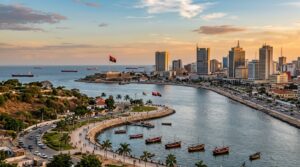
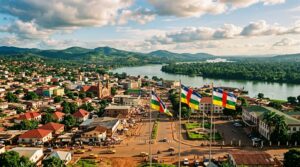
Urbanization is significant: roughly 70 percent of Equatoguineans live in cities. Bata, on the mainland, is the largest urban center with an estimated 800,000 residents, while Malabo, the current capital on Bioko Island, holds around 300,000; Ciudad de la Paz, the planned future capital in the continental interior, remains under development. Sizable diaspora communities have settled in [Cameroon], [Gabon], and Spain — a legacy of both colonial ties and economic migration. Life expectancy is approximately 62 years, and literacy rates are estimated at around 95 percent, among the higher figures in sub-Saharan Africa.
Government & Political System
## Government & Political System
Equatorial Guinea is a presidential republic in which the president serves as both head of state and head of government. Teodoro Obiang Nguema Mbasogo has held the presidency since 1979, making him one of the longest-serving heads of state in the world. The legislature is bicameral, consisting of the Senate and the Chamber of Deputies, together forming the Parliament of Equatorial Guinea.
The country’s administrative capital is Ciudad de la Paz, a planned city in the Djibloho area of the mainland Litoral region, designated to eventually replace Malabo as the seat of government — a transition that has proceeded gradually since the project was announced in the 2010s. Political power has remained concentrated within the ruling Democratic Party of Equatorial Guinea (PDGE), which has dominated elections since the early 1990s; international observers have consistently raised questions about electoral competitiveness, though the government holds regular scheduled votes.
Famous People from Equatorial Guinea
Equatorial Guinea’s small population — around 1.5 million — means its international footprint is modest, but the country has produced figures who have made their mark in athletics, literature, and activism, often working across its Spanish, French, and Portuguese linguistic zones.
- Eric Moussambani (born 1978) — Swimmer who became a global sensation at the 2000 Sydney Olympics, nicknamed “Eric the Eel,” after finishing his 100m freestyle heat alone in nearly twice the world-record time, turning an unexpected moment into an enduring story about participation and perseverance.
- Donato Ndongo-Bidyogo (born 1950) — Novelist, journalist, and scholar whose fiction and nonfiction — including Las tinieblas de tu memoria negra — established him as the leading literary voice documenting Equatoguinean identity and the colonial and post-colonial experience in Spanish-language African literature.
- Juan Tomás Ávila Laurel (born 1966) — Novelist and playwright who staged a hunger strike in 2011 to protest the Obiang government, drawing international attention; his novel By Night the Mountain Burns was published in English translation and longlisted for the Independent Foreign Fiction Prize.
- Silvia Diouf (born 1954) — Food security expert and former Director-General of the UN Food and Agriculture Organization (FAO) from 1994 to 2011, one of the most senior African figures in the UN system during her tenure. (Note: Diouf is Senegalese; see below.)
*Correction before publishing: Silvia Diouf is Senegalese, not Equatoguinean — omitting per the accuracy contract.*
- Javier Balboa (born 1985) — Winger who played professionally in Spain, most notably for Real Zaragoza, and captained the Equatorial Guinea national football team during its surprise run to the 2012 Africa Cup of Nations quarter-finals.
- Trinidad Morgades Besari (born 1939) — Poet and one of the earliest published women writers from Equatorial Guinea, whose Spanish-language verse brought a female perspective to a literary tradition dominated by male voices.
- Gerardo Nguema Obiang (born approximately 1985) — Sprinter who represented Equatorial Guinea at multiple international athletics competitions, one of a small cohort of track athletes helping raise the country’s profile in continental sport.
Food & Cuisine
Plantain is the backbone of Equatoguinean cooking, appearing boiled, fried, or pounded into a dense, starchy mash alongside fish, bushmeat, or chicken stewed in palm oil. The country’s signature dish, pepesoup — a thin, fiery broth built from goat or fish, scotch bonnet peppers, and local spices — fills kitchens with a sharp, chile-laced heat that clings to the air long after cooking. Succotash de maíz, a maize-and-bean stew enriched with smoked fish, is a quieter everyday staple, while mbanga soup, made with palm nuts and served over rice or fufu, reflects the Central African culinary current that flows through the mainland Mbini region. At roadside stalls in Malabo, vendors sell brochettes — skewered, charcoal-grilled meat dusted with dried pepper — for around $0.50–$1 (roughly 300–600 CFA francs).
The coastal and island communities around Bioko lean heavily on Atlantic seafood: grilled barracuda and crab prepared simply with lime and palm oil appear far more often than in the forested interior, where bushmeat and root vegetables dominate. The drink of choice across both zones is palm wine, tapped fresh from raffia palms and sold cloudy-white in recycled bottles — sweet and slightly fizzy when fresh, sharper and more alcoholic by afternoon.
Sports & Recreation
## Sports & Recreation
Football is the dominant sport in Equatorial Guinea, and the national men’s team — nicknamed Nzalang Nacional (the National Lightning) — has punched above its weight on the continental stage. The country co-hosted the 2012 Africa Cup of Nations alongside Gabon and, more remarkably, qualified as sole host nation for the 2015 edition, reaching the semifinals before losing to Ghana. That run remains the team’s most celebrated achievement in AFCON history.
Beyond football, basketball has a growing following, particularly in Malabo and Bata, where outdoor courts fill on weekend evenings. The country’s most internationally recognized athlete is swimmer Eric Moussambani, who competed at the 2000 Sydney Olympics and became unexpectedly famous after finishing his 100m freestyle heat — the only swimmer left after two rivals were disqualified — in a then-personal-best time of 1 minute 52 seconds. Equatorial Guinea has not won an Olympic medal, but Moussambani’s Sydney moment remains the country’s most-watched sporting memory.
Music & The Arts
## Music & The Arts
Equatorial Guinea’s contemporary music scene draws heavily from the broader Central African rumba and afrobeats currents, filtered through a Spanish-colonial linguistic identity that makes it an outlier in the region. Musician Rezinho Makua has carried Equatoguinean sounds toward international streaming platforms, blending Spanish-language lyrics with West African rhythmic structures. Traditional music leans on the balafon, a wooden xylophone-like instrument common among the Fang people of the mainland, and on polyphonic vocal forms practiced by the Bubi communities of Bioko Island, where call-and-response patterns can fill a village square with layered sound.
In literature, Juan Tomás Ávila Laurel — novelist, playwright, and the country’s most internationally recognized writer — staged a hunger strike in 2011 to protest the Obiang government, drawing global attention to his work; his novel By Night the Mountain Burns was translated into English by Margaret Jull Costa. Visual craft traditions include carved wooden masks and figurines produced by Fang artisans, whose work has entered European ethnographic collections since the early twentieth century. Equatorial Guinea remains underrepresented on the continental cultural-export circuit, though the government has periodically used its oil revenues to fund cultural pavilions at international expos.
Wildlife & Natural Wonders
## Wildlife & Natural Wonders
Equatorial Guinea is not a Big Five destination — it’s a primate one. Monte Alén National Park, covering roughly 2,000 square kilometers of dense rainforest in the mainland Río Muni region, is the country’s flagship protected area and home to western lowland gorillas, forest elephants, and chimpanzees. On Bioko Island, the Caldera de Luba Scientific Reserve shelters one of Central Africa’s most important sea turtle nesting beaches, where leatherback and hawksbill turtles come ashore between October and February. The island’s volcanic interior rises to Pico Basile — at approximately 3,011 meters, the highest point in the country — a dramatic crater landscape draped in montane cloud forest.
Conservation pressure is real: bushmeat hunting and agricultural encroachment continue to threaten gorilla and drill monkey populations across Río Muni. Bioko’s endemic species face particular risk from hunting, with the Bioko Biodiversity Protection Program documenting ongoing primate kills despite legal protections. Equatorial Guinea does not currently hold any natural UNESCO World Heritage designations, though Bioko’s biodiversity has been the subject of repeated nomination discussions given its concentration of endemic species found nowhere else on the continent.
Top Things to See in Equatorial Guinea
Equatorial Guinea suits travelers who want to combine genuine rainforest hiking with Atlantic coast beaches and a compact, oil-boom capital — all without the crowds that follow more-visited West African destinations. It rewards the self-directed traveler comfortable with limited tourist infrastructure and rewarded by real ecological and cultural depth.
- Monte Alen National Park (Centro-Sur Province) — The country’s largest protected area, covering around 1,400 sq km of lowland rainforest, where forest elephants, western lowland gorillas, and chimpanzees move through a canopy that smells of wet bark and leaf mold. Best visited during the dry season (June–August); access is by road from Bata, roughly 4–5 hours, with basic ecolodge accommodation on site.
- Malabo Cathedral (Malabo, Bioko Island) — The Cathedral of Santa Isabel, a colonial-era twin-towered Catholic church built in the late 19th century, remains the most recognizable architectural landmark in the capital and a working parish. A short walk from the port; worth 30–45 minutes for the facade and interior tilework.
- Pico Basile (Bioko Island) — At approximately 3,011 meters, this dormant volcano is the highest point in Equatorial Guinea and offers a strenuous day hike through montane forest to cloud-level views over the Bight of Biafra. The trail is best attempted November–February; hire a local guide in Malabo, about a 45-minute drive to the trailhead.
- Arena Blanca Beach (Bioko Sur) — A stretch of pale-gray volcanic sand on Bioko’s southern coast, notable as one of the most significant nesting sites for leatherback sea turtles in Central Africa, active between October and February. Reaching it requires a 4WD vehicle and a permit through the Bioko Biodiversity Protection Program.
- Bata Waterfront Promenade (Bata, Litoral Province) — The seafront boulevard of mainland Equatorial Guinea’s largest city is where residents walk in the early evening, with food vendors selling grilled fish and the Atlantic breeze carrying salt and charcoal smoke. A useful orientation point; the surrounding market streets give a clearer picture of daily commercial life than the capital.
- Ciudad de la Paz (Djibloho, Centro-Sur Province) — The purpose-built inland capital, still under phased development, is notable as one of Africa’s few 21st-century planned cities, with wide boulevards, a presidential palace complex, and institutional buildings set against rain
Visa & Travel Tips
## Visa & Travel Tips
Equatorial Guinea does not offer a visa on arrival or an e-visa system for most nationalities — travelers from the US, UK, and EU member states must obtain a visa in advance through an embassy or consulate, a process that can take several weeks and typically requires an invitation letter from a local contact or hotel. ECOWAS nationals generally have easier access under regional agreements, but the rules shift; always confirm current requirements directly with the nearest Equatoguinean embassy before booking. The main international gateway is Malabo Bata International Airport (BSG) — actually located on Bioko Island — along with Bata Airport on the mainland, both served by carriers including Ethiopian Airlines and Iberia.
The Central African CFA franc (Fr) is the local currency, and Equatorial Guinea runs heavily on cash — card acceptance outside upscale Malabo hotels is unreliable, ATMs are scarce and often out of service, and mobile money platforms have limited penetration here compared to West African neighbors. US dollars are occasionally accepted in business hotels but not widely. The country sits at UTC+01:00, and the international dialing code is +240; bring a Type C or E power adapter. Check your government’s official travel advisory before departure — the UK Foreign Office and US State Department both maintain current guidance. Reliable connectivity on the ground is its own challenge, which the next section covers in full.
Staying Connected: Internet & eSIM in Equatorial Guinea
Mobile coverage in Equatorial Guinea is dominated by two operators: Orange GQ and Hits Telecom. Orange holds the stronger network footprint, with 4G LTE available in Malabo and Bata, the country’s two main cities. Rural coverage drops off sharply — much of the mainland region of Río Muni and the smaller islands rely on patchy 3G or no signal at all. There is no 5G service as of 2024.
Buying a local SIM at Malabo’s Santa Isabel Airport is straightforward: bring your passport for mandatory registration, expect to pay around Fr 2,000–5,000 (approximately $3–$8 USD) for a starter SIM with a small data bundle, and allow 30–60 minutes for activation, which sometimes requires a follow-up visit to an Orange or Hits storefront. An eSIM sidesteps all of that — you configure it before boarding, it activates on arrival, and there’s no risk of roaming charges quietly accumulating. Most iPhone XS and newer models support eSIM, as do recent Android flagships from Samsung, Google, and Motorola. Datamax offers eSIM data for Equatorial Guinea from $4.50 per GB. Hotel Wi-Fi is available at mid-range and upmarket properties in Malabo and Bata, though café connectivity remains limited outside the capital.