Gabon
Gabon at a Glance
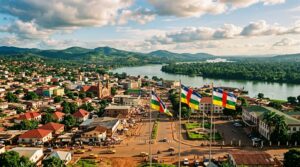
Gabon sits on the Atlantic coast of Central Africa, straddling the equator, with roughly 85 percent of its land covered by dense rainforest — one of the largest intact forest ecosystems remaining on Earth. The official name is the Gabonese Republic, with Libreville as the capital and a national population of approximately 2.5 million. At 267,668 km², the country is slightly larger than the United Kingdom, though far less densely settled.
The country is best known for three things: oil, which has funded a relatively high GDP per capita by regional standards; its extraordinary biodiversity, including forest elephants and western lowland gorillas protected across 13 national parks; and the presidency of Omar Bongo, who ruled for 41 years until his death in 2009, shaping modern Gabonese politics in ways that still echo today. Lopé National Park, a UNESCO World Heritage Site, contains both intact rainforest and ancient savanna with some of the continent’s oldest rock engravings. Travelers who assume Gabon is simply a petroleum state tend to miss that it has quietly protected more of its forest than almost any other tropical nation — a story worth understanding before you arrive.
Geography & Climate
Gabon sits on the Atlantic coast of Central Africa, straddling the equator just north of the Congo River basin. It shares land borders with Equatorial Guinea and Cameroon to the north and the Republic of the Congo to the east and south. At 267,668 square kilometers, it is a mid-sized country whose coastline stretches roughly 800 kilometers along the Gulf of Guinea.
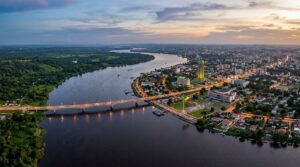
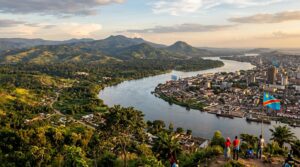
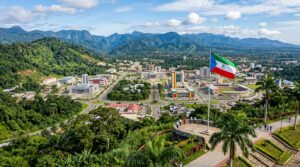
The interior is dominated by dense equatorial rainforest — some of the most intact on the continent — broken by low plateaus and the Crystal Mountains (Monts de Cristal) in the northwest, which rise to around 1,000 meters. The Ogooué River, Gabon’s principal waterway, drains most of the country before emptying into the Atlantic near Port-Gentil, threading through forest so thick that the canopy closes overhead and the air below smells permanently of wet bark and decomposing leaves.
Gabon’s climate is equatorial: hot and humid year-round, with temperatures typically between 22 °C and 32 °C (72–90 °F). Two wet seasons run roughly February–May and October–December, separated by shorter dry periods. The main dry season falls June–September, when coastal breezes offer some relief. Annual rainfall in Libreville averages around 2,500 mm. Flooding is the primary natural hazard, particularly along the Ogooué basin during peak rains.
A Brief History of Gabon
Before European contact, the territory now called Gabon was home to the Myènè-speaking peoples along the coast and, further inland, the Fang, who migrated southward from the Sahel region over several centuries. The Kingdom of Orungu, centered near the Ogooué River delta, became a significant coastal polity by the eighteenth century, controlling trade in ivory, beeswax, and — grimly — enslaved people moving through the Atlantic network.
France established a presence in 1839 when naval officer Édouard Bouët-Willaumez signed a treaty with Orungu ruler King Denis (Antchouwe Kowe Rapontchombo), and the territory was formally incorporated into French Equatorial Africa in 1910. The colonial period brought Catholic mission schools, forced labor on infrastructure projects, and the slow extraction of timber and minerals — a pattern that shaped the country’s economic structure long after independence.
Gabon became independent on August 17, 1960, with Léon M’ba serving as its first president. The transition was relatively peaceful compared to neighboring territories, though France retained deep economic and military ties — a relationship sometimes called Françafrique. M’ba’s successor, Omar Bongo, ruled from 1967 until his death in 2009, one of the longest tenures in African history. His son Ali Bongo then held power until August 2023, when a military junta ousted him following a disputed election, placing General Brice Oligui Nguema at the head of a transitional government. That coup marked the most abrupt transfer of power in Gabon’s post-independence history.
Culture, Religion & Daily Life
## Culture, Religion & Daily Life
Christianity is the dominant faith in Gabon, practiced by an estimated 80 percent of the population across Catholic, Protestant, and evangelical congregations. A smaller share — roughly 10 percent — follows Islam, concentrated largely in the north and among communities with ties to neighboring [Cameroon] and [Republic of the Congo]. Traditional animist beliefs, sometimes woven alongside Christian practice rather than standing apart from it, remain meaningful in rural areas.
French is the official language and the medium of education, government, and urban commerce, but Gabon’s roughly 2.5 million people speak around 40 indigenous Bantu languages at home. Fang, Myènè, and Nzebi are among the most widely spoken vernaculars, each carrying its own oral literature and ceremonial vocabulary.
Daily life in Libreville moves to the rhythm of the Marché Mont-Bouët, the capital’s sprawling central market, where vendors sell smoked fish, manioc leaves, and palm oil in the thick morning heat — the air carrying woodsmoke and overripe plantain in equal measure. Shoppers greet one another in French and Fang in the same breath, code-switching mid-sentence without pause. Gabon’s Independence Day falls in August, marking the country’s break from French administration in 1960 with parades along the Boulevard Triomphal Omar Bongo in Libreville.
Economy & Industry
## Economy & Industry
Gabon’s economy runs on oil, which accounts for roughly 80% of export revenues and has kept GDP around $20 billion — a relatively high figure for a population of approximately 2.5 million. The state-owned operator Gabon Oil Company manages much of the upstream sector, while French energy giant Perenco operates several mature offshore fields. That petroleum dependence is a structural vulnerability: production has been declining since its 1990s peak, pushing the government to diversify.
Manganese mining is the second pillar. Gabon holds some of the world’s largest manganese reserves, and the Compagnie Minière de l’Ogooué (Comilog), majority-owned by French group Eramet, exports millions of tonnes annually through the Owendo terminal near Libreville. Timber — particularly okoumé wood — was historically significant, though a 2010 ban on raw log exports shifted the sector toward domestic processing, adding value before shipment. The Central African CFA franc (Fr) is the currency, shared with five neighboring countries and pegged to the euro; the exchange rate runs approximately 600 Fr to the dollar in 2025, though it fluctuates with the euro. Gabon is a member of the Economic Community of Central African States (ECCAS) and a signatory to the AfCFTA.
Following the 2023 military transition, the transitional government has signaled investment in agricultural self-sufficiency and downstream petrochemical processing — reducing the country’s paradoxical dependence on imported food and refined fuel.
People & Demographics
Gabon’s population sits at approximately 2,469,296 — a relatively small count for a country the size of the United Kingdom, translating to a sparse density of around nine people per square kilometer. The median age is estimated at roughly 22–23 years, giving the country a notably young demographic profile, though a growing urban middle class is gradually shifting that skew. Life expectancy is approximately 66–67 years, and literacy runs around 85 percent of adults, though figures vary by source and region.
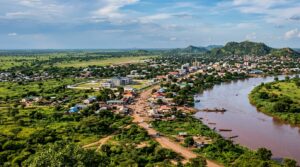
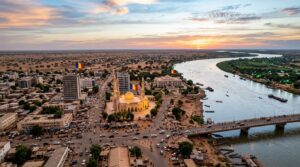
Gabon is one of Africa’s most urbanized countries, with roughly 90 percent of the population living in cities. Libreville, the capital, holds an estimated 800,000 to one million residents and dominates national life economically and politically. Port-Gentil, the country’s oil hub on the Atlantic coast, is the clear second city, with a population of around 130,000–150,000. Smaller but significant, Franceville anchors the southeast. Gabonese diaspora communities are concentrated primarily in France, reflecting the country’s Francophone ties, with smaller communities in [Cameroon] and [Republic of the Congo].
Government & Political System
## Government & Political System
Gabon is a presidential republic, where the head of state also serves as head of government. In August 2023, the military seized power in a coup following a disputed presidential election, dissolving existing institutions and suspending the constitution. A transitional government now administers the country, led by a general who assumed the role of head of state — a significant break from the civilian governance Gabon had maintained since independence in 1960.
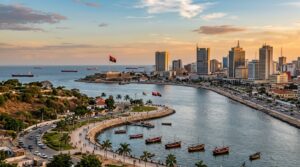
Libreville, situated on the Estuary of the Gabon River, is the capital and seat of government, housing the presidency, ministries, and transitional administrative bodies. Before the coup, Gabon operated a bicameral legislature composed of the National Assembly (lower house) and the Senate (upper house). Those bodies were dissolved following the military takeover; their reconstitution, along with a return to civilian rule, remains a stated goal of the transitional authorities, though a firm timeline has not been publicly confirmed.
Famous People from Gabon
Gabon’s international profile punches above its weight for a country of around 2.3 million people, with its most recognized figures clustered in politics, conservation, and sport rather than pop culture or literature.
- Omar Bongo (1935–2009) — served as President of Gabon for 41 years, making him one of the longest-ruling heads of state in modern African history and a central figure in Françafrique diplomacy.
- Pierre-Emerick Aubameyang (born 1989) — striker who won the Premier League Golden Boot in 2019 with Arsenal and captained Gabon’s national football team, becoming the country’s most globally recognized athlete.
- Mario Aubameyang (born 1958) — Pierre-Emerick’s father, who played professional football in France and Gabon, helping establish the family as a footballing dynasty across two generations.
- Patience Dabany (born 1944) — singer and former First Lady whose Afropop recordings found audiences across francophone Africa, making her one of Gabon’s few internationally distributed musical artists.
- Lee White (born 1971) — British-Gabonese conservationist who served as Gabon’s Minister of Forests and Environment and helped secure Gabon’s status as Africa’s largest carbon sink through landmark forest protection policy.
- Anthony Obame (born 1987) — taekwondo athlete who won a silver medal at the 2012 London Olympics, Gabon’s first-ever Olympic medal in any sport.
Food & Cuisine
## Food & Cuisine
Cassava is the backbone of Gabonese cooking, eaten as boiled chunks, pounded into a stiff dough called bâton de manioc (wrapped in banana leaves and steamed until it turns a pale, waxy yellow), or fermented into a sharper paste. It typically accompanies nyembwe chicken, the country’s most recognized dish — a slow-cooked stew built around palm nut pulp that coats everything in a deep rust-red oil. Poisson braisé, whole fish grilled over charcoal and served with piment sauce, is equally common, especially along the Atlantic coast around Port-Gentil. Inland, viande de brousse — bushmeat prepared with plantain and forest herbs — appears in village meals, though availability and legality vary.
At roadside stalls in Libreville, vendors sell beignets de manioc, fried cassava fritters that emerge hot and slightly crisp outside, dense within. Palm wine, tapped fresh from raffia palms and mildly fizzy with natural fermentation, is the drink most likely to appear at a communal gathering. Coastal communities lean heavily on seafood and coconut-based preparations, while the interior Ogooué basin favors game, root vegetables, and smoked fish with a pronounced woodsmoke aroma that clings to the sauce long after cooking.
Sports & Recreation
## Sports & Recreation
Football is Gabon’s dominant sport, followed obsessively from Libreville’s neighborhood pitches to the country’s smallest villages. The senior men’s national team, known as the Panthers, has twice hosted the Africa Cup of Nations — in 2012 (co-hosted with [Equatorial Guinea]) and again in 2017 — though they have yet to lift the trophy. Their most memorable AFCON run came in 2012, when they reached the quarterfinals on home soil before losing to Mali on penalties.
The country’s most famous athlete is Pierre-Emerick Aubameyang, the striker who spent peak years at Borussia Dortmund and Arsenal and captained the Panthers for over a decade. Basketball has a growing following, particularly among Libreville’s youth, with outdoor courts filling up on weekend evenings to the sound of sneakers on concrete. Gabon has sent athletes to multiple Olympic Games but has not yet won a medal, with its best performances coming in athletics and judo.
Music & The Arts
## Music & The Arts
Gabon’s contemporary music scene centers on ndombolo and Afro-rumba hybrids rooted in the broader Central African dance-music tradition, though the country’s most globally recognized export remains Pierre-Claver Akendengué, a guitarist and poet whose album Nandipo (1974) drew international attention and whose work still circulates in world-music circles. Younger artists like Patience Dabany — once first lady, now a recording artist with a genuine following across Francophone Africa — show how Gabonese pop navigates personal narrative and regional identity. Traditional music leans heavily on the ngombi, a harp-like instrument with eight strings whose bright, plucked tone anchors Fang ceremonial music, and on the balafon, a wooden xylophone whose resonators hum with a woody warmth during Bwiti spiritual ceremonies.
Gabon’s most internationally recognized literary voice is Laurent Owondo, whose novel Au bout du silence brought Gabonese fiction into French literary conversations. Visual arts here are inseparable from the Kota reliquary figures — copper-sheathed wooden sculptures historically placed over ancestral remains — which now appear in major ethnographic collections from Paris to New York, making them one of Central Africa’s most studied craft traditions.
Wildlife & Natural Wonders
## Wildlife & Natural Wonders
Gabon holds roughly 80% forest cover and protects around 11% of its land in a network of 13 national parks — a conservation commitment rare anywhere on Earth. Lopé National Park, a UNESCO World Heritage Site since 2007, is the flagship: it shelters one of Central Africa’s densest populations of forest elephants, along with western lowland gorillas moving through a landscape where ancient savanna meets equatorial rainforest. Ivindo National Park draws researchers and careful travelers to the Kongou Falls, a broad, thundering curtain of white water dropping through intact jungle — one of the continent’s most powerful waterfalls by volume.
Gabon is not a Big Five country in the classic safari sense; there are no lions or rhinos in the wild here. Instead, it’s defined by forest elephants, western lowland gorillas, chimpanzees, and, offshore, humpback whales and whale sharks along the Atlantic coast near Mayumba National Park. Poaching of forest elephants for ivory remains the most serious conservation pressure, and Gabon has lost a significant portion of its elephant population over the past two decades despite active ranger programs.
Top Things to See in Gabon
Gabon suits travelers who want serious wilderness without the crowds that follow East Africa’s safari circuit. The country pairs Atlantic coastline with equatorial rainforest and a compact, walkable capital — making it a workable mix of wildlife, coast, and urban stops in a single trip.
- Lopé National Park (Lopé, Ogooué-Ivindo Province) — A UNESCO World Heritage Site covering around 5,000 sq km of forest-savanna mosaic, home to forest elephants, western lowland gorillas, and mandrills in numbers rarely seen elsewhere. Dry season (June–September) offers the clearest wildlife viewing; most visitors fly into Lopé airstrip from Libreville and stay two to four nights.
- Pongara National Park (across the estuary from Libreville) — A short pirogue ride from the capital delivers you to nesting leatherback sea turtle beaches and forest trails with red buffalo and sitatunga. Turtle season runs October through March; day trips are possible, though an overnight at the park lodge gives you the beach at dawn.
- Pointe-Denis Beach (Libreville Estuary) — The closest proper beach to Libreville, a narrow Atlantic strip reached by a 20-minute boat crossing from Port Môle, where the air smells of salt and smoked fish from vendors along the shore. Weekends draw Librevilleurs for grilled capitaine fish and cold Régab beer; weekday visits are quieter.
- Ivindo National Park (Makokou Region) — Home to Kongou Falls, one of central Africa’s widest waterfalls, and research sites where forest elephants gather in bais (forest clearings) to feed on mineral-rich soil. Access requires a flight to Makokou and a river journey; plan at least three nights to justify the travel.
- Libreville Presidential Palace Quarter (Libreville) — The Boulevard Triomphal and surrounding administrative district give a clear read on post-independence Gabonese architecture — wide avenues, the Omar Bongo Mausoleum, and the Musée National des Arts et Traditions du Gabon, which holds carved reliquary figures of the Fang and Kota peoples. The museum is walkable from the central market and takes roughly two hours.
- Loango National Park (Gamba Region, South Coast) — Known for the rare spectacle of forest elephants and buffalos walking directly onto Atlantic beaches, a scene that draws wildlife photographers from across the world. The park is accessible by charter flight from Libreville; stays of three to five nights are standard given the distance
Visa & Travel Tips
## Visa & Travel Tips
Most visitors to Gabon need a visa, but the process varies by nationality. US and UK citizens can apply for an e-visa through the official government portal before departure, while ECOWAS nationals generally enter without a visa. EU citizens should verify current requirements, as policy has shifted in recent years — always confirm with the nearest Gabonese embassy or your own government’s travel portal before booking. The main gateway is Libreville’s Léon-M’ba International Airport, served by Air France, Ethiopian Airlines, and Royal Air Maroc, among others. Gabon runs on UTC+01:00 year-round, and you’ll dial +241 for local numbers. Power outlets use Type C and E plugs, so pack a universal adapter.
The Central African CFA franc (Fr) is the only reliable currency on the ground; card acceptance outside Libreville’s larger hotels and supermarkets is limited, and US dollars are not widely accepted as payment. ATMs are available in Libreville and Port-Gentil but can be unreliable in smaller towns, so carry adequate cash before heading upcountry. Mobile money is less developed here than in West Africa — MTN MoMo has some presence, but coverage is patchy. The French and US governments both rate Gabon as requiring heightened caution in certain regions; check your national travel advisory for current specifics. With logistics sorted, the next practical question is staying connected — which brings us to SIM cards and eSIM options.
Staying Connected: Internet & eSIM in Gabon
Mobile coverage in Gabon is dominated by three operators: Airtel, Libertis (a local subsidiary of Maroc Telecom), and Moov Africa. All three offer 4G LTE in Libreville and the main provincial towns like Port-Gentil and Franceville; 5G is not yet commercially available. Outside urban centers, coverage thins quickly — rural stretches along the N1 highway and most of the interior rainforest have patchy 3G at best, so download maps and key documents before leaving the city.
Buying a local SIM at Libreville’s León-Mba International Airport is straightforward: bring your passport for mandatory registration, and expect to pay around Fr 1,000–2,000 (roughly $1.60–$3.30 USD) for the card itself, with data bundles starting around Fr 5,000 ($8) for a few gigabytes. Activation typically takes 15–30 minutes. A faster alternative is an eSIM — you purchase and install a data plan before your flight lands, skipping the airport kiosk entirely and avoiding roaming charges the moment you switch on your phone. Most iPhone XS and newer models support eSIM, as do recent Android flagships from Samsung, Google, and OnePlus. Hotel Wi-Fi is reliable in Libreville’s mid-range and upscale properties, and a growing number of cafés in the capital offer free connections.