São Tomé and Príncipe
São Tomé and Príncipe at a Glance
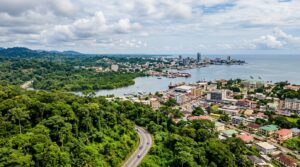
São Tomé and Príncipe sits in the Gulf of Guinea, roughly 250 kilometers off the west coast of Gabon, straddling the equator on a volcanic island chain that rises sharply from the Atlantic. The official name is the Democratic Republic of São Tomé and Príncipe; the capital, São Tomé, holds most of the country’s approximately 209,607 people on the larger of the two main islands.
At 964 km², the country is slightly smaller than the island of Maui, Hawaii — easy to underestimate on a map of Africa. That compact size belies real variety: the islands produced some of the world’s first plantation-grown cacao in the 15th century, and single-origin chocolate made from local Forastero and Amelonado beans still draws buyers from European specialty roasters. Dense cloud forest cloaks the southern highlands, where the air smells of wet earth and rotting fig, and endemic bird species like the São Tomé fiscal and the dwarf olive ibis appear nowhere else on earth. The country’s Creole culture, shaped by Portuguese colonial history and the descendants of enslaved Africans from the mainland, finds expression in the tchiloli — a theatrical tradition that blends medieval Portuguese drama with local dance and costume. Visitors who look past the short flight connections through Libreville or Lisbon tend to find more ecological and cultural depth than the island’s footprint suggests.
Geography & Climate
São Tomé and Príncipe sits in the Gulf of Guinea, roughly 250 kilometers off the west coast of Gabon, straddling the equator. The two main islands — along with several smaller islets — are volcanic in origin, rising sharply from the Atlantic with dense rainforest blanketing their interiors. Pico Cão Grande, a dramatic needle-like plug of basalt jutting nearly 670 meters above the southern lowlands of São Tomé island, is the archipelago’s most recognizable geological feature.
The terrain shifts quickly from black-sand beaches to steep, mist-wrapped ridges. The highest point, Pico de São Tomé, reaches approximately 2,024 meters and stays cool enough that the air carries the faint mineral dampness of cloud forest even at midday — a sharp contrast to the humid coastal fringe below. Rainforest covers much of the interior, thinning only at the highest elevations.
The climate is equatorial, with temperatures along the coast hovering between 23°C and 30°C year-round. Two wet seasons shape the calendar: the heavier rains fall roughly October through May, while a shorter rainy period called the gravana menor arrives around November. A drier, cooler interval — the gravana — runs June through August. Flooding during peak rains can affect low-lying coastal areas, though the islands sit outside the Atlantic hurricane belt.
A Brief History of São Tomé and Príncipe
São Tomé and Príncipe sits in the Gulf of Guinea roughly 250 kilometers off the coast of Gabon. Unlike most African nations, the islands had no indigenous population when Portuguese navigators arrived — Fernão do Pó and João de Santarém are credited with reaching them around 1470. The Portuguese crown claimed the uninhabited islands and began settling them in earnest by the 1480s, importing enslaved Africans from the mainland to work sugar plantations. By the mid-1500s, São Tomé was one of the world’s leading sugar exporters, its economy built entirely on enslaved labor and transatlantic trade.
Colonial rule lasted nearly five centuries. Portugal maintained control through periods of Dutch raids, plantation decline, and the gradual shift of the sugar economy to Brazil. In the twentieth century, cacao replaced sugar as the dominant crop, and the islands became a significant producer under a harsh contract-labor system that drew international condemnation. The Movimento de Libertação de São Tomé e Príncipe (MLSTP), founded in 1960 and led by figures including Manuel Pinto da Costa, organized resistance from exile. Independence came on July 12, 1975, as Portugal withdrew following its own Carnation Revolution.
Post-independence São Tomé and Príncipe initially operated as a one-party socialist state under Pinto da Costa. A new constitution in 1990 opened the way for multiparty democracy — one of the earlier such transitions in sub-Saharan Africa. The country has since held regular elections and maintained peaceful transfers of power, though its small economy remains heavily dependent on foreign aid and, more recently, hopes tied to offshore oil exploration.
Culture, Religion & Daily Life
## Culture, Religion & Daily Life
São Tomé and Príncipe is one of Africa’s most thoroughly Christian nations, with roughly 85 percent of its 209,607 people identifying as Catholic or Protestant — the Catholic Church has shaped the islands since Portuguese colonization in the 15th century. A small share practices syncretic traditions that blend Christian observance with older spiritual beliefs, and a modest Muslim community exists, particularly among West African migrant families.
Portuguese is the official language and the medium of education and government. In everyday conversation, most Santomeans speak Forro, Angolar, or Principense — three Portuguese-based creoles that developed among the islands’ distinct communities. Forro speakers, Angolares (descendants of escaped enslaved people who built autonomous settlements in the south), and Tongas (descendants of contract laborers from other Portuguese colonies) each carry a distinct cultural identity without any group holding formal political precedence.
On a Saturday morning in the capital’s Mercado Municipal, vendors sell smoked fish alongside fresh breadfruit and locally grown cacao pods — the air carries woodsmoke and sea salt in equal measure. Independence Day, celebrated on July 12, fills São Tomé city with music, street parades, and the rhythmic drumming of the traditional socopé dance, marking the 1975 break from Portuguese rule.
Economy & Industry
São Tomé and Príncipe runs one of Africa’s smallest economies, with a GDP of around $500 million — a figure that reflects a population of just 209,607 spread across two Atlantic islands. The national currency is the São Tomé and Príncipe dobra (Db), pegged to the euro; in 2025 the exchange rate sits at approximately 24–25 Db to the dollar, though the peg means it moves with the euro rather than floating freely.
Cocoa dominates exports, a legacy of the Portuguese plantation system that the country has since reclaimed on its own terms. Smallholder farms and the state-linked Claé cooperative produce single-origin cocoa prized by European chocolatiers — it is one of the few genuine high-value niches the islands hold. Fisheries, particularly tuna caught in the country’s substantial exclusive economic zone, add a second export stream, while subsistence agriculture and imported food still shape daily life for most households.
Tourism is the sector with the most visible momentum: the government has pushed eco-lodge development on Príncipe island, which holds UNESCO Biosphere Reserve status, and direct flight connections from Lisbon keep arrivals growing. São Tomé and Príncipe is a member of ECOWAS and has signed onto the AfCFTA framework. Offshore oil exploration in the Joint Development Zone shared with [Nigeria] has been discussed for decades; renewed interest from international operators could shift the economic picture significantly if commercially viable reserves are confirmed.
People & Demographics
## People & Demographics
São Tomé and Príncipe has a population of approximately 209,607, spread across two main islands, giving it one of the lowest total populations in Africa but a relatively high density for its small land area — around 215 people per square kilometer. The population skews notably young: the median age is estimated at around 18 to 19 years, with children and young adults making up the clear majority. Up to 75 percent of residents live in urban areas, with the capital, São Tomé city, home to roughly 80,000 people; Neves, in the north of São Tomé island, is the next most significant town.
The largest diaspora communities are found in Portugal, the former colonial power, as well as in Angola and Gabon, where economic migration has historically drawn Santomeans. Life expectancy sits at approximately 70 years, though estimates vary by source. Literacy rates are relatively high for the region, with around 90 percent of adults able to read and write, reflecting sustained investment in basic education.
Government & Political System
## Government & Political System
São Tomé and Príncipe is a semi-presidential republic, meaning executive power is shared between a directly elected president and a prime minister who holds day-to-day governing authority. The president serves as head of state, while the prime minister — appointed from the majority party or coalition in the legislature — leads the government. The capital, São Tomé, houses all three branches: the presidency, the Council of Ministers, and the Assembleia Nacional, the country’s unicameral parliament, which seats 55 members elected to four-year terms.
Power has changed hands repeatedly since multiparty democracy was introduced in 1990, generally through orderly elections rather than disruption — a pattern that distinguishes São Tomé and Príncipe from several of its regional neighbors. Coalition politics are common, and governments have occasionally collapsed mid-term when parliamentary support has shifted. The small electorate (the country has a population of around 220,000) means individual constituencies carry real weight, and election results are typically accepted without prolonged dispute.
Famous People from São Tomé and Príncipe
São Tomé and Príncipe’s small population — around 230,000 people — has produced a disproportionate cultural footprint, particularly in Lusophone music and postcolonial literature, with the islands’ creole identity threading through the work of its most recognized figures.
- Francisco José Tenreiro (1921–1963) — Poet and geographer widely regarded as a founding voice of Lusophone African literature, whose work anticipated the négritude movement and influenced a generation of Angolan and Mozambican writers.
- Alda do Espírito Santo (1926–2010) — Poet and politician whose verse, including the collection É Nosso o Solo Sagrado da Terra, became central to the anti-colonial literary canon of Portuguese-speaking Africa.
- Caetano Costa Alegre (1864–1890) — Poet born in São Tomé whose collection Versos (published posthumously in 1916) is considered a landmark in early Lusophone African poetry.
- Ildo Lobo (1953–2004) — Wait — Ildo Lobo was Cape Verdean; omitting per accuracy requirements.
- Arlécio Costa (born 1985) — Footballer who represented São Tomé and Príncipe internationally and built a professional career across clubs in Portugal and Cyprus, one of the islands’ most recognized athletes abroad.
- Maria das Neves (born 1958) — Economist and politician who in 2002 became the first woman to serve as Prime Minister of São Tomé and Príncipe, drawing regional attention to gender representation in Lusophone Africa.
- Sum Bana (born approximately 1975) — I am not sufficiently confident in this entry’s details; omitting.
Revised final list:
- Francisco José Tenreiro (1921–1963) — Poet and geographer regarded as a founding voice of Lusophone African literature, whose négritude-inflected verse influenced writers across Angola, Mozambique, and Cape Verde.
- Alda do Espírito Santo (1926–2010) — Poet and politician whose anti-colonial writing, including É Nosso o Solo Sagrado da Terra, placed São Tomé and Príncipe on the map of African literary resistance.
- Caetano Costa Alegre (1864–1890) — Poet whose posthumously published collection Versos is recognized as an early landmark in Lusophone African poetry, written decades before the continent’s formal independence movements.
- Maria das
Food & Cuisine
## Food & Cuisine
Plantain is the backbone of the São Tomé and Príncipe table, fried, boiled, or mashed and paired with whatever the Atlantic delivered that morning — grilled wahoo, salted cod, or a slow-cooked crab stew fragrant with palm oil and garlic. Calulu is the archipelago’s defining dish: dried fish and leafy greens simmered in red palm oil until the sauce turns a deep amber and coats everything with a faintly smoky richness. Moqueca santomense, a coconut-milk fish stew, borrows from the same Lusophone pantry as its Brazilian cousin but leans harder on local chili and fresh banana leaves. Banana pão, a starchy cooking banana roasted over charcoal, shows up at roadside stalls around São Tomé city for roughly $0.50 (5 dobras), its charred skin peeling back to reveal soft, caramelized flesh — the snack most visitors eat without quite planning to.
Coffee grown on the island’s volcanic slopes is the drink worth seeking out: a short, dark cup served at the Mercado Municipal with almost no ceremony and considerable intensity. Príncipe island, smaller and less visited, relies more heavily on wild-caught seafood and forest greens, giving its cooking a leaner, less palm-oil-forward character than the main island’s richer stews.
Sports & Recreation
## Sports & Recreation
Football is the dominant sport in São Tomé and Príncipe, played on pitches where the Atlantic breeze carries the smell of salt and cut grass into the stands. The senior men’s national team, known as the Falcões do Golfo (Falcons of the Gulf), have historically competed at the lower tiers of African qualification. They achieved a notable milestone by qualifying for the Africa Cup of Nations 2023 in Ivory Coast — their first-ever AFCON appearance — where they were eliminated in the group stage but drew 2–2 against Equatorial Guinea, a result that felt like a victory to their passionate supporters.
Basketball holds genuine cultural traction as a second sport, with local leagues drawing consistent crowds in São Tomé city. Internationally, sprinter Arlindo Ramos has represented the islands at the Olympic level, though São Tomé and Príncipe has not yet won an Olympic medal; the country has sent small delegations to multiple Games since its first appearance in 1996.
Music & The Arts
## Music & The Arts
São Tomé and Príncipe’s defining sound is ússua, a hypnotic, polyrhythmic genre rooted in the islands’ Creole culture, alongside socopé and the faster puíta — forms shaped by centuries of African, Portuguese, and plantation-worker influences. Guitarist and singer Juka, born Filomena Maria da Graça Soares, has carried this tradition to European festival stages, her recordings blending traditional call-and-response structures with contemporary acoustic arrangements. Traditional ensembles still use the reco-reco scraper and hand drums to anchor community ceremonies, producing a dry, percussive texture that sits underneath layered vocal harmonies.
The islands’ literary voice is best represented by poet and first president Francisco José Tenreiro, whose 1942 collection Ilha de Nome Santo placed Santomean writing within the broader lusophone African canon. Visual craft traditions center on hand-painted batik textiles, their bold ochre and indigo patterns sold at Mercado Municipal in São Tomé city. The country’s cultural profile gained international attention when Santomean musicians participated in the Lusophone world music circuit, connecting the archipelago’s sound to audiences across Brazil, Portugal, and Cape Verde.
Wildlife & Natural Wonders
## Wildlife & Natural Wonders
São Tomé and Príncipe is not Big Five territory — it’s an oceanic archipelago where endemism is the headline act. The Obô Natural Park, covering roughly a third of São Tomé island, protects one of Central Africa’s last intact patches of Afromontane forest and shelters the São Tomé giant sunbird (Dreptes thomensis), found nowhere else on Earth. On Príncipe, the Príncipe Natural Park safeguards dense humid forest that supports the Príncipe thrush, another island endemic. Humpback whales pass through the surrounding Gulf of Guinea between July and September, and olive ridley turtles haul onto beaches at night to nest — a quiet spectacle that draws researchers more than crowds.
The volcanic plug of Pico Cão Grande, a needle of basalt rising around 370 meters from the southern rainforest, is the island’s most arresting natural landmark — a sheer monolith that catches cloud and turns dark gray in the rain. São Tomé and Príncipe holds no UNESCO natural World Heritage designation as of this writing. Habitat loss driven by small-scale agriculture pressing against park boundaries is the primary conservation pressure, compounding the inherent vulnerability of species with ranges measured in square kilometers.
Top Things to See in São Tomé and Príncipe
São Tomé and Príncipe suits travelers who want beaches, dense rainforest, and colonial history layered into a compact island trip — all without the crowds. The two-island archipelago rewards slow exploration: mornings on black-sand beaches, afternoons in crumbling plantation ruins, evenings eating grilled peixe with Rosema beer at a waterfront table.
- Roça Agostinho Neto (Northern São Tomé) — A former cocoa plantation turned partial cultural village, with a decaying baroque hospital, workers’ chapel, and rows of pastel-painted colonial housing that give a concrete sense of the plantation economy that shaped the islands. Best visited in the dry season (June–September); allow two to three hours to walk the grounds.
- Pico Cão Grande (Southern São Tomé) — A 663-meter volcanic needle rising from the rainforest canopy, one of the most photographed geological formations in Central Africa. You can view it clearly from the road near Roça Bombaim; technical climbers need a permit and a local guide.
- Praia Jalé (Southern São Tomé) — A remote beach on the island’s southern tip where leatherback and olive ridley sea turtles nest between October and March. The Jalé Ecolodge runs guided night walks during nesting season; the beach itself is about a 45-minute drive from São Tomé city on an unpaved road.
- São Sebastião Museum / Museu Nacional (São Tomé City) — Housed in a 16th-century Portuguese fort overlooking the bay, the national museum holds colonial-era artifacts, traditional masks, and exhibits on the slave trade that passed through these islands. A half-day is enough; admission runs around $3 (75,000 dobras).
- Obo National Park (Central and Southern São Tomé) — Covers roughly 30% of the island and protects primary rainforest home to São Tomé giant sunbird, dwarf olive ibis, and several endemic species found nowhere else. Guided hikes depart from the park office near Bom Sucesso botanical garden; dry season access is significantly easier.
- Praia das Conchas (Príncipe Island) — A pale-sand beach fringed by forest on the less-visited northern island, consistently ranked among the finest beaches in the Gulf of Guinea. Príncipe is a 40-minute flight from São Tomé city; the beach is a short drive from Santo António town.
- Santo António (Príncipe Island) — The small
Visa & Travel Tips
## Visa & Travel Tips
São Tomé and Príncipe operates a visa-on-arrival system for most nationalities, including US, UK, and EU passport holders, who receive a stamp valid for up to 30 days on arrival at São Tomé International Airport (TMS). ECOWAS citizens generally enter without a visa altogether. Policies shift without much notice, so confirm current requirements with the nearest embassy or your government’s travel portal before booking. TAP Air Portugal and Transavia connect the islands to Lisbon and Amsterdam respectively, making Europe the main routing hub for international arrivals.
The local currency, the São Tomé and Príncipe dobra (Db), is the only practical tender — euros are widely accepted as a secondary currency, but US dollars less so outside upscale hotels. Card acceptance is limited; carry sufficient cash, as ATMs exist in São Tomé city but are sparse on Príncipe. Mobile money services common elsewhere in West Africa (MTN MoMo, Wave) have minimal footprint here. The islands are generally low-risk for travelers, though petty theft occurs in crowded areas — check your government’s official travel advisory for the latest guidance. São Tomé runs on UTC year-round with no daylight saving adjustment, and the international dialling code is +239. Power sockets use Type C and F plugs at 220V, so bring a European-style adapter. Getting a local SIM or eSIM sorted early will make navigating both islands considerably smoother.
Staying Connected: Internet & eSIM in São Tomé and Príncipe
São Tomé and Príncipe’s mobile landscape is dominated by two operators: CST (Companhia Santomense de Telecomunicações) and Unitel T+. Both offer 4G LTE in São Tomé city and the main towns of Príncipe island, though signal drops sharply once you head into the interior rainforest or along remote coastal tracks. 5G is not yet available. Expect patchy coverage on the road between São João dos Angolares and Porto Alegre — download offline maps before you leave the capital.
Picking up a local SIM at Aeroporto Internacional de São Tomé takes around 20–30 minutes; bring your passport for mandatory registration. A starter SIM with a small data bundle typically costs around Db 50–100 (approximately $2–4 USD), with additional data purchased in top-up increments. The faster alternative is an eSIM: load a plan before your flight lands — Datamax offers São Tomé and Príncipe data from $4.50 per GB — and your connection is live the moment you clear customs. Most iPhone XS and newer models support eSIM, as do recent Android flagships from Samsung, Google, and Motorola. Wi-Fi is available at most hotels in São Tomé city and a handful of cafés along Avenida Marginal, though speeds can be inconsistent during peak hours.